ManorDolgen am See

Dolgen Manor

Dolgen Manor

To be privately owned

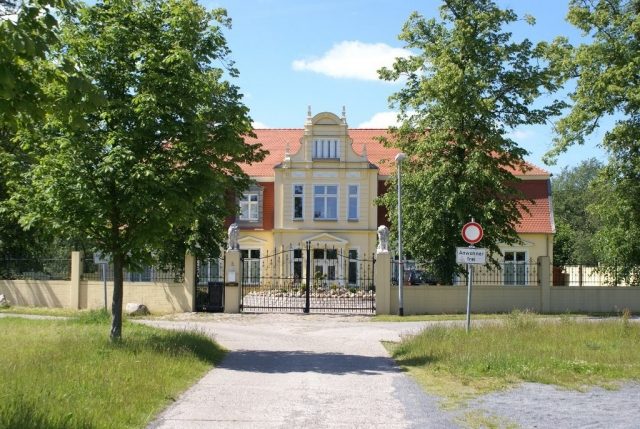
Dolgen Manor House, located in the Dolgen district of the municipality of Dolgen am See in the Rostock district, is a manor house originally built in the 16th century and subsequently rebuilt numerous times in the Neo-Renaissance style. It acquired its current appearance after renovation work in the 1890s by Gustav Freiherr von Plessen. After extensive restoration work, which began in 1995, it was largely authentically restored to this condition.

The former Knight's Estate and Manor Village of Dolgen+

In 1285, Lord Nikolaus II of Werle granted the village of Dolgen am See to the Rostock citizen Nikolaus, and the place was first mentioned in a document. A few years later, it came into the possession of the Monastery of the Holy Cross. Dolgen belonged to the knightly estates until 1945 and, according to Niekammer's Address Book, had an area of 468.1 hectares. From the end of the 18th century until 1945, the estate belonged to the von Plessen family. Leopold von Plessen lived here until his death in 1837. Through inheritance, the manor house came into the possession of his son Hermann, who became a Mecklenburg chamberlain. The last owner from the ancient Mecklenburg noble family "von Plessen" committed suicide along with numerous other villagers on May 2, 1945, when the Red Army marched into Dolgen. The knight's estate of Dolgen was expropriated in 1945 as part of the land reform in Germany, parceled out, and initially settled by new settlers; in 1950, it was converted into an LPG (agricultural production cooperative). Part of the former manor park on Lake Dolgen was developed during GDR times as a holiday camp for the Volkspolizei (People's Police) and also used by the Society for Sport and Technology. After 1990, it was privatized and has been called Feriendorf Dolgen (Dolgen Holiday Village) since 2006.

The Manor House and its Associated Building Ensemble+

The ancient Mecklenburg noble family von Drieberg had a manor house built on parts of the former castle foundations at the beginning of the 16th century. Until the end of the war in 1945, there was an escape tunnel under the building, dating from the time of the medieval castle complex; whether this tunnel has survived to this day in the course of the epochal post-war events has not been handed down. Over time, this house underwent repeated structural changes. In 1782, the building and the knight's estate of Dolgen as a whole became the property of the later minister, privy councilor, and government president (1836) of Mecklenburg, Leopold von Plessen. At the beginning of the 19th century, he had the manor house converted into a representative manor house with a mansard hip roof and a two-story central risalit in the Neo-Renaissance style, and he used it intensively during the summer months from 1824 until his death in 1837. For the renovation, Leopold von Plessen and his wife Sophie based their plans on those of Orellen Manor House belonging to the von Campenhausen family in Livonia (today Ungurmuiža, Raiskums parish, Pārgauja municipality in Latvia). Under Leopold von Plessen, Dolgen and its manor house achieved considerable political significance through the visits of numerous domestic and foreign state guests and other high-ranking personalities. In 1837, the knight's estate of Dolgen had 93 inhabitants. The thatched stables belonging to the estate ensemble and the cobblestone avenue leading to the manor house were completely removed during the GDR era and after the reunification of Germany in 1990. In 1994, the manor house was auctioned by the Treuhandliegenschaftsgesellschaft (Trust Property Company) in a bidding process and subsequently extensively and largely faithfully restored in the Neo-Renaissance style. Today it is used for residential purposes. On the grounds, there are still remnants of the former family chapel and hereditary burial site of the von Plessen family from the Dolgen house; this building was used as a storage room from the 1950s onwards, after the deceased had previously been reburied in an anonymous mass grave in the church cemetery of Hohen Sprenz. The administrator's house, which belongs to the estate ensemble and manor house, has been largely preserved in its original form and renovated.

Lords of the Manor from the Plessen Family+

The ownership of the knight's estate of Dolgen by the von Plessen family of lords of the manor until the forced expropriation by the communists in 1945 is as follows:

  • Leopold Engelke Hartwig von Plessen (1782–1837)
  • Hermann Leopold Christian von Plessen (1837–1855)
  • Gustav Julius Ferdinand von Plessen (1855–1915)
  • Leopold Friedrich Ernst Hans von Plessen (1915–1945)

Take Mobile History with you

You are reading this text for free. Premium adds what matters on the road: descriptions read aloud, sites found through your camera, whole regions taken offline.

  • Every description, including the ~17,700 Premium sites
  • Audio guide: have descriptions read to you on location
  • AR finder: see sites through your camera, with distance and bearing
  • Unlimited saved sites

14 days free, then from €2.99 a month. Cancel anytime.

Source: Wikipedia · Licence: CC BY-SA 4.0 · Image: Roland Neubert, Halle (Saale)

This description draws on the facts documented in the linked Wikipedia article; Wikipedia content is licensed under CC BY-SA 4.0. Wording and editing: Mobile History.

Location: 53.9531, 12.2598