ManorWangels

Farve Manor

Farve Manor

To be privately owned

Gut Farve in the municipality of Wangels in eastern Schleswig-Holstein dates back to a medieval castle. The estate, which was once one of the noble estates, is still managed today. The manor house is inhabited and not publicly accessible.

The silver find from Gut Farve testifies to Bronze Age settlement.

In the Middle Ages, a small castle complex belonging to the Pogwisch family was located on the grounds of the present-day estate. Its members belonged to the Equites Originarii in the county and the subsequent Duchy of Holstein. Henning Pogwisch came into conflict with the Danish King Christian I, who subsequently had the castle destroyed in 1480. After Henning Pogwisch's death, his descendants regained control of the property and had a new castle built at the beginning of the 16th century, which became the core of the present manor house. The Pogwisch family remained at Farve until 1662, when the estate passed to the von Blome family through inheritance, to whom the estate belonged almost continuously for the following centuries. It only briefly came into the possession of the Counts of Holstein through a renewed inheritance rule, but Farve returned to Blome ownership after a wedding in 1749. At the beginning of the 19th century, the lords of the manor changed several times until the property finally went to the Reventlow family, under whom the manor house received its present form. Farve remained in the possession of various lines of the Reventlows until 1926, who sold the estate to the Counts Waldersee at Gut Waterneverstorf. A final sale took place in 1929 to the Counts von Holck, who are still resident there today.

The estate is still farmed today. The estate complex and the manor house are privately owned and not accessible to visitors, but the Farver Mill, which belongs to the estate, is used for tourism.

Buildings+

The Manor House

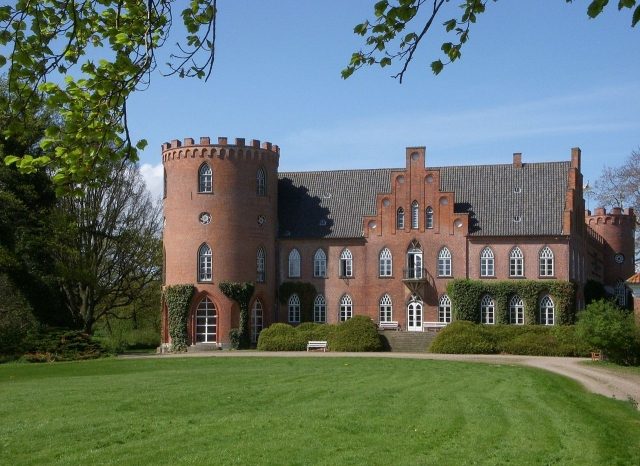
The core of the manor house still dates back to the castle complex from the beginning of the 16th century. It is a four-winged complex around an inner courtyard; the large main tower, the west and south wings, and the Renaissance portals of the courtyard still date from the time construction began. With its four-winged architectural style, the castle-like building is an exception in the architectural landscape of Schleswig-Holstein, where the so-called double houses or one- to three-winged house complexes predominated on the estates of the landed gentry.

The manor house, built during the Renaissance, was extended and modernized at the beginning of the 19th century under the Blome family. It received its present form from 1837 under Count Ernst von Reventlow, who had the house redesigned by Joseph Eduard Mose, referring to the English Castle-Style, in the romantic forms of Neo-Gothic with pointed-arch windows, battlements, and stepped gables, and had the north wing with the courtyard entrance built. The interiors are furnished in the Historicism style, in keeping with the taste of the time.

The Garden and the Estate Complex

With the redesign of the manor house in the mid-19th century, a park in the style of English landscape gardens was laid out around the building, designed with tall solitary trees, lawns, ponds, and circular paths. North of the manor house is the farmyard, whose extensive building stock, such as the riding stable, partly dates back to the 18th century. North of the farmyard is the Farver Mill, a gallery Dutch windmill from 1828.

Take Mobile History with you

You are reading this text for free. Premium adds what matters on the road: descriptions read aloud, sites found through your camera, whole regions taken offline.

  • Every description, including the ~17,700 Premium sites
  • Audio guide: have descriptions read to you on location
  • AR finder: see sites through your camera, with distance and bearing
  • Unlimited saved sites

14 days free, then from €2.99 a month. Cancel anytime.

Source: Wikipedia · Licence: CC BY-SA 4.0 · Image: http://de.wikipedia.org/wiki/Datei:Gut_Farve_2012.jpg

This description draws on the facts documented in the linked Wikipedia article; Wikipedia content is licensed under CC BY-SA 4.0. Wording and editing: Mobile History.

Location: 54.2853, 10.7938