Cultural Events
Greiffenhorst Manor (Krefeld)

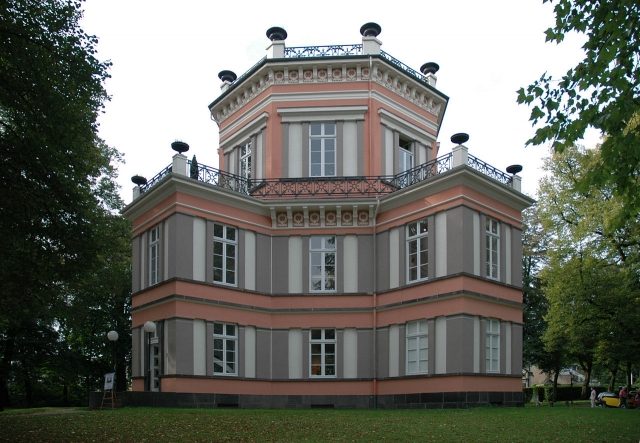
Haus Greiffenhorst, also known as Greiffenhorstschlösschen and Schloss Greiffenhorst, is a former hunting lodge in the Linn district of Krefeld, in the immediate vicinity of Linn Castle. The neoclassical building from the 19th century stands in Greiffenhorstpark, a landscape garden designed by Maximilian Friedrich Weyhe.
In 1826, the Krefeld silk manufacturer Cornelius de Greiff inherited the Linn Mill Farm (Linner Mühlenhof) and the Hausenhof along with lands and accessories from his father Isaak. Subsequently, around 1840, de Greiff commissioned the Düsseldorf court gardener Maximilian Friedrich Weyhe to create a landscape garden, the so-called Greiffenhorstpark, on the land between the two properties along the Linn Mill Stream (Linner Mühlenbach).
Furthermore, between 1838 and 1843, he had a small hunting and garden lodge built on the inherited properties, presumably according to plans by the Düsseldorf regional building inspector Otto von Gloeden. The execution of the work on site was the responsibility of the construction manager L. Jürges. The construction cost Cornelius de Greiff around 20,000 Thalers, but for unknown reasons, he lost interest in it shortly after its completion. Haus Greiffenhorst was, in all likelihood, not even completely furnished and was used by its builder for only a very short time, as the master of the house preferred to hold his banquets after hunts at the nearby Hausenhof. However, the gardener was housed in the upper floors of the building for a longer period.
In 1924, the city of Krefeld acquired the building and initially leased it out. In the following period, Haus Greiffenhorst developed into a popular café. The house survived the Second World War almost undamaged; only the windows were shattered by the detonation of an aerial mine 500 meters away during a British air raid. Towards the end of the war and especially immediately afterwards, however, all combustible material was stolen from the empty house. In the post-war period, it visibly deteriorated, and initial renovation measures in 1953 could not change this.
It was not until 1971 to 1974 that the building was fundamentally restored with financial support from the Krefeld Art Association and the citizenry. Since then, it has served as a venue for exhibitions, readings, concerts, and lectures. The rooms can also be rented for receptions and conferences. From August to November 2010, Haus Greiffenhorst underwent another renovation. During this, the old pink exterior paint was removed and replaced with the historical paintwork. At the same time, measures were taken on the roof and windows. In total, the work amounted to 84,000 Euros.
Description+
Haus Greiffenhorst consists of a three-story central building with an octagonal floor plan, which is extended on four sides by two-story, square wing buildings to form a cross shape. In the north-south axis, the building has two entrances, and its tall windows are framed by pilasters. The plastered exterior facade is horizontally structured by cornices. The wing buildings have roof terraces connected by narrow balconies on console cornices. These consoles are repeated in the cordon cornice of the central building. Since the central building towers over the other parts like a tower, the form of the building follows the architectural type of the tower belvedere from the late 18th century. The viewing platform on the roof of the central building is surrounded by a wrought-iron balustrade, which is also found on the roof terraces of the wing buildings. The corner pillars of the balustrades appropriately bear wrought-iron vases. All parts of the house conform to the proportions of the golden ratio. The internal room layout previously followed the external form: a central hall was flanked by four adjoining rooms.
Stylistically, the building can be assigned to Berlin Classicism, influenced by Karl Friedrich Schinkel. It combines various elements of South German park castles into its own style.
Take Mobile History with you
You are reading this text for free. Premium adds what matters on the road: descriptions read aloud, sites found through your camera, whole regions taken offline.
- Every description, including the ~17,700 Premium sites
- Audio guide: have descriptions read to you on location
- AR finder: see sites through your camera, with distance and bearing
- Unlimited saved sites
14 days free, then from €2.99 a month. Cancel anytime.
Source: Wikipedia · Licence: CC BY-SA 4.0
This description draws on the facts documented in the linked Wikipedia article; Wikipedia content is licensed under CC BY-SA 4.0. Wording and editing: Mobile History.
Location: 51.3363, 6.6522