ManorKrauschütz

Krauschütz Manor

Krauschütz Manor

Apartments

The Krauschütz estate was always a component of Elsterwerda Castle. In 1502, Georg and Hans von Köckritz sold several rents in Krauschütz to Georg von Sachsen, and likewise in 1513 to Jacob and Otto von Köckritz. Elsterwerda Castle and the estate came into the possession of King August the Strong in 1727 through a judicial auction, who made the property a chamber estate. Extensive construction work was carried out on the castle, and with the park, an ensemble was created that even Frederick the Great did not deny his admiration.

The electoral chamber estate was leased from then on. The following were named here:

  • Samuel Gottlieb Langen, bailiff and jurist,
  • Johann Benjamin Grabner, administrator,
  • 1754: Carl Christoph Beschorner, first as co-tenant, then sole tenant,
  • Gottfried Schneider,
  • around 1779: Friedrich Christian Hammer, electoral Saxon bailiff and regional father of the Elsterwerda chamber estate,
  • 1809: Mr. Freitag, bailiff and court holder.

After the division of Saxony in 1815, according to the provisions of the Congress of Vienna, the chamber estate became the royal domain of Krauschütz and had 187 inhabitants. Carl-Ludwig Hübler took over the domain and pension office and later passed it on to his son. He was followed by Amtsrat August Müller, who received the honorary citizenship of the city of Elsterwerda on his 76th birthday for his services to agriculture and the city. In April 1898, Richard Barthel took over the domain.

In 1932, the Krauschütz domain was parcelled out by the Siedlungsgesellschaft Sachsenland, and in 1940, it was forcibly incorporated into the municipality of Elsterwerda. Despite subsequent objection and petition, the residents' wish to be de-incorporated was not granted, and Krauschütz continued to be managed as Elsterwerda-Süd until 1992. However, by resolution of the city council, the district was able to resume its traditional name Krauschütz after the fall of the Berlin Wall.

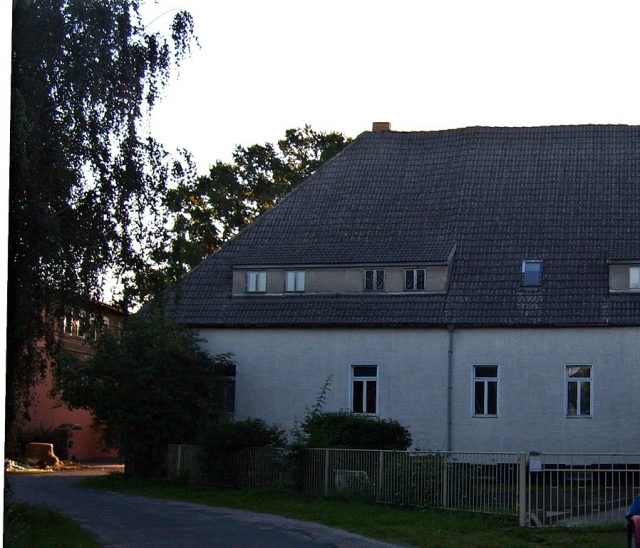
The former domain, from which, according to legend, an underground but collapsed passage is said to lead to the castle, is still clearly recognizable as such today. The former manor house, equipped with a hip roof, was probably built in the first half of the 18th century. The area of the former farmyard is currently divided into several plots of land, which are in private hands. The old manor house was divided into two halves in 1945. One part housed the local nursery for years, and after the fall of the Berlin Wall, a homeless shelter, until this part of the house was also sold.

Take Mobile History with you

You are reading this text for free. Premium adds what matters on the road: descriptions read aloud, sites found through your camera, whole regions taken offline.

  • Every description, including the ~17,700 Premium sites
  • Audio guide: have descriptions read to you on location
  • AR finder: see sites through your camera, with distance and bearing
  • Unlimited saved sites

14 days free, then from €2.99 a month. Cancel anytime.

Source: Wikipedia · Licence: CC BY-SA 4.0

This description draws on the facts documented in the linked Wikipedia article; Wikipedia content is licensed under CC BY-SA 4.0. Wording and editing: Mobile History.

Location: 51.4534, 13.5295