ManorNeschwitz - Saritsch

Saritsch Manor
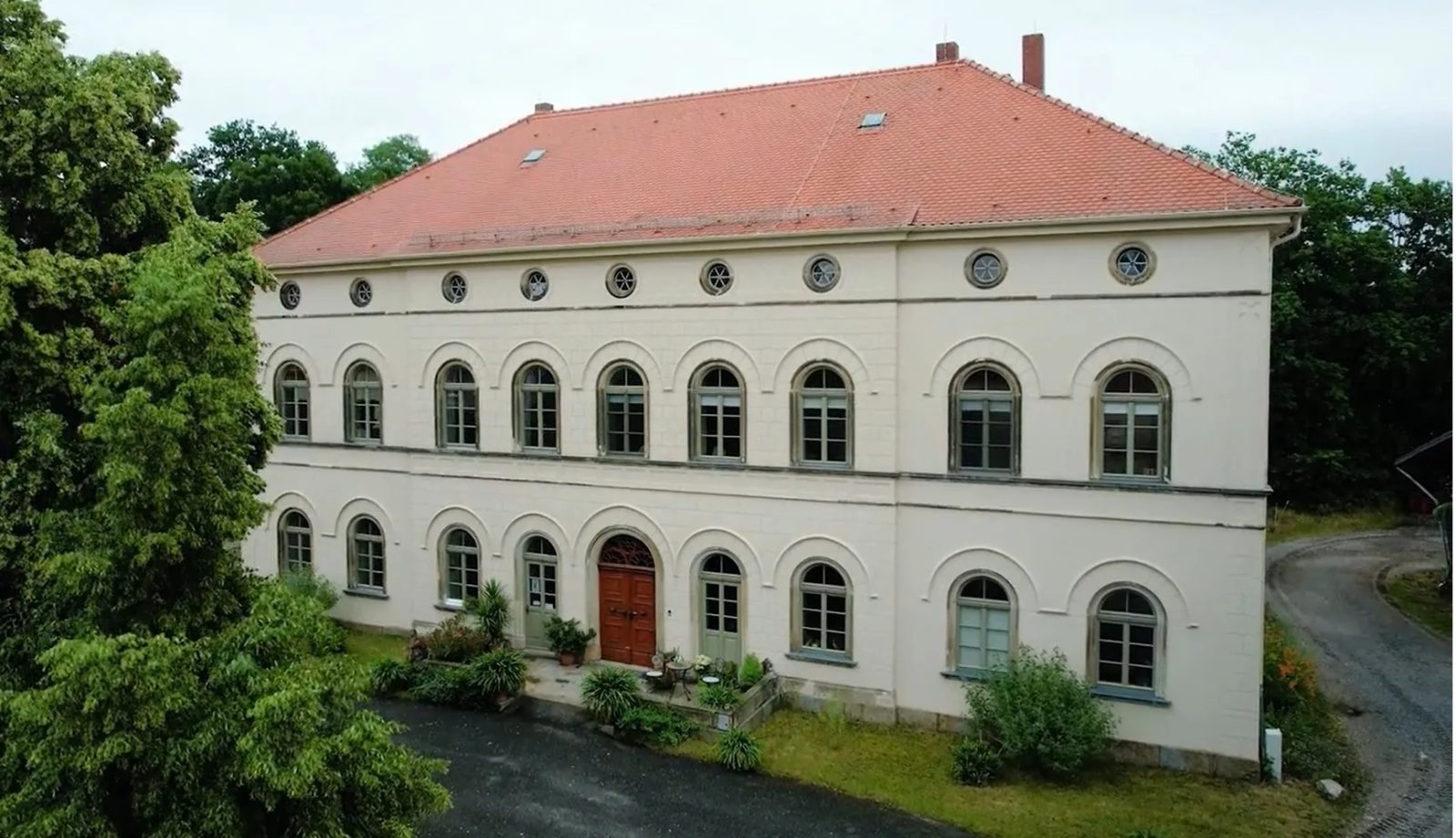
Saritsch Manor

To be privately owned

The Manor House+

The manor house (first mentioned in 1412) in Saritsch dates back to a medieval moated castle, the remains of which have been found in a water-rich depression on the southeastern edge of the village. The manor house was surrounded by a moat that could be flooded in times of danger. In the 16th century, this fortification, secured by moats, was abandoned, and the existing manor house complex was built on the northeastern edge of the village.

The manor had an area of 114 ha, of which 86 ha were fields, 17 ha meadows, 8 ha forest, it operated a sand pit and kept horses, cattle, sheep, and pigs.

It possessed high jurisdiction, which meant the judicial decision over all occurring legal and administrative cases.

Around 1600, Hans von Ponickau of Prietitz, district governor of Bautzen, owned the estates of Saritsch and Loga; he sold them in 1607 to Friedrich von Lutitz of Milstrich.

From about 1623, the Budissin court judge Heinrich von Zezschwitz (born 1583) of Lubachau and Kleinwelka was the owner. From this date, the Saritsch manor remained in the possession of the von Zezschwitz family for 100 years (3 generations).

In 1722, the estate came into the possession of the von Theler family through Hans Christoph von Theler for approximately 220 years (until 1946) for 16,600 Thalers. However, since the descendants were mostly female (ancestor tree pdf or family tree), and it was customary in the past to adopt the husband's name, superficial observers refer to this as a change of ownership; moreover, sales within the family were also common.

In 1733, Hans Christoph von Theler had the post mill built west of Saritsch.

In 1740, he sold the estate and its appurtenances to his wife for 18,000 Thalers.

In 1745, the forge was sold to tenant Georg Zimmermann.

In 1750, the widow sold the property for 22,000 Thalers to her daughter Erdmuth Magdalena Schulze, née von Theler, married to the pastor of Königswartha; in the same year, the windmill was sold to Christian Schneider.

In 1772, the property passed by inheritance to her daughter Erdmuthe Wilhelmine Fiedler, née Schulze.

In 1805, her son Carl Gottlob Fiedler inherited the estate; he was the last owner and lord of the village. Among other things, he promoted the construction of the school in Saritsch.

In 1847, his son Ernst Maximilian Fiedler became his successor; he paid an annual annuity of 720 Thalers to his father. In 1856, his older siblings Henriette von Döring of Purschwitz, née Fiedler, and Carl Friedrich Fiedler renounced their claims.

In 1898, the Swiss Wälti family came to the farm as helpers for 4 years. In 1902, the Wälti family left the farm without their 6-year-old son Jacob. He continued to live on the farm and was supported by the Fiedlers: He attended the elementary school in Saritsch for 8 years and then the Agricultural College in Bautzen for 3 years.

In 1902, after the death of Ernst Maximilian Fiedler, Max, Liddy, and Susanna Fiedler inherited and managed the estate. The sister, Thekla Sidonie von Hartmann, who had been married to Obergersdorf since 1872, was paid out.

Since leaving school, Jakob Wälti participated in the administration of the manor, which he then took over himself in 1915 after the death of Max Ehrenfried Fiedler.

In 1922, Jacob Wälti married, had a new house built (tenant's house), and concluded a lease agreement with the Fiedlers (valid with extension until 1962).

In 1932, the auction of the farm was threatened.

In 1937, Wälti acquired German citizenship; an adoption by Susanna Fiedler was not granted.

Wälti Family

In 1941, Susanna Fiedler, the last resident of the castle, died, in the sense of a manorial rule. Then, Thekla Sidonie von Hartmann, the sister who had been married to Obergersdorf since 1872 and paid out, inherited the estate.

1945

In September 1945, Jakob Wälti tried to obtain recognition as a seed and livestock breeding farm (wheat and potato cultivation, horse breeding, cattle breeding).

In 1945, the estate passed by inheritance to grandson Max Günter von Hartmann (ancestor tree).

At the end of November 1945, the tenant Jacob Wälti was dispossessed during the land reform and had to leave the farm with his family and only a few belongings.

From 1946, new farmers settled and cultivated the land.

In 1953, an LPG of type 1 was founded.

Until 1963, forced collectivization: All areas were incorporated into the LPG. After the LPG was founded, a machine lending station (MAS) and later a machine-tractor station (MTS) were located on the manor's farm.

From 1970, the farm was part of the LPG Animal and Plant Production Großwelka. With further specialization, fodder production was housed here.

Post-Reunification Period

Since 1991, the farm has been the operational headquarters of Saritscher-Agrar GmbH, a subsidiary of LVH GmbH & Co. Dienstleistungs KG Schwarzadler.

History of the House+

The exact date of the construction of the manor house is unknown to us; there are two different accounts:

"The current manor house is said to be the third on the new site; the first was covered with straw, the second with shingles, and the last, built around 1835, with bricks, and the construction method was accordingly. The first two were gone after about 100 years." (Kral, M. 1924)

And the second speaks of:

"Around 1860, conversion to the current manor house as a two-story building with a hip roof in late Classicist style with a uniform facade structure and round-arched windows. As a special accent, a weather vane with an unenclosed bell was erected on the roof ridge and a clock in the dormer in the middle round window opening." (Source unknown)

Since 1722, the manor house has been owned by the von Theler family. Since the heirs were mostly daughters and, as was customary in the past, adopted their husband's name, there were name changes that superficial observers refer to as changes of ownership. The ancestor tree researched by me is shown in the following PDF or family tree.

In 1902, after the death of Ernst Maximilian Fiedler, Max, Liddy, and Susanna Fiedler inherited and managed the estate.

In 1941, Susanna Fiedler, the last resident of the castle, died, in the sense of a manorial rule. Then, Thekla Sidonie von Hartmann, the sister who had been married to Obergersdorf since 1872 and paid out, inherited the estate, or rather her grandson.

During the gutting of the house, such as removing floors and chipping off plaster, structures were exposed that suggest the following assumed room layout from before 1945:

In 1945, the estate passed by inheritance to the grandson Max Günter von Hartmann.

In 1945, the von Hartmanns were dispossessed. The furnishings still present at the time of expropriation fell victim to looting.

From 1946, new farmers settled.

The hall (see figure "Last use of OG before 1993" below) on the upper floor was enlarged by breaking out walls and served as a cultural center for rural film screenings, meetings, village dances, etc. In some rooms, schoolchildren were also temporarily taught. In addition, there was a nursing station, a youth room, the Konsum sales outlet, the inn "Zum Krug," and the municipal administration.

Post-Reunification Period

In 1992, the roof was re-covered.

Until 1993, the Neschwitz municipal administration held its office hours twice a week; until the end of June, a general practitioner came once a week.

In 1999, the property was sold to a real estate agent. He planned to convert the house into 5 rental apartments, but nothing happened.

In June 2009, the property was bought back by the municipality of Neschwitz.

Current Use

In July 2009, the Triebs family bought the property.

In 2012, renovation of the first construction phase for their own residential purposes began (see milestones).

In October 2013, the Triebs family moved into the first quarter of the house.

Take Mobile History with you

You are reading this text for free. Premium adds what matters on the road: descriptions read aloud, sites found through your camera, whole regions taken offline.

  • Every description, including the ~17,700 Premium sites
  • Audio guide: have descriptions read to you on location
  • AR finder: see sites through your camera, with distance and bearing
  • Unlimited saved sites

14 days free, then from €2.99 a month. Cancel anytime.

Source: Wikipedia · Licence: CC BY-SA 4.0 · Image: Foto: I. Triebs (Community)

This description draws on the facts documented in the linked Wikipedia article; Wikipedia content is licensed under CC BY-SA 4.0. Wording and editing: Mobile History.

Location: 51.2358, 14.3351