Hotel
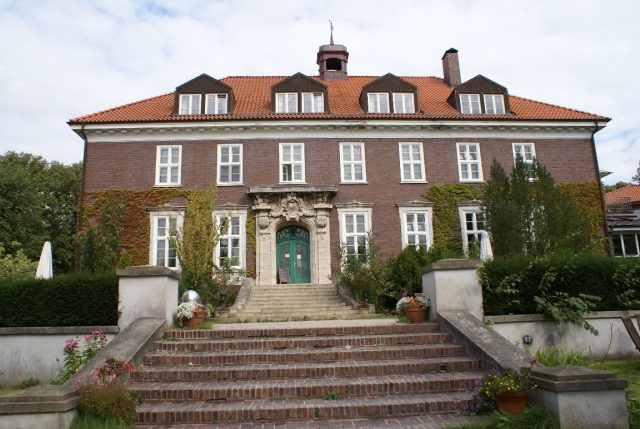
Stellshagen Manor

Stellshagen was first mentioned in a document in 1230 as "Stellershagen" in the Ratzeburg tithe register with a size of 18 hides. The name "Stellershagen" refers to the settlement of the Klützer Winkel in the 13th century, where the determinant "Steller" is to be interpreted as the name of the settler and the basic word "-hagen" (wood, hedge, enclosed field) refers to the clearing of the Klützer forest. From the 15th century, isolated sources exist about the peasant inhabitants of Stellshagen, from which it can be seen that in 1404, 12 hides were still being cultivated.
Early Modern Period
The village was integrated into the manorial system of the neighboring noble families, so the farmers in Stellshagen had to perform extensive services for the lords. From the 16th century, the von Plessen family, based in Damshagen, owned estates in Stellshagen, and by the 18th century, they succeeded in acquiring almost all peasant holdings. However, other landlords also owned estates in Stellshagen. The lords of Plessen mostly leased their estates to local tenants. During the Early Modern Period, Stellshagen politically belonged to the Knightly Office of Grevesmühlen.
Modern Period
Hans Bernhard von Plessen united the estates in Stellshagen and Damshagen in 1817. In 1819, he sold the Stellshagen estate to Gotthard Bernhard Vorbeck for 63,000 Thalers. In 1833, the estate passed to Johann August Bosselmann and in 1855 from him to his son Johann Heinrich Georg Friedrich Bosselmann. He sold it in 1865 for 225,000 Thalers to Karl Bernhard Rudolff. Through a forced auction, the estate was acquired in 1886 by Count Ludwig von Bothmer. At this time, the Stellshagen estate comprised 353.3 hectares of land. In 1894, Stellshagen passed into the possession of Otto Graf von Bothmer. In 1918, the estate was separated from the Bothmer property and sold to the Chamberlain Hans von Plessen. In 1924, the Stellshagen estate was acquired by the Hamburg architect and building contractor Franz Bach senior from the Chamberlain Hans von Plessen. On a hill opposite the Eichsberg, Franz Bach built the Stellshagen manor house in 1924, which today houses the organic and health hotel. Franz Bach's son, the farmer Franz Bach junior, managed the estate, which comprised 130 hectares of land, from 1924 to 1945. As a landowner, Franz Bach junior showed great social commitment by building the farmworker houses on the village street and enlarging the reaper barracks for the farmworkers in 1927. The estate and the village experienced a general upswing due to his measures, and the population doubled (the population of Stellshagen was around 60 inhabitants in the 1920s, 130 in 1930; 107 in 1942 and 196 in 1946). On April 30, 1935, Franz Bach junior submitted an application for the separation of Stellshagen from the municipality of Damshagen to the Grevesmühlen office. The Reich Governor of Mecklenburg approved the separation, so that Stellshagen became an independent municipality from April 1, 1936. Franz Bach junior was appointed mayor of Stellshagen by the district administrator of the Schönberg district on March 27, 1937.
History after 1945
In 1945, the landowner Franz Bach junior was dispossessed and expelled by the communists. Subsequently, the estate was divided into 38 new farmer settlements. After the manor house had initially been used primarily by refugees as a residential building, it became a district party school of the SED in 1946. In 1954, the manor house was expanded into a special school for children with learning disabilities ("Clara Zetkin School") with a boarding school for the Grevesmühlen district. In 1972, a new school building was constructed next to the manor house, while the manor house continued to be used. In 1994, the school was moved to Grevesmühlen, leaving the manor house uninhabited. In 1949, Kurt Krüger was elected mayor in Stellshagen. In 1950, Stellshagen and Damshagen were merged again into one municipality, with Kurt Krüger becoming mayor. In 1952, Josef Lupa became the new mayor, but was dismissed in 1953. Paul Dietrich then became mayor, serving until 1969. In 1969, Helmut Oldenburg became mayor. In 1959, the municipalities of Damshagen/Stellshagen and Reppenhagen/Welzin merged. In Stellshagen, the first LPG (Agricultural Production Cooperative) of the Klützer Winkel, Type I, was founded in 1952 by the farmer Egon Feldt and five new farmers. In 1953, an LPG Type II was founded. In 1955, this LPG took over the areas of Nedderhagen from the ÖLB Gartenbeck. From the LPGs Damshagen, Stellshagen, Welzin and Reppenhagen, the LPG "Ernst Thälmann" was formed in 1960. This LPG belonged to the "Klützer Winkel" cooperation from 1966. In 1973, the plant products from the LPG "Ernst Thälmann" were separated and integrated into the Cooperative Department of Plant Production (KAP) "Klützer Winkel". In 1975, the LPGs Damshagen, Grundshagen and Redewisch merged to form the LPG Klütz (Animal Production).
History after 1989
In 1994, Gertrud Cordes, the granddaughter of Franz Bach junior, acquired the manor house from the Nordwestmecklenburg district. Due to her concept of using it as an organic and health hotel, Gertrud Cordes was awarded the contract in a bidding process. The Bio- und Gesundheitshotel Stellshagen opened in 1996 and has since become a regionally significant tourist center in the Klützer Winkel. The village's infrastructure was subsequently renewed and expanded; for example, in 2003, after two years of work, a 2500 m² village park was inaugurated in the middle of the village on a formerly swampy area. The listed farmworker houses and the reaper barracks are still located along the village street. The village is characterized by a lively community life among the villagers and the neighborhood in the Klützer Winkel, as well as guests from all over the world. In particular, the Bio- und Gesundheitshotel Stellshagen led to a coexistence between people from all over Germany and abroad. It is a village custom, for example, that the village choir performs a serenade for all jubilarians.
Take Mobile History with you
You are reading this text for free. Premium adds what matters on the road: descriptions read aloud, sites found through your camera, whole regions taken offline.
- Every description, including the ~17,700 Premium sites
- Audio guide: have descriptions read to you on location
- AR finder: see sites through your camera, with distance and bearing
- Unlimited saved sites
14 days free, then from €2.99 a month. Cancel anytime.
Source: Wikipedia · Licence: CC BY-SA 4.0 · Image: Roland Neubert, Halle (Saale)
This description draws on the facts documented in the linked Wikipedia article; Wikipedia content is licensed under CC BY-SA 4.0. Wording and editing: Mobile History.
Location: 53.9465, 11.1413