ManorStockelsdorf

Stockelsdorf Manor

Stockelsdorf Manor

Cultural Events

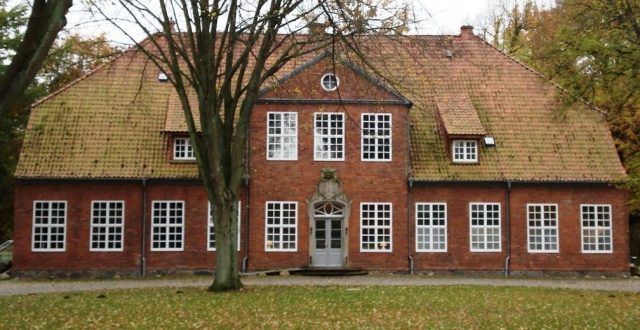
Stockelsdorf Manor is a manor house in the Schleswig-Holstein municipality of Stockelsdorf in the district of Ostholstein. It is the manor house of the former Stockelsdorf estate.

The single-story building (approx. 30 x 20 meters) was constructed from red unplastered bricks on a foundation of broken fieldstones and features a wide central risalit with a triangular gable, occupying about a quarter of the building's width, which has a round window. It has a hipped roof covered with red roof tiles, with a dormer window on each side of the central risalit. The building's portal is framed by a sandstone element crowned by the builder's coats of arms and bearing the year of construction, 1761. The Rococo architectural style is expressed in the design of this sandstone element – on an otherwise very simply constructed building. Contrary to its current state, the manor's roof was likely previously covered with a divided roof in the Baroque style.

The manor house was built in 1761 by Georg Nicolaus Lübbers, who acquired the Stockelsdorf estate in the same year and founded the Stockelsdorf faience manufactory in 1771 – possibly by the master builder Johann Adam Soherr – for which an existing manor house was demolished. Lübbers' daughter Maria Catharina married the merchant and later Lübeck mayor Friedrich Nölting, who thus came into possession of the Stockelsdorf estate after his father-in-law's death.

After several changes of ownership, the municipality of Stockelsdorf acquired the manor house and the associated land in 1950. Subsequently, the manor house was used as a school.

The building was classified as a "cultural monument of special importance" in 1986 and is one of the landmarks of the municipality of Stockelsdorf.

Until 1998, the building was used as residential accommodation for asylum seekers. In 2000, Stockelsdorf Manor was transferred by the municipality of Stockelsdorf to the non-profit Stockelsdorf Manor Foundation, founded in October 2000 and approved on December 13, 2000, and was renovated and restored between 2001 and 2003.

The building is used for cultural purposes such as concerts and exhibitions, as well as by a restaurant. Part of the associated garden is preserved as a park.

Take Mobile History with you

You are reading this text for free. Premium adds what matters on the road: descriptions read aloud, sites found through your camera, whole regions taken offline.

  • Every description, including the ~17,700 Premium sites
  • Audio guide: have descriptions read to you on location
  • AR finder: see sites through your camera, with distance and bearing
  • Unlimited saved sites

14 days free, then from €2.99 a month. Cancel anytime.

Source: Wikipedia · Licence: CC BY-SA 4.0 · Image: http://de.wikipedia.org/wiki/Datei:Herrenhaus_Stockelsdorf.JPG

This description draws on the facts documented in the linked Wikipedia article; Wikipedia content is licensed under CC BY-SA 4.0. Wording and editing: Mobile History.

Location: 53.8978, 10.6436