ManorKöln

Thurnner Hof Manor (Köln)

Thurnner Hof Manor (Köln)

Cultural Events

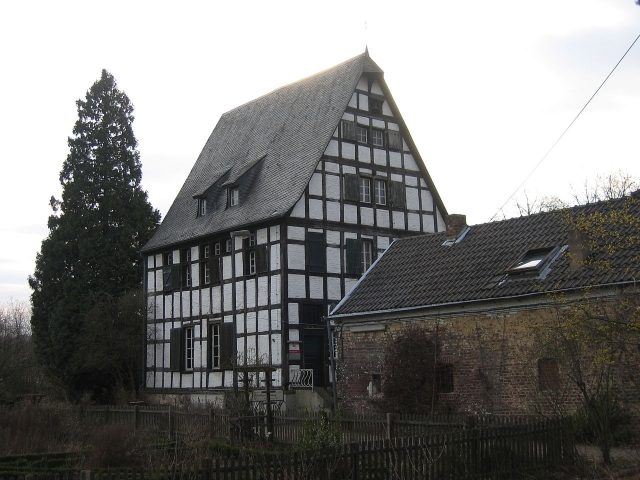
The Thurner Hof is a manor house and former knight's seat located in Cologne-Dellbrück, consisting of the manor house at the southeast corner, a four-winged courtyard complex, and a corner tower (the "Türmchen") at the northwest corner. It has been owned by the City of Cologne since 1911. "Thurn" is an Old High German form of "Turm" (tower) and refers to the original form of the castle as a motte. The name also transferred to the associated settlement, now part of Cologne-Dellbrück.

The courtyard complex is surrounded to the east and south by a 7,200 m² garden area, which is maintained on a voluntary basis and serves, among other things, as a teaching garden for the VHS Cologne. The garden, with its educational mission, is open to visitors on Saturdays from 12 p.m. and in the summer months on Wednesdays from 4 p.m. The Thurner Hof is also the venue for the Cologne Plant Exchange every year on the first Sunday in May.

Heinrich von Thurn, around 1150, who also owned estates in Wichheim (today part of Cologne-Holweide), is considered the oldest known owner. The urbarium of the Cologne Benedictine monastery of St. Pantaleon mentions the Thurner Mill in 1322 and 1324, from which the monastery received income. The next owner documented, though only mentioned in 1423, is a family Hermann von Thurn (vamme Thurme). In 1526, the von Quadt zu Haus Buschfeld family is mentioned for the first time. In 1560, Adolf von Brambach (probably named after an estate of the same name in the Overath area) owned the Thurner Hof, which he sold to his brother-in-law Hans von Hoven, called Pampus. In 1590, Hans Ludwig von Hatzfeld then bought the Hof. Adolf von Quadt zu Haus Buschfeld reacquired the Hof for his family in 1612. He also owned Haus Iddelsfeld and was Bachgraf for the lower course of the Strunde. In 1627, he had the still-preserved courtyard gate with the Quadt-Pallant alliance coat of arms erected. In 1750, the last direct male owner of the Hof from this family died; his brothers were high clerics in the Diocese of Trier and were therefore excluded as heirs. His cousin, Franz von der Leyen zu Hohengerold, now took over the Thurner Hof and had it managed by a tenant named Schnell. After ten years, a merchant named Schül(l)gen followed as owner, for whom the still-preserved memorial cross on the Strunde was probably erected shortly after 1819. In 1818, the Hof came into the possession of the Neuhöffer family. Several more tenants and owners followed, including Carl Krein, until the property was acquired by the City of Cologne in 1911.

The Manor House+

The former manor house was probably built in its current half-timbered form in the 16th century, as Paul Clemen wrote in the 1901 inventory of art monuments of the Mülheim district, which mentions the Thurner Hof as one of the few secular buildings. The stone, vaulted basement suggests that a building stood here before. Above it, accessed by an external staircase from the north, rises a two-story half-timbered post-and-beam structure with a two-and-a-half-story, steep, slate-covered gable roof with its ridge oriented north-south. An extension was later added to the west, over which this side of the roof is now hipped. The framework of the house is built without visible braces; the high main floors have cross-mullioned window openings. This corresponds to a number of large Bergisch half-timbered houses of the 16th and 17th centuries, but is unique in the (current) Cologne city area. In the lower floor, a hall with larger windows and stucco decoration was probably added in the 18th century.

In the early 1970s, the house was renovated and set up as an outpost of the Cologne Adult Education Center. During this process, the facade plaster was removed, and the damaged half-timbered facades were fitted with plastic fillings. Inside, dilapidated ceilings and walls were extensively clad. This, as well as a lack of building maintenance (damage to the roof), caused massive structural damage in the following decades. Since August 2010, the manor house has therefore been renovated as part of the labor market and urban beautification project "Win-Win for Cologne," among others, by the Cologne Youth Welfare.

Stables+

The farm buildings of the Thurner Hof house the stables of the Dellbrück Riding Club "Kornspringer," which also uses the "Türmchen."

The Garden+

The garden complex consists of a cottage garden, a former moated ditch, and an orchard meadow, where the apiary is also located. The garden and the 16th-century half-timbered manor house form an aesthetic unit.

The Cottage Garden

The cottage garden is the heart of the garden complex. Boxwood-bordered beds lead to an old pear tree that stands in the center of the cottage garden.

In the flower beds, "old-fashioned" flowers such as pasque flower, red foxglove, peony, and columbine are grown. In March, fragrant violets can be discovered along the paths, followed shortly after by wild pansies. In June, hollyhocks tower over all other flowers. In the wild perennial bed, the inconspicuous wild tulips and pasque flower bloom early in the year, and in summer, the bright blue borage and Siberian iris.

In the vegetable beds, out-of-fashion useful plants such as garden orach, turnip greens, chard, parsnip, Jerusalem artichoke, and broad beans grow, among others. Vegetable cultivation is carried out for educational reasons in two different ways: as row mixed cropping according to Gertrud Franck, where plants are grown in a specific sequence in closely spaced rows, and as more traditional bed mixed cropping, where heavy, light, and medium feeders are grown one after another.

In the herb beds, too, one finds plants that were cultivated in a 16th-century manor house garden: rue, meadowsweet, myrrh chervil, and motherwort can be found here, as well as parsley, bay leaf, and wild garlic, which has become popular again in recent years.

The Moated Ditch

The moated ditch is the ecological heart of the garden. Generously supported by state funds, a working group of the VHS Cologne ensured the reflooding of the remaining part of the historic moated ditch. Due to the varying water depths, the diverse light conditions from deeply shaded to fully sunny, and the adjacent long dry stone wall, an extraordinary ecological diversity with a multitude of aquatic and marsh plants has developed here. Here one finds protected plants such as the yellow water lily and the white water lily, on whose leaves wagtails hunt for insects in summer.

In spring, yellow marsh marigolds line the water's edge, and in summer, the reddish-purple purple loosestrife, as well as bur-reeds, bogbean, and marsh iris. In March, one can see the spawn of common frogs in the water, and from April, also that of water frogs. The kingfisher, which breeds nearby, has part of its hunting ground here. It can often be observed looking for fish on the willow branches protruding above the water surface. Also to be observed is the grey heron, for which the ponds at Thurner Hof are also ideal hunting grounds. In summer, mallards also regularly breed here.

Due to the different habitats, a great variety of different dragonfly species can be found here. They are best observed from the jetty that extends far into the pond area, from which one can also see the courtship display of the moderlieschen and sticklebacks. Opposite the pond jetty is a long dry stone wall. Bumblebees and solitary bees nest there.

The Orchard Meadow

The largest area of the Thurner Hof garden complex is occupied by the orchard meadow. Here, too, an attempt is made to do justice to the historical ambience of the old knight's estate by selecting the cultivated varieties. Here, regionally typical old apple varieties such as the Rhenish Bohnapfel and the Rhenish Krummstiel grow. However, the aim of the teaching garden is also to be able to show visitors the entire spectrum of fruit, nut, and berry varieties. In addition to plums, one also finds apricots, peaches, cherries, a walnut tree, and hazelnut bushes, as well as rarer varieties such as medlars and the Sorbus domestica.

Numerous bird species find nesting opportunities in the wild hedges surrounding the orchard meadow. The goldfinch can be observed as well as the greenfinch. In winter, a larger number of long-tailed tits occasionally arrive, frolicking in the branches of the old fruit trees.

Take Mobile History with you

You are reading this text for free. Premium adds what matters on the road: descriptions read aloud, sites found through your camera, whole regions taken offline.

  • Every description, including the ~17,700 Premium sites
  • Audio guide: have descriptions read to you on location
  • AR finder: see sites through your camera, with distance and bearing
  • Unlimited saved sites

14 days free, then from €2.99 a month. Cancel anytime.

Source: Wikipedia · Licence: CC BY-SA 4.0

This description draws on the facts documented in the linked Wikipedia article; Wikipedia content is licensed under CC BY-SA 4.0. Wording and editing: Mobile History.

Location: 50.9711, 7.0763