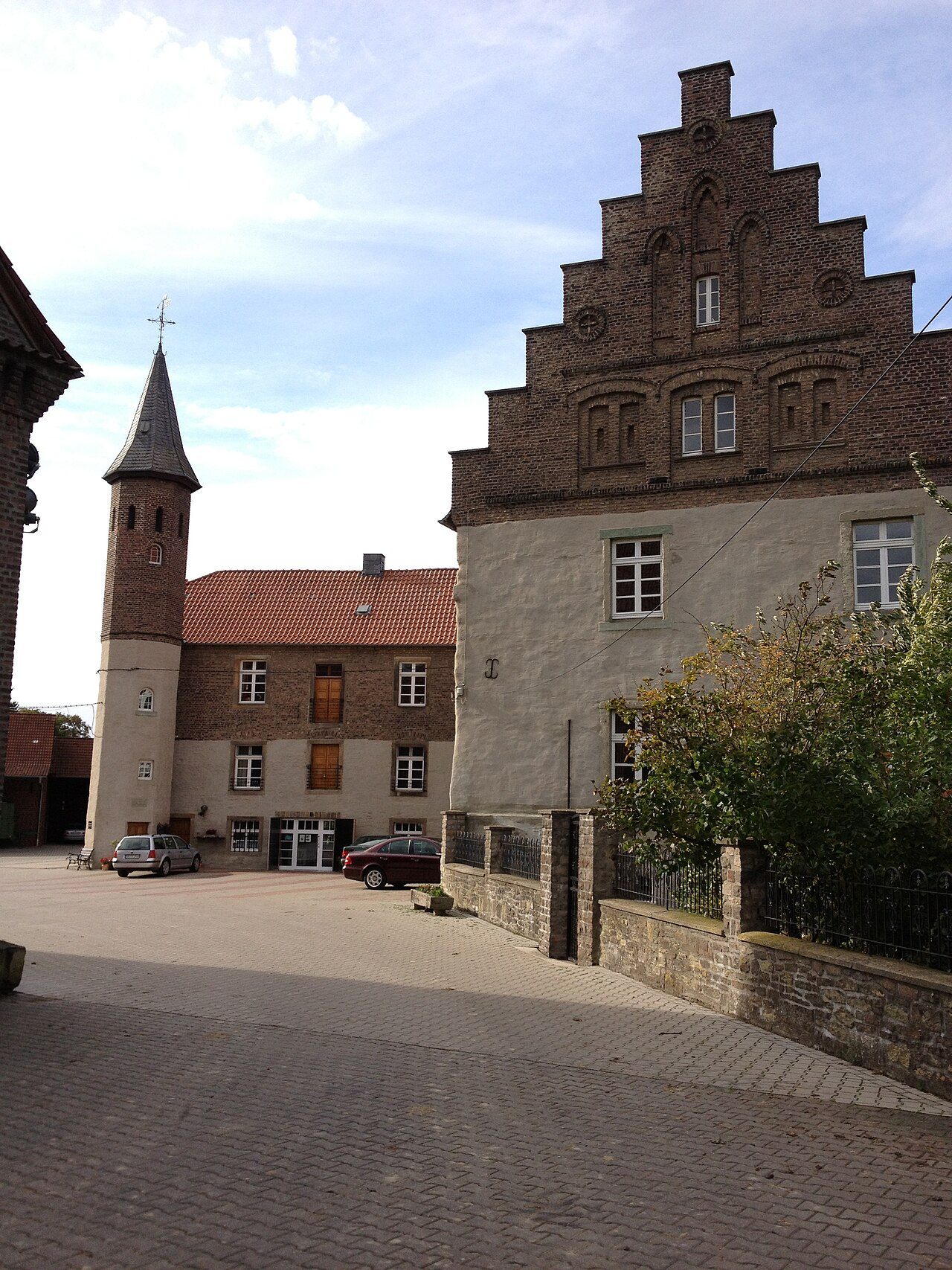
ManorWesthemmerde

Westhemmerde Manor

Westhemmerde Manor

To be privately owned

Haus Westhemmerde is a former noble seat and a moated castle in Westhemmerde, today a district of Unna in Westphalia. It is one of Unna's most famous architectural monuments.

Family von dem Broel gen. Plater (until 1649)

Its origins date back to the end of the 14th century. In the 16th century, the family von dem Broel called Plater built the current architectural monument as a moated castle. The complex was extended and rebuilt several times throughout its history. The lords of Haus Westhemmerde also held the patronage over the church of Westhemmerde.

When Haus Westhemmerde was built is largely unknown. The first documented mention presumably occurred in 1217, when Gerhard von dem Broel (de Brule) is mentioned as a witness in a document in which Count Gottfried von Arnsberg sold estates near Werl to Wedinghausen Monastery. He himself did not live at Haus Westhemmerde, but at Haus Broel, located 1 kilometer away.

In the first third of the 14th century, the Broel family, who were in feudal service to Arnsberg, fell into economic difficulties. The Count of Mark confiscated lands belonging to the estate. From about 1362, the family, possibly through marriage, adopted the surname Plater. Around 1455, Haus Broel was abandoned by Rotger von dem Broel, and he moved to Westhemmerde. At the end of the 15th century, Goddert von dem Broel had the northern main house built, which is still present as the oldest building in the current complex. Around 1560, the main house was extended by an annex. During the Thirty Years' War, Haus Westhemmerde was plundered several times by Swedish and imperial troops. When the plague also broke out, the family left Haus Westhemmerde in September 1635 and lived with relatives until 1639.

With Hermann von dem Broel gen. Plater, the Broel line died out in 1659, and the house fell to the eldest daughter Mechthild Katharina, who had been married to Johann Bernhard Vogt von Elspe zu Borghausen since 1649, and thus to the family of the Vögte von Elspe.

Vögte von Elspe (1649-1800)

However, the family Vogt von Elspe zu Borghausen und Westhemmerde lived on the estate in Borghausen where they had 7 children. In early 1670, the family then moved to Haus Westhemmerde, as the eighth child was already born here. From the Fürstenberg inheritance, Johann Bernhard Vogt von Elspe zu Bamenohl und Westhemmerde also received Haus Werl in 1653. Haus Westhemmerde was plundered several times by French troops during the war years 1672 to 1679.

Haus Westhemmerde reached its largest estate holdings under Konrad Wilhelm Vogt von Elspe, for in 1716, 56 farms and cottages belonged to the estate. Konrad Wilhelm Vogt von Elspe died in 1716 without eligible heirs, so his nephew Friedrich Wilhelm Vogt von Elspe received the estates and paid off the other heirs. He had the west wing added to the house and moved his residence to Westhemmerde.

After Friedrich's death, his estates fell to his eldest son Gisbert Bernhard Vogt von Elspe without an inheritance settlement. In 1718/19, he had the estate buildings renovated, the west wing extended to the south, and added a south wing with a gate passage to the building. In the Seven Years' War from 1758-1761, the house suffered heavy losses from French and also Prussian troops. Gisbert Bernhard Vogt von Elspe also died in 1770 without descendants; his wife had already left him two years earlier, so his estate fell to his brother Gisbert Moritz Vogt von Elspe, who was in the service of the Dutch court, as well as his two sisters. Gisbert Bernhard Vogt von Elspe's widow received one third of the estates but was compensated with 20,000 Dutch guilders in 1776.

Families von Bodelschwingh - Plettenberg and Romberg (1800-1927)

As the last of the Elspe line, Gisbert Moritz died in the night of March 11 to 12, 1800, at the age of 80, as Obersthofmeister to William of Orange-Nassau in The Hague. He had stipulated in his will that his niece Anna Luise Gisbertine von Bodelschwingh, née Vogt von Elspe, be appointed as universal heir. Her daughter from a second marriage, Christine Sophie Luise, married Baron Carl Wilhelm Georg von Plettenberg in 1788.

Subsequently, the house remained in the possession of the von Romberg family until 1927 and was leased, among others, to the Neheim entrepreneur Josef Cosack, founder of the Hammer Eisenwerke, and then between 1901 and 1955 to the Kremerskothen family from Eiberg near Essen.

Modern Era

Later, the estate passed into the possession of the Ruhrtalsperrenverein. Since 1955, the house and the associated agricultural areas have been in private ownership. In the last 30 years, the complex has been carefully restored under the principles of monument protection.

Take Mobile History with you

You are reading this text for free. Premium adds what matters on the road: descriptions read aloud, sites found through your camera, whole regions taken offline.

  • Every description, including the ~17,700 Premium sites
  • Audio guide: have descriptions read to you on location
  • AR finder: see sites through your camera, with distance and bearing
  • Unlimited saved sites

14 days free, then from €2.99 a month. Cancel anytime.

Source: Wikipedia · Licence: CC BY-SA 4.0 · Image: Tomekgaw / CC BY-SA 3.0 via Wikimedia Commons

This description draws on the facts documented in the linked Wikipedia article; Wikipedia content is licensed under CC BY-SA 4.0. Wording and editing: Mobile History.

Location: 51.5485, 7.7848