CastleStraubing

Herzog Castle Straubing
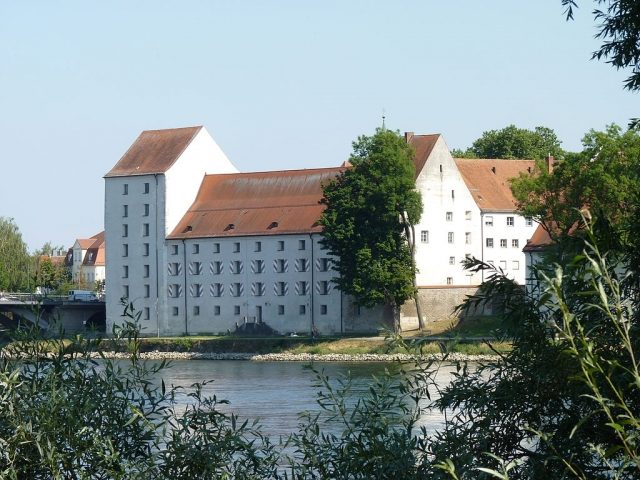
Herzog Castle Straubing

Tax Office
Health Department
City ​​Library
City ​​Archives

The Ducal Castle in Straubing was the Bavarian residence of the Dukes of Bavaria-Straubing, who also resided in The Hague as Counts of Holland, Zeeland, and Hainaut.

Duke Albrecht I began construction in 1356. He had an open residence built on the banks of the Danube.

The ensemble consists of:

  • Princely Buildings in the Palas: A large hall building between two massive residential towers along the Danube, which was extended in 1422. In the central part, above the Dürnitz, is the Knights' Hall, built under Albrecht's son Johann III according to Dutch models, which is more accurately described as a Estates Hall. To the sides were the ducal living quarters. In the eastern tower there is a very narrow spiral staircase which provided access to the floors of the residential tower.
  • Castle Courtyard: This is divided into two sections, the ground-level part and the much deeper courtyard in the background, to which the so-called Rider's Staircase leads down. From the upper courtyard, a wide bridge formerly extended over the deeper courtyard into the long wing opposite, which houses the Knights' Hall on the upper floor.
  • Castle Chapel St. Sigismund and St. George: Construction began in 1373, and the consecration took place in 1393. In the 15th century, the chapel nave was rebuilt. In the Baroque period, the vaulting was altered, and the stucco dates from around 1720.
  • Gate Tower: It was built before 1356 as part of the city wall and was later incorporated into the complex. The indentations where a portcullis once denied access are still visible today. The machine that raised the gate is still present in the tower's roof truss. Also still present are two bells, one of which dates from 1544 and was cast by Hans Meixner in Landshut. The building is adorned with a frieze of coats of arms, which among others also shows the Dutch coat of arms; directly above the gate is the Palatine-Bavarian coat of arms of Elector Karl Theodor.
  • North Wing (oldest part of the building with a hall, possibly for chancery functions)
  • Vizthumspalast (Palace of the Vicedominus/Governor)
  • At the northwest corner of the castle complex is a small tower, better known as the Agnes Bernauer Tower. She was allegedly imprisoned there; however, it is not a prison but served defensive purposes. Moreover, it was built about 100 years after the tragic death of the bath attendant's daughter.
  • further Gothic smaller towers and buildings, not all of which are still preserved.

Buildings from the then-existing city fortifications were taken over and their use changed.

The most important function was probably as a meeting place in a ceremonial setting, e.g., for coronation ceremonies, homage ceremonies, or as a court. In 1430, Emperor Sigismund convened an Imperial Diet in Straubing, which was held in the Ducal Castle.

At the same time, the building also served as the secular government headquarters with the Rentamt (revenue office), Kastenamt (treasury office), and Mautamt (toll office).

The neighboring Carmelite monastery does not belong to the direct structural castle area but was built in the same context and is the burial place of the dukes and higher nobility.

After the End of the Duchy+

Initially, the ducal Vicedom was in charge. After 1425, when the Straubing line of the Wittelsbach family died out in the male line with Johann III, the Vicedom was appointed by the Munich dukes. With the Vicedom's office, later the Rentamt, Straubing was the seat of government and Lower Bavarian administrative center for centuries.

In the Baroque period, the former ducal rooms were converted into barracks, which marked the beginning of the complex's decay. Intermediate ceilings were installed in the Knights' Hall, the inner courtyard was accordingly rebuilt and provided with a wide Rider's Staircase. Further reconstruction measures resulted in no historical rooms being preserved. In 1906, the soldiers moved to newly built barracks.

After a renovation in the 1990s, large parts are accessible as office spaces and event venues. The original Knights' Hall ceiling was also uncovered.

At the former Ducal Tower, a giant Saint Christopher greets all visitors to the city. The fresco was donated in 1934 by Hedwig Dietl. When the Danube bridge was blown up shortly before the end of World War II, it suffered great damage. In 1990, the fresco was restored by a Straubing artist.

The Ducal Castle Today+

Today, Straubing's Ducal Castle serves as the seat of the tax office and the health department and also houses the city library and city archive. In the inner courtyard, in addition to other open-air events, the Agnes Bernauer Festival takes place every four years (next performances in 2015). Furthermore, the Knights' Hall is used for events and concerts, and there is the Museum in the Ducal Castle, which shows changing exhibitions.

Take Mobile History with you

You are reading this text for free. Premium adds what matters on the road: descriptions read aloud, sites found through your camera, whole regions taken offline.

  • Every description, including the ~17,700 Premium sites
  • Audio guide: have descriptions read to you on location
  • AR finder: see sites through your camera, with distance and bearing
  • Unlimited saved sites

14 days free, then from €2.99 a month. Cancel anytime.

Source: Wikipedia · Licence: CC BY-SA 4.0

This description draws on the facts documented in the linked Wikipedia article; Wikipedia content is licensed under CC BY-SA 4.0. Wording and editing: Mobile History.

Location: 48.8849, 12.5732