Museum
Highclere Castle

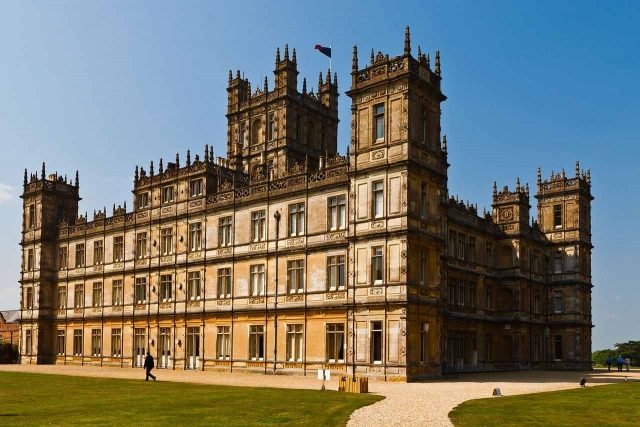
Highclere Castle is a country house in the Jacobethan style, with park designed by Capability Brown. The 1,000 acre (405 hectare) estate is in Hampshire, England, about 5 miles (8.0 km) south of Newbury, Berkshire. It is the country seat of the Earl of Carnarvon, a branch of the Anglo-Welsh Herbert family. It is the main filming location for the British television period drama Downton Abbey.
The castle stands on the site of an earlier house, which was built on the foundations of the medieval palace of the Bishops of Winchester, who owned this estate from the 8th century. The original site was recorded in the Domesday Book. Since 1679, the castle has been home to the Carnarvon family.
In 1692, Robert Sawyer, a lawyer and college friend of Samuel Pepys, bequeathed a mansion at Highclere to his only daughter, Margaret, the first wife of the 8th Earl of Pembroke. Their second son, Robert Sawyer Herbert, inherited Highclere, began its picture collection and created the garden temples. His nephew and heir Henry Herbert was created Baron Porchester and 1st Earl of Carnarvon by King George III.
The house was then a square, classical mansion, but it was remodelled and largely rebuilt for the third Earl by Sir Charles Barry in 1839–1842, after he had finished building the Houses of Parliament. It is in the Jacobethan style and faced in Bath stone.
The term "Jacobethan" refers to the Victorian revival of English architecture of the late 16th century and early 17th century, when Tudor architecture was being challenged by newly arrived Renaissance influences. During the 19th century there was a huge Renaissance revival movement, of which Sir Charles Barry was a great exponent—Barry described the style of Highclere as "Anglo-Italian".
Barry had been inspired to become an architect by the Renaissance architecture of Italy and was very proficient at working in the Renaissance-based style that became known in the 19th century as Italianate architecture. At Highclere, however, he worked in the Jacobethan style, but added to it some of the motifs of the Italianate style. This is particularly noticeable in the towers, which are slimmer and more refined than those of Mentmore Towers, the other great Jacobethan house built in the same era. Barry produced an alternative design in a more purely Italian Renaissance style, which was rejected by Lord Carnarvon. The external walls are decorated with strapwork designs typical of Northern European Renaissance architecture. The Italian Renaissance theme is more evident in the interiors. In the saloon, in an attempt to resemble a medieval English great hall, Barry's assistant Thomas Allom introduced a Gothic influence evident in the points rather than curves of the arches, and the mock-hammerbeam roof.
Although the exterior of the north, east and south sides were completed before the 3rd Earl died in 1849 and Sir Charles Barry died in 1860, the interior and the west wing (designated as servants' quarters) were far from complete. The 4th Earl turned to the architect Thomas Allom, who had worked with Barry, to supervise work on the interior of the Castle, which was completed on 1878.
The 1st Earl rebuilt his park according to a design by Capability Brown in 1774–1777, relocating the village in the process— the remains of the church of 1689 are at the south-west corner of the castle. The famous 18th century seed collector Bishop Stephen Pococke was a friend and brought Lebanon Cedar seeds from a trip to Lebanon. These beautiful trees can be seen in the garden today.
There are various follies and eye-catchers on the estate. To the east of the house is the Temple, a strange structure erected before 1743 with Corinthian columns from Devonshire House in Piccadilly. "Heaven's Gate" is an eye-catcher about 18 m high on Sidown Hill, built in 1731 from a design, it is thought, by the 9th Earl of Pembroke. It fell shortly afterwards. The event was witnessed by Rev. J Milles, who recorded that "we had not been there above half an hour before we saw it cleave from ye foundations and it fell with such a noise yet was heard at three or four miles (5 or 6 km) distant."
The hybrid holly Ilex x altaclerensis (Highclere holly) was developed here in about 1835 by hybridising the Madeiran Ilex perado (grown in a greenhouse) with the local native Ilex aquifolium.
Exhibition+
The castle is home to an Egyptian Exhibition, which was founded by George Herbert, the 5th Earl, who, along with his archaeological colleague Howard Carter, discovered the tomb of the Egyptian Pharaoh Tutankhamun in 1922. The 5th Earl was an enthusiastic amateur Egyptologist, undertaking in 1907 to sponsor the excavation of nobles' tombs in Deir el-Bahari (Thebes).
Take Mobile History with you
You are reading this text for free. Premium adds what matters on the road: descriptions read aloud, sites found through your camera, whole regions taken offline.
- Every description, including the ~17,700 Premium sites
- Audio guide: have descriptions read to you on location
- AR finder: see sites through your camera, with distance and bearing
- Unlimited saved sites
14 days free, then from €2.99 a month. Cancel anytime.
Source: Wikipedia · Licence: CC BY-SA 4.0
This description draws on the facts documented in the linked Wikipedia article; Wikipedia content is licensed under CC BY-SA 4.0. Wording and editing: Mobile History.
Location: 51.3266, -1.3614