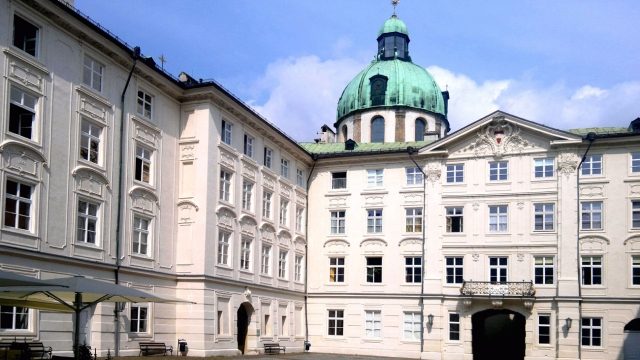
CastleInnsbruck

Innsbruck Castle

Innsbruck Castle

The Castle can be visited

The Hofburg in Innsbruck was once the seat of the Tyrolean provincial princes.

The first lodging on this site was used by Duke Leopold III. This and other properties were acquired by his son Friedrich IV, whose son Archduke Sigmund the Rich in Coin, Count of Tyrol, had a medieval castle built. His successor, the German King and later Emperor Maximilian I, expanded the complex. In 1534, the ceiling of the Giant's Hall, which had been renovated in 1510, was destroyed by fire and subsequently restored by King Ferdinand. Due to earthquake damage to the walls, the castle facade was reinforced with semicircular towers in 1536.

It was not until Maria Theresia (reigned from 1740–1780) that the order was given for the renovation in the style of courtly Viennese Rococo. This is how the magnificent building still presents itself today. Maria Theresia was only in Innsbruck twice, in 1739 in transit and in 1765 for the wedding of her son Leopold II to the Spanish princess Maria Ludovica, which is commemorated by the Triumphal Arch at the end of Maria-Theresien-Straße. The joyful event of the wedding was overshadowed by the death of her husband Franz Stephan of Lorraine (due to the consequences of a stroke) on August 18, 1765. The death chamber was converted into a chapel at the Empress's command. She also had the noble convent for ladies built at that time. The canonesses had to pray for the deceased Emperor. Members of the imperial family used the castle until the end of the monarchy; it was also the seat of the Tyrolean provincial princes and is now owned by the Republic of Austria.

Construction Details+

The Innsbruck Hofburg is built in the courtly Rococo style and is a monumental work of Austrian architecture. The Hofburg has a built-up area of approximately 5000 m², there are about 400 rooms - including over 30 private apartments. The building has four floors; the chapel and two larger halls span multiple floors.

The large castle courtyard is accessed through the southern castle gate, continuing into the smaller kitchen courtyard located to the west. Visitors can tour the state rooms, which include:

  • Giant's Hall (ballroom) with portraits of Maria Theresia, her husband, and their 16 children. The room is 31.5 m long, 13 m wide, and 11 m high. The hall's name, however, is not derived from its size but from the giants depicted in paintings from the Maximilian era.
  • Guard Hall (reception room for the Giant's Hall)
  • Imperial Apartments (Lorraine Room, Chapter Room, Ferdinand's Room)
  • Hofburg Chapel with an antechamber and sacristy
  • Andreas Hofer Hall, Andreas Hofer resided here from August 13 to October 21, 1809
  • Yellow Room, White Salon, Pink Salon, Rondell Room, Passage Room, Bedroom, Corner Cabinet, Chinese Room, Audience Room

The Hofgarten, located diagonally opposite, belongs to the Hofburg.

Take Mobile History with you

You are reading this text for free. Premium adds what matters on the road: descriptions read aloud, sites found through your camera, whole regions taken offline.

  • Every description, including the ~17,700 Premium sites
  • Audio guide: have descriptions read to you on location
  • AR finder: see sites through your camera, with distance and bearing
  • Unlimited saved sites

14 days free, then from €2.99 a month. Cancel anytime.

Source: Wikipedia · Licence: CC BY-SA 4.0 · Image: Robby-BF

This description draws on the facts documented in the linked Wikipedia article; Wikipedia content is licensed under CC BY-SA 4.0. Wording and editing: Mobile History.

Location: 47.2689, 11.3944