The remains of the Castle can be visited
CastleSchelklingen
Hohenschelklingen Castle
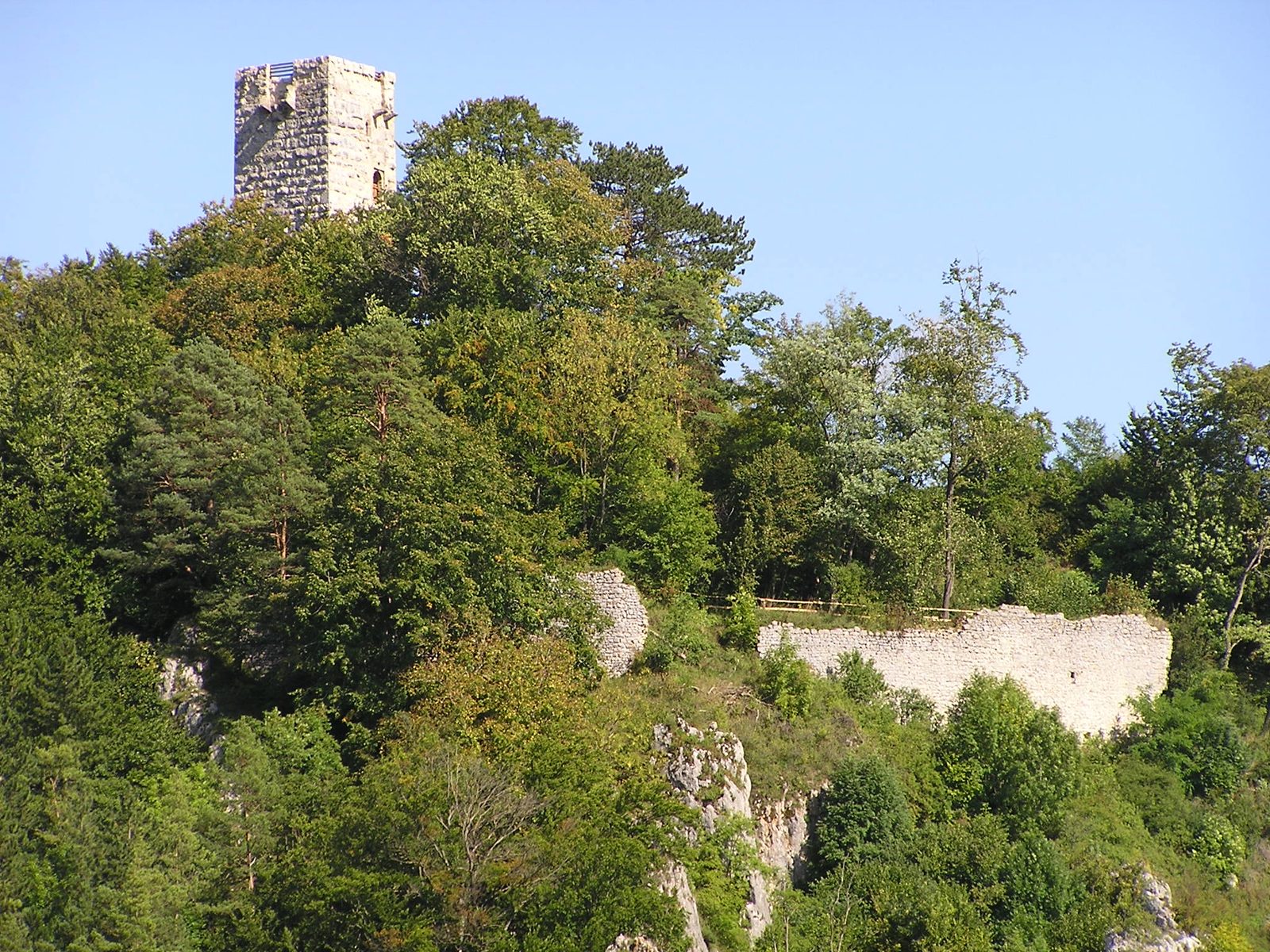
Hohenschelklingen Castle, also written Hohen Schelklingen, is the ruin of a high medieval hilltop castle near Schelklingen in the Alb-Donau-Kreis in Baden-Württemberg.
Geographical Location+
The ruin is located in the south of the Swabian Alb at an altitude of 621.5 m above sea level on a mountain spur of the 685 m above sea level Schlossberg, located 500 m to the north, between the Schelklingen Valley, formed by the Urdonau, in the west and the Längental in the east. South below the castle ruin lies the town of Schelklingen.
History+
The castle was first mentioned in 1127 as Castro et villae Schälkalingen. At that time, it was, together with the town of Schelklingen, in the possession of the noble brothers Rüdiger, Adalbert and Walter von Schelklingen. The builders of the castle must also have come from this family. Until the beginning of the 13th century, Walter von Schelklingen, first mentioned shortly before 1184, was still the owner of the castle and the town of Schelklingen. At the beginning of the 13th century, ownership changed through the marriage of Walter von Schelklingen's heiress daughter, Adelheid, to Count Heinrich von Berg. Around the period from 1210 to 1241, Count Heinrich III. von Berg was the lord of the castle and town of Schelklingen. Among other things, he is also credited with elevating Schelklingen to a town. Presumably, a castle expansion of Hohenschelklingen Castle in the area of the outer bailey also took place under him. After Heinrich III., his son Ulrich II. von Berg (1248–1266) took over the rule of the castle. He first appears in 1248 as Count of Berg-Schelklingen. When Urspring, today a district of Schelklingen, was destroyed in 1246/1247, a siege of the castle is assumed.
Subsequently, the castle was fundamentally modernized and around 1265 the keep was built in its present form. During the tenure of Count Konrad (1319–1346) of Berg-Schelklingen, the town and castle experienced their greatest flourishing as a residential city and administrative center of the Counts of Berg. In 1343, Count Konrad and his only daughter Luitgard sold the town, including the castle complex, to the Dukes Albrecht, Friedrich, Leopold and Rudolf of Austria. The castle was the main residence of the comital family until the extinction of the Counts of Berg with Konrad von Berg-Schelklingen in April 1346. Thereafter, Schelklingen lost its central function and thus the castle also lost its importance as a comital residence. Through the pledging of the lordship of Schelklingen, the complex became the seat of the respective pledge lord. Until 1396, Konrad von Reischach was the owner. In 1396, ownership then passed to Duke Ulrich von Teck. From 1438, Burkhard von Stadion was the new pledge holder. Around 1507, King Maximilian I sold the pledged lordship to Lutz von Freyberg. At this time, however, only the guards were permanent castle residents. In 1530, Konrad von Bemelberg (or Konrad von Boyneburg) became the lord of the town and castle. In 1633, Hohen Schelklingen Castle was destroyed during a march-through by the Blaubeurer. From May 1650 to 1653, the castle was demolished and its stones were used to build the Franciscan monastery in Ehingen. The remains were left to decay, which continues to this day. Until 1893, the castle ruin remained in manorial possession. In that year, the town of Schelklingen bought the 1,100 Morgen of forest located on its territory and also the fishing waters in the Ach from Friedrich Kaulla (1807–1895), descendant of the court factor Karoline Kaulla and since 1851 owner of the "Rittergut Oberdischingen", for 175,000 Marks. In the autumn of 1896, the castle ruin was renovated by the town of Schelklingen and the Schwäbischer Albverein. During this, the rubble that had half-filled the keep was removed, a ground-level access was created, and a staircase was installed inside. In 1910, Konrad Albert Koch carried out an excavation for the castle's floor plans, after which a floor plan of Hohenschelklingen Castle could be drawn for the first time. After the castle researcher Stefan Uhl re-examined the castle in 1990, and finally further renovation measures were carried out by the town of Schelklingen, the complex was reopened to the public in 1999. Since then, the 22 m high keep, also called the castle tower, can be climbed as a viewing tower on certain days. The castle ruin is a protected monument and has been entered in the list of Schelklingen's architectural monuments.
Take Mobile History with you
You are reading this text for free. Premium adds what matters on the road: descriptions read aloud, sites found through your camera, whole regions taken offline.
- Every description, including the ~17,700 Premium sites
- Audio guide: have descriptions read to you on location
- AR finder: see sites through your camera, with distance and bearing
- Unlimited saved sites
14 days free, then from €2.99 a month. Cancel anytime.
Source: Wikipedia · Licence: CC BY-SA 4.0 · Image: No machine-readable author provided. AlexanderF~commonswiki assumed (based on copyright claims). · Wikimedia Commons · CC BY-SA 3.0
This description is a machine translation of an excerpt from the linked Wikipedia article. The source text was written by its authors, the translation is by Mobile History; like the original it is licensed under CC BY-SA 4.0.
Location: 48.3796, 9.7316