Official residences of the Dutch Royal Family
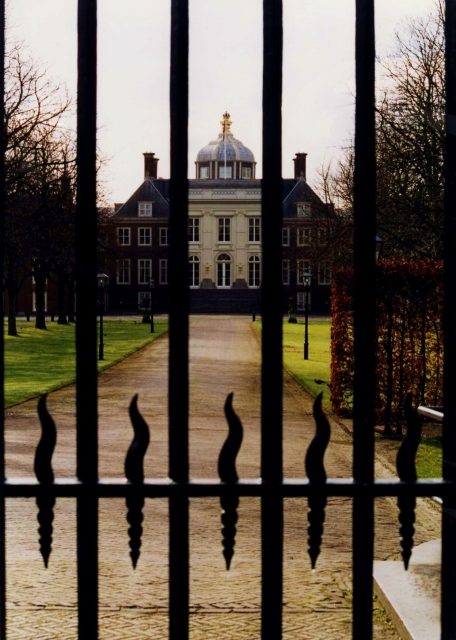
Huis ten Bosch

Huis ten Bosch is one of the three official residences of the Dutch Royal Family, located in The Hague in the Netherlands. It has been home to Queen Beatrix since 1981. The other Royal palace in The Hague, Noordeinde Palace, is used for work-related purposes. A replica of the palace was built in Sasebo, Japan in a theme park bearing the same name.
Construction of Huis ten Bosch was begun on 2 September 1645, under the direction of Bartholomeus Drijffhout, and to a design by Pieter Post and Jacob van Campen. It was commissioned by the wife of the stadholder, Amalia von Solms on a parcel of land granted to her by the States General (Loonstra, 1983, Slothouwer 1945). This first stone was laid by Elizabeth of Bohemia.
Later inhabitants+
Over the next century and a half, the palace would change possession from the Nassau family, the king of Prussia, and many Stadholders until the French invaded in 1795. They gave the palace to the Batavian (Dutch) people who still own it to this day. Napoleon Bonaparte's brother, Louis, king of Holland, briefly lived in the palace between 1805 and 1807.
When William I was proclaimed King of the Netherlands, he made Huis ten Bosch one of his official residences. It became a favourite location for many members of the Royal Family, and during World War I it became the primary residence of Queen Wilhelmina.
The Queen and her family were forced to evacuate the palace for Britain (from which the Queen's family, but not the Queen herself, would move on to Canada) when the German army invaded the Netherlands during World War II. The Nazi administration planned to demolish the palace, but the controller convinced them not to. However, the palace was damaged beyond habitation.
Current status as Royal residence+
Between 1950 and 1956, the palace was restored and once again became a Royal residence. It became the prime residence once more in 1981.
The palace has undergone major reconstructions since it was built. Currently, it consists of a central part with two long wings, spanning approximately 110 m from end to end.
Take Mobile History with you
You are reading this text for free. Premium adds what matters on the road: descriptions read aloud, sites found through your camera, whole regions taken offline.
- Every description, including the ~17,700 Premium sites
- Audio guide: have descriptions read to you on location
- AR finder: see sites through your camera, with distance and bearing
- Unlimited saved sites
14 days free, then from €2.99 a month. Cancel anytime.
Source: Wikipedia · Licence: CC BY-SA 4.0 · Image: Peter van der Wielen
This description draws on the facts documented in the linked Wikipedia article; Wikipedia content is licensed under CC BY-SA 4.0. Wording and editing: Mobile History.
Location: 52.0931, 4.3438