Corporation house of the student fraternity Corps Rhenania Würzburg
CastleWürzburg
Hutten Castle
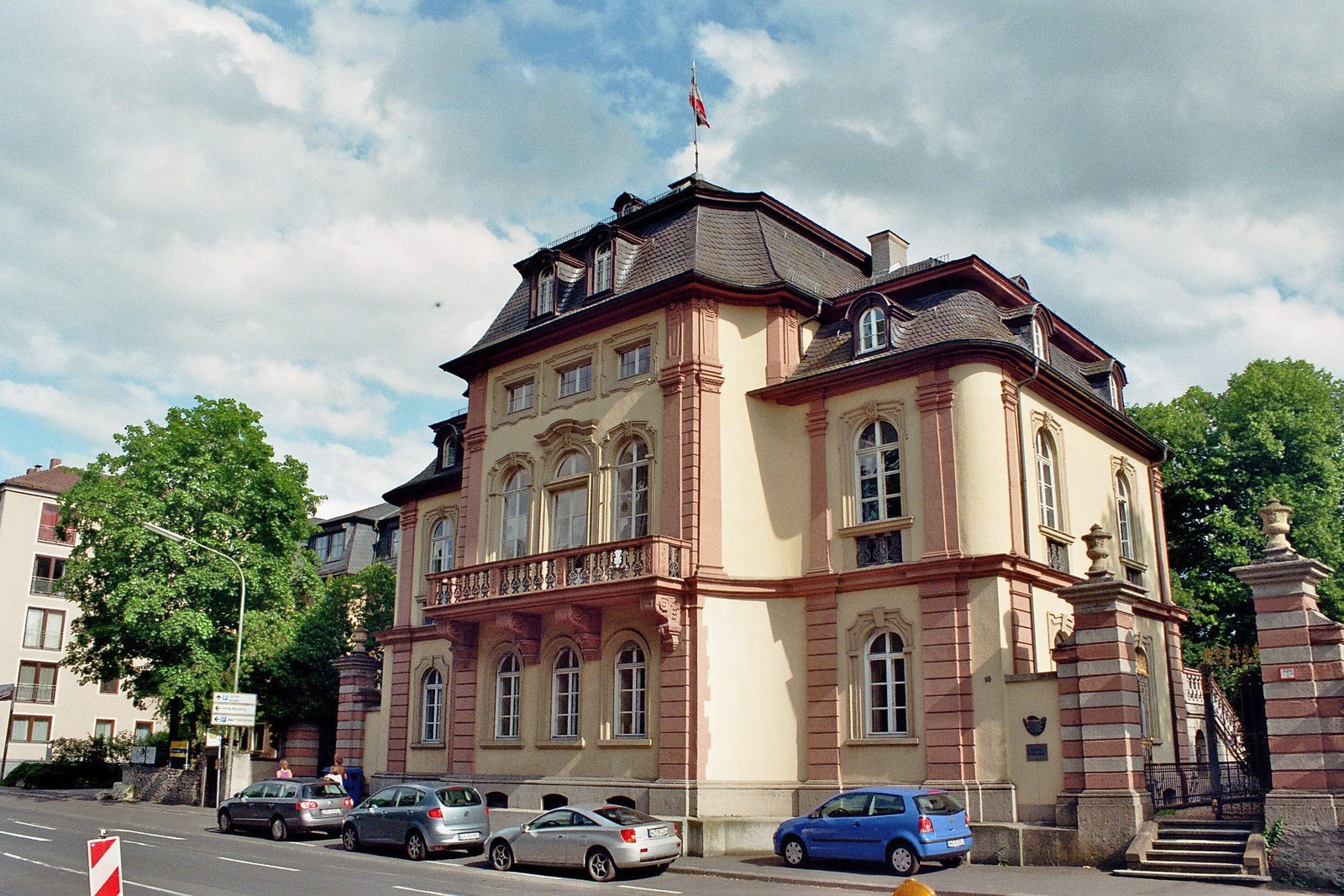
The Huttenschlösschen is a baroque estate in Würzburg, built around 1720 as a summer residence, which was heavily damaged during World War II and subsequently rebuilt. Since 1884, it has been used as the fraternity house of the student association Corps Rhenania Würzburg.
The building was constructed between 1719 and 1721 by the then Dean of the Cathedral and later Prince-Bishop Christoph Franz von Hutten (1673–1729) as a private summer palace ("Lusthaus") in a representative park. Based on new archival findings, the architect was clearly the then court architect Joseph Greissing, whose plans were modeled after a very famous garden palace in Vienna at the time. It is possible that Christoph Franz von Hutten, who was the leader of the anti-Schönborn party in the cathedral chapter, intended to use the building to underscore his claim to the position of Prince-Bishop, to which he was indeed elected in 1724. In accordance with this elevation in rank, the garden complex was further developed between 1724 and 1729. The ensemble of palace and park was built in the southwest of the city directly outside the city fortifications that still existed at the time. While the park was opened for public use, the palace remained reserved for the owner. An inscription carved into the masonry attested to the concept: "publicae amoenitati et privatae salubritati" (For public amenity and for one's own health). In 1803, the von Hutten family sold the plot of land and the building. Thereafter, the property had six different owners until 1884. When the de-fortification of Würzburg began around the middle of the 19th century, i.e., the dismantling of the old military fortifications, the park was increasingly fragmented by the construction of apartment buildings. By 1854, the Hutten garden around the building was only one-tenth of its original size, and the property increasingly fell into disrepair.
Time as Corps House+
In November 1884, the alumni association of Corps Rhenania Würzburg acquired the property and building. The palace, and especially the large ballroom, were renovated, the stucco ceiling was renewed and repainted.
Source: Wikipedia · Licence: CC BY-SA 4.0 · Image: Rabe! · Wikimedia Commons · CC BY-SA 3.0
This description is a machine translation of an excerpt from the linked Wikipedia article. The source text was written by its authors, the translation is by Mobile History; like the original it is licensed under CC BY-SA 4.0.
Location: 49.7852, 9.9291