Museum
Isenburg Castle

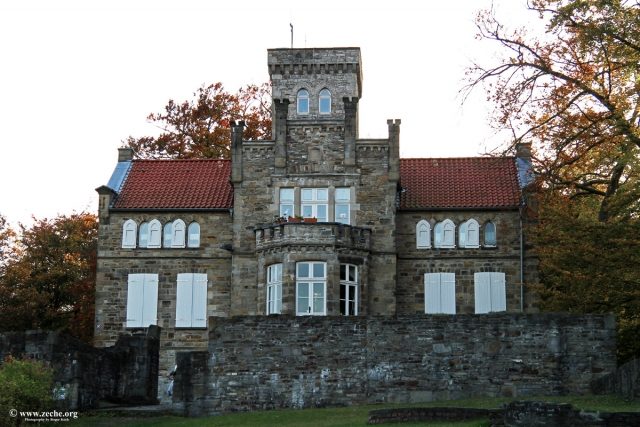
The Isenburg in Hattingen, called Burg Isenberg in old documents, was built for Arnold von Altena (1173–1209) on the Isenberg west of the city between 1193 and 1199. Destroyed in 1225, the castle today remains as a ruin on a steep rocky spur above the Hattingen Ruhr loop. Within the ruins stands the 19th-century country house Custodis.
In the 12th and 13th centuries, the Isenberg had an ideal strategic and traffic-geographical location. It lay between the capital of the Archdiocese of Cologne (50 km) and the capital of the Duchy of Westphalia, Soest (70 km), precisely on the former Hilinciweg (Kleiner Hellweg, west of the castle) and its crossing over the Ruhr at a ford. However, this ford was not on the old long-distance road between Cologne and Soest. Its name still proclaims its connection to iron, literally contained as the Low German "Isen". The castle was also the administrative center of the County of Isenberg.
Layout+
At the time of its construction, the Romanesque complex represented an unusually large fortification. The castle consists of the so-called upper and lower castle, each approximately 120 m long and extending over the ridge of the Isenberg.
Intensive iron smelting took place at the castle at that time. Within its wide walls, the lower castle housed two bloomery furnaces and associated workshops. The only access led through the recessed chamber gate of the lower castle on the Ruhr side. Only the western gate cheek of this gate remains. The eastern part of the gate slipped due to later stone quarrying. In the lower castle, there are also the ruins of a residential tower, a stamping mill (workshop), and a forge. The main gate is integrated into the U-shaped palas of the upper castle. From there, a third gate led to the former "castle garden". Today, this gate leads to nothing - this part of the castle has also slipped down the steep mountain. In the palas building, besides the living quarters of the count's family, there were also the chapel and the so-called Burgmannenhaus (vassal's house).
At the southwestern end of the castle complex is the ruin of the keep. Since the castle was most threatened here by a relatively wide rock plateau, the tower was specially protected by a curtain wall and a neck ditch. This tower, like the keep of the family's ancestral castle, Burg Altena, has a horseshoe-shaped floor plan. With a width of about 20 m, it was one of the largest towers of its kind.
Plaster remnants on the northern wall show that the castle was originally plastered in white.
In a document from the year 1200, the castle is first mentioned as Castrum Ysenberg. Count Arnold's son, Friedrich von Isenberg (1193–1226), adopted the name in 1217. He killed his second cousin, Archbishop Engelbert I of Cologne. As a result, Emperor Frederick imposed the imperial ban and the Pope the excommunication on the Isenberger. The Isenberg castles Novus Pons (Nienbrügge, on the Lippe, west of Hamm) and the Isenburg were then besieged by troops of the vassals of the new Cologne Archbishop Heinrich von Molenark and partly razed to the ground using the slash-and-burn method. On November 14, 1226, one year after the deed, Count Friedrich von Isenberg was publicly executed in Cologne for his act by being broken on the wheel.
To prevent the reconstruction of the Isenburg, Count Adolf I von der Mark, who participated in the siege, had Burg Blankenstein near Hattingen built between 1227 and 1230, reportedly from the stones of the destroyed castle. Today it has been proven that the material of Burg Blankenstein did not come from the Isenburg.
Count Dietrich von Altena-Isenberg, Friedrich's son, however, had the New Isenburg built in Essen in 1241 to assert his supposed hereditary claim to the Vogt rights of the Essen Abbey against the Archdiocese of Cologne. His claim remained unsuccessful. Dietrich was finally enfeoffed with the small County of Limburg.
In 1858, Max Josef Custodis had the country house Custodis, named after him, built over the then not yet excavated ruin of the palas, which served the artist and builder as a summer house. A quarry was operated on the east side until a part of the castle wall also slipped in the early 20th century during a rockslide. In the 1920s, an open-air theater was built south of the neck ditch.
Some parts of the Isenburg were uncovered between 1969 and 1989 by a total of 500 students from the Waldstraße Gymnasium in Hattingen, the so-called "Buddel-AG" (Digging Club) under the direction of Studienrat Heinrich Eversberg. According to an old book by Hentzen, "Berg und Mark," an as yet undiscovered gold treasure is said to be on the property.
Current Use+
Today, the castle ruin is a publicly accessible monument. It can be reached from the higher southern side, past the neck ditch and the keep.
The Association for the Preservation of the Isenburg today not only maintains the castle complex but also operates the museum in Haus Custodis with research and excavation results on the Isenburg. Further finds are exhibited in the Bügeleisenhaus in Hattingen's old town. The museum at the castle is open on weekends. The Isenburg and Haus Custodis are owned by the city of Hattingen. Haus Custodis today serves as the exposed official residence of Hattingen's monument conservator.
Take Mobile History with you
You are reading this text for free. Premium adds what matters on the road: descriptions read aloud, sites found through your camera, whole regions taken offline.
- Every description, including the ~17,700 Premium sites
- Audio guide: have descriptions read to you on location
- AR finder: see sites through your camera, with distance and bearing
- Unlimited saved sites
14 days free, then from €2.99 a month. Cancel anytime.
Source: Wikipedia · Licence: CC BY-SA 4.0 · Image: http://www.zeche.org/
This description draws on the facts documented in the linked Wikipedia article; Wikipedia content is licensed under CC BY-SA 4.0. Wording and editing: Mobile History.
Location: 51.3877, 7.1522