ManorNeuwied - Heddesdorf

Isenburger Hof Manor
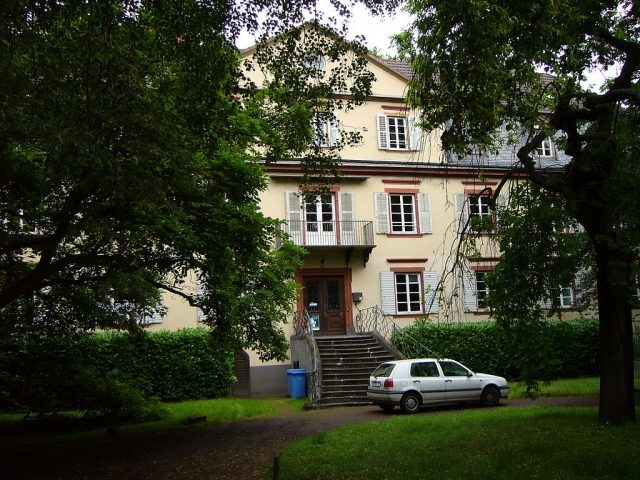
Isenburger Hof Manor

To be privately owned

The Isenburger Hof or Herrenhöfchen is part of Heddesdorf, a district of Neuwied in Rhineland-Palatinate. The former estate is bisected by the B 42 in the area of the Heddesdorf fairground and is partly built with a high-rise building. Today it is known as Landratsgarten.

It remains historically obscure how the initial Isenburger Hof was established in Heddesdorf. It is only certain that the Isenburgers were able to retain ownership of their court in Heddesdorf until 1528.

In 1564, it was reported that the ancestors of the abbot of Marienstatt had formerly lent a sum of money to the convent of the hermitage in Rheinbrohl, for which thirty guilders were then pledged to the monastery people as security. Wilhelm von Witzelnbach was commissioned that year with the settlement of the pending issue. Over a period of 10 years, the parties were involved in resolving this case.

By 1562 at the latest, the name "wiedischer Hof" (Wied court) was already in use. It can therefore rightly be assumed that around this time the counts of Wied acquired the court. As early as 1528, a Wied-Isenburg inventory of the Heddesdorf possessions was drawn up. At that time, the court comprised 63 Morgen. This remained so until 1553. However, the number of properties subsequently decreased, so that in 1643 only 46 Morgen were accounted for. The court's properties were quite scattered, as could be proven in 1589. The already wealthy Heddesdorf citizen Thomas Melsbach had bought several fields with some fellow citizens.

The court included several vineyards and also the so-called Werth (Wörth) on the Rhine. In 1579, Count Johann von Wied pledged the Heddesdorf court for 1000 Reichstaler to his son, Count Hermann. His early death (1591 near Rouen) allowed the court to be used initially by Count Johann Wilhelm von Wied. Upon his death (1633), the court was inherited by his brother Philipp Ludwig von Wied. However, because he ran into considerable economic difficulties, he sold the Heddesdorf court to his mother Magdalena von Hardeck and thus received 6000 guilders. The Countess is considered extremely active in the acquisition of economic assets. Her traces can be found in all parts of the county. Her death in 1657 came too early for the economic recovery of the House of Wied. Her unmarried daughter Johanna Walpurgis, usually just called "the Fräulein", inherited a large part of the accumulated fortune. Despite the covetousness of her cousin, Count Friedrich III of Wied, she bravely held on to her inheritance. When she was struggling with death in Bendorf in 1672, she made Friedrich promise not to alienate the inheritance. Count Friedrich reported in Walpurgis's year of death that the now inherited Heddesdorf court was being used by Christoph von Stein, in whose favor an annual payment of 32 Malter of grain was due. Despite the count's discomfort, the payment was brought from the Wied court in Rems.

The count's economic hardship pushed the promise of Bendorf into the background. In 1683, the count sold the court to Carl Ludwig von Sayn. He paid the purchase price of 4160 Reichstaler as well as a carriage with six horses and a ring worth 400 Reichstaler. Only the Werth on the Rhine remained in the possession of the Wied count, to be united with the castle garden. The Heddesdorf court remained in the possession of the Sayn count until 1761. The count's family also resided there temporarily. Around this time - so it was told - the two unmarried daughters of the Sayn countess lived there in the court house. The house in Heddesdorf was ultimately heavily indebted because imperial military levies increasingly burdened it. For this reason, Count Carl Ludwig von Sayn had already had to pledge the Heddesdorf court to the Rommersdorf abbot Carl Wirtz for 733 Reichstaler in 1698.

The Count of Wied, too, found himself compelled by economic bottlenecks to lease the court immediately after its repurchase (1671) to the active Hermann Dietrich Bachoven. At that time, Bachoven was successfully engaged in property trading in the Wied lands. Mr. Bachoven's heirs soon found themselves embroiled in endless disputes because the court estates were still leased out and the tenants fell behind with the agreed payments. Count Friedrich then bought the court with the promise to raise the burdens of 3696 Reichstaler lying on it to satisfy the creditors. However, the two Sayn daughters, Countesses Carolina and Concordia, were allowed to live on the Heddesdorf court for the time being.

Around 1740, the manor house, which has remained almost unchanged in its original form to this day, was built in the rural Baroque style on the site of the court house. From 1851 to 1906, it served as the seat of the Neuwied district administrator.

Ultimately, Count Alexander von Wied bought the court in 1761 with all its given freedoms, but excluding the adjoining residential house, by paying Count Alexander Ludwig the sum of 15,000 guilders. At that time, the old Sayn house, as the mentioned residential house, was located directly on the ring wall. From then on, the house, court, and estates remained continuously Wied. However, the Sayn residential house was later sold to the Portuguese Count Oliviera. He later bequeathed it to the Wiegershausen family, who soon after sold it to a Mr. von Trott. The latter sold it in 1801 to the Rhenish Baron Johann Justus von Runkel. His son became mayor of Heddesdorf in 1817, and his grandson Eduard Justus von Runkel was appointed district administrator in 1851.

Take Mobile History with you

You are reading this text for free. Premium adds what matters on the road: descriptions read aloud, sites found through your camera, whole regions taken offline.

  • Every description, including the ~17,700 Premium sites
  • Audio guide: have descriptions read to you on location
  • AR finder: see sites through your camera, with distance and bearing
  • Unlimited saved sites

14 days free, then from €2.99 a month. Cancel anytime.

Location: 50.4419, 7.4655