College of Design Offenbach
Isenburger Castle (Offenbach)
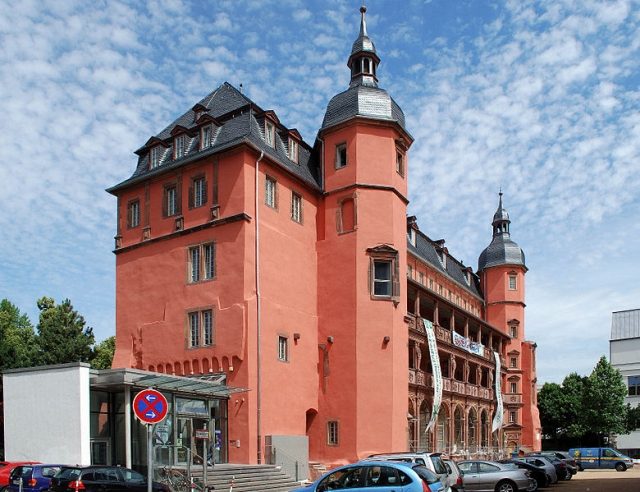
Isenburg Castle is a Renaissance castle in Offenbach am Main. The medieval noble family Isenburg had it built in the 16th century. Among art historians, Isenburg Castle is considered a remarkable Renaissance object. This is evident from the differently designed facades on the north and south sides of the castle. The south side, facing the city, presents itself as a relaxed Renaissance facade with arcades between two stair towers, while the north side, facing the Main river, shows a defensive facade made from parts of the older building fabric. The castle was once planned as a four-wing castle. However, this construction project was never realized.
The moated castle built by Count Werner III of Falkenstein in 1394 is considered to be its predecessor.
Isenburg Castle was completed in 1559. It burned down shortly after its completion in 1564. The subsequent reconstruction is responsible for the galleries on the south side of the castle that are still preserved today. Historically significant congresses were held in the castle several times, for example in 1741 for the reform of the Imperial Constitution. During the Thirty Years' War, Isenburg Castle also played a role in relation to the neighboring city of Frankfurt am Main. King Gustav II Adolf of Sweden resided here and tried to persuade the Frankfurt councilors to surrender the city. Until 1883, the landscape and history painter Leopold Bode had a studio in the castle, and later the building also played a significant role in the painter's work.
In 1900, the castle passed from private ownership into the possession of the Grand Duchy of Hesse-Darmstadt. At the end of World War II, the castle was severely damaged.
Under the direction of architect Paul Friedrich Posenenske, the castle was rebuilt from 1952 to 1956 (begun by Erwin Schwarzer) and prepared for use as a state building authority. Externally, numerous details were elaborately restored, but later ornamental forms were removed. Inside, a modern, contemporary interior was created with high-quality object furniture. In 1977, the castle was painted in an orange-red color. Around 2000, the castle was renovated internally again by INDEX Architekten, and from 2007, a facade renovation took place, which has recently been completed.
Current Use+
Isenburg Castle is now part of the campus of the Offenbach University of Art and Design. The areas of painting and photography as well as the computer workstation are housed here. The ground floor is kept free for events.
Take Mobile History with you
You are reading this text for free. Premium adds what matters on the road: descriptions read aloud, sites found through your camera, whole regions taken offline.
- Every description, including the ~17,700 Premium sites
- Audio guide: have descriptions read to you on location
- AR finder: see sites through your camera, with distance and bearing
- Unlimited saved sites
14 days free, then from €2.99 a month. Cancel anytime.
Source: Wikipedia · Licence: CC BY-SA 4.0
This description draws on the facts documented in the linked Wikipedia article; Wikipedia content is licensed under CC BY-SA 4.0. Wording and editing: Mobile History.
Location: 50.1079, 8.7648