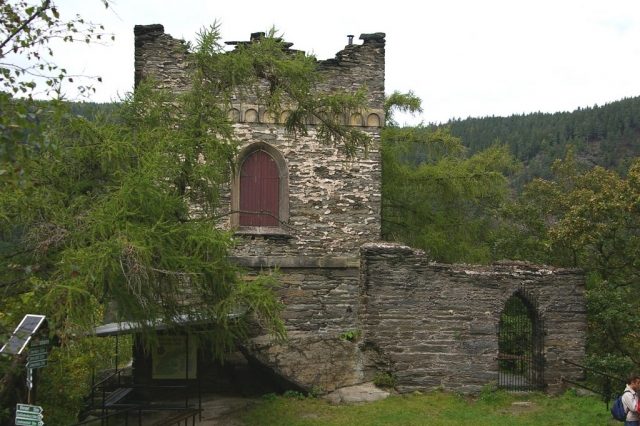
CastleBad Blankenburg

Eberstein Castle

Eberstein Castle

The remains of the Castle can be visited

The Historic Building: A Journey Through Time+
From Princely Residence to Public Property+

The castle was built in 1844 by the Princes of Schwarzburg-Rudolstadt. In 1945, the owners were dispossessed and expelled by the Communists.

Construction and Early Years

The construction of the castle began in 1840 under Prince Albert of Schwarzburg-Rudolstadt. It was intended as a summer residence and hunting lodge. The architectural style is a blend of Neo-Gothic and Romantic Classicism, characteristic of the period.

The princely family used the castle extensively for receptions, balls, and hunting parties. It quickly became a social hub for the regional aristocracy.

The Tumultuous 20th Century+

With the end of World War I and the collapse of the monarchy in Germany, the castle's role began to change. While it remained in the family's possession, its political significance diminished.

World War II and Expropriation

During World War II, parts of the castle were used to house refugees. In 1945, with the advance of the Soviet army and the subsequent establishment of the communist regime in East Germany, the princely family was expropriated without compensation and forced to leave their ancestral home.

The castle, along with all its contents, became state property. Many valuable artifacts were dispersed or lost during this period of upheaval.

Post-War Period and New Uses+

After the war, the castle served various purposes under the communist government.

From Sanatorium to Museum

Initially, it was converted into a sanatorium for tuberculosis patients. Later, it housed a vocational school. In the 1970s, a decision was made to transform it into a museum, focusing on regional history and the castle's past.

Extensive renovation work was undertaken to restore parts of the castle to their former glory and adapt other areas for exhibition spaces.

The Present Day+

After the reunification of Germany in 1990, the castle's ownership was transferred to the state of Thuringia. It continues to operate as a museum and a cultural center.

A Cultural Landmark

Today, the castle is a popular destination for tourists and locals alike. It hosts various exhibitions, concerts, and events throughout the year. The beautiful castle park is also open to the public, offering a serene escape.

Efforts are continuously made to preserve the historical substance of the building and to make its rich history accessible to a broad audience.

Take Mobile History with you

You are reading this text for free. Premium adds what matters on the road: descriptions read aloud, sites found through your camera, whole regions taken offline.

  • Every description, including the ~17,700 Premium sites
  • Audio guide: have descriptions read to you on location
  • AR finder: see sites through your camera, with distance and bearing
  • Unlimited saved sites

14 days free, then from €2.99 a month. Cancel anytime.

Location: 50.6678, 11.2499