Apartment
Cafe
Friedrichsthal Castle

Friedrichsthal Hunting Lodge is a former hunting residence of the Mecklenburg Grand Duke Friedrich Franz I in Friedrichsthal, a present-day district of Schwerin. The hunting lodge and the cavalier houses, which formerly belonged to the castle complex, are listed buildings. The castle is located on the northwestern outskirts of Schwerin, directly on Federal Highway 104 leading to Gadebusch, about 400 meters north of Lake Neumühler See. The ditch "De Kanal", which runs behind the hunting lodge, flows into this lake. To the south and southwest, mixed forests adjoin the area. The northern and eastern surroundings are characterized by single-family housing estates.
Structure+
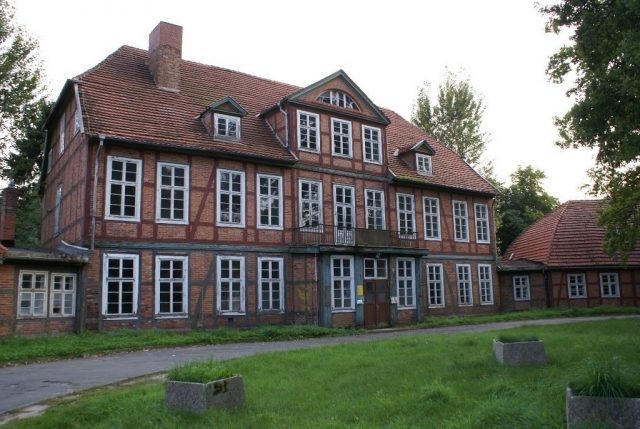
The Friedrichsthal Hunting Lodge is a two-story half-timbered building, whose origins date back to 1790. The main house is covered with a half-hipped roof, from which a dormer with a gable roof running transversely to the ridge of the main roof rises in the middle. In addition, there are two gable dormers on the north side facing the street. The entrance porch of the house was added later and is emphasized by a balcony. The two single-story, semi-circular projecting wing buildings, erected in 1798, are also constructed in half-timbering and equipped with plank truss roofs and eyebrow dormers. These outbuildings were later structurally connected to the central house.
Opposite the castle, on the other side of the street, are two former, single-story half-timbered cavalier houses, which were significantly altered structurally in 1995/96.
Around 1790, the then government councilor August Georg von Brandenstein bought land west of the Hellkrug inn, which had existed since 1722, for which he concluded a 24-year lease agreement in 1790, and had a summer house built there. After several changes of ownership, Friedrich Franz I acquired this building with its plot of land in 1797 for 4000 Thalers. In view of the game-rich surroundings, he had it converted into a hunting lodge. The castle complex was extended in 1798 by two semi-circular side wings, which served as a carriage house and stable, and later by the two cavalier houses for the master of the hunt and the pack, as well as stables. In 1805, the main building was raised by one story according to plans by Johann Chornelius Barca, the father of Johann Georg Barca. However, the hunting lodge was little used by the Grand Duke and was therefore made available to associations and citizens. The last court hunt is said to have taken place in 1822. Efforts in the following years to sell the castle came to nothing.
In 1914, soldiers in need of recuperation were accommodated here; from the First World War onwards, the west wing served as a home for war orphans; in 1936, the castle was handed over to the Kyffhäuserbund as a "warriors' home". From 1945, the hunting lodge functioned as a tuberculosis sanatorium and finally, until after the reunification, as a retirement home. The building, which had been vacant since 1993 and was in need of renovation, was sold at the end of 2010 to a Berlin investor, who plans, among other things, a café there.
Of the landscape park, which extended to Lake Neumühler See, the southern part was cleared in 1945 to provide reparations to the Soviet Union, and from 1948 onwards it was settled as part of the land reform; later, this area was developed with residential and weekend houses. Since 2008, the restoration of the remaining park area to enhance the residential environment has been discussed.
Miscellaneous+
The interior included the scenic wallpaper "La chasse à Compiègne" (The Hunt of Compiègne), which was printed in Paris in 1814 after designs by Antoine Charles Horace Vernet and acquired by Grand Duke Friedrich Franz I in Hamburg. It depicts scenes of a courtly red deer hunt. It is assumed that this hunting wallpaper is the only surviving example of this print. The wallpaper was moved and has been on display, with a brief interruption, in Friedrichsmoor Hunting Lodge in the district of the same name in the town of Neustadt-Glewe since 1964.
In the castle park, a memorial stone for Karl Axel von Monroy (* March 17, 1880) is preserved. He was a ministerial assessor and died, after being drafted as a reserve officer in World War I, on February 6, 1915, in a field hospital in Noyon in northern France. His grave is located in Nampcel. The memorial stone in Friedrichsthal was erected one year after his death.
Take Mobile History with you
You are reading this text for free. Premium adds what matters on the road: descriptions read aloud, sites found through your camera, whole regions taken offline.
- Every description, including the ~17,700 Premium sites
- Audio guide: have descriptions read to you on location
- AR finder: see sites through your camera, with distance and bearing
- Unlimited saved sites
14 days free, then from €2.99 a month. Cancel anytime.
Source: Wikipedia · Licence: CC BY-SA 4.0 · Image: Roland Neubert, Halle (Saale)
This description draws on the facts documented in the linked Wikipedia article; Wikipedia content is licensed under CC BY-SA 4.0. Wording and editing: Mobile History.
Location: 53.6524, 11.3274