CastleBensheim - Auerbach

Fürstenlager Castle
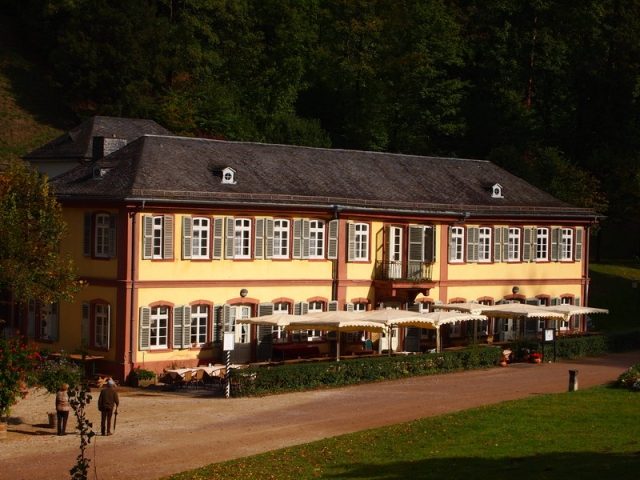
Fürstenlager Castle

Hotel
Restaurant
Cultural Events


The Fürstenlager, also known as Fürstenlager Auerbach, was built around 1790 by the Landgraves and Grand Dukes of Hessen-Darmstadt in Auerbach, a district of Bensheim an der Bergstraße since 1939, as a summer residence for the Landgraviate.

In a park of about 42 hectares, with over 50 exotic trees and shrubs, a variety of court buildings are arranged in the manner of a village. The park is an early English garden in Germany, embedded in a hilly landscape. The garden art ensemble is largely preserved in its original form. Today, the park is a popular local recreation area for the population in the Rhine-Main region. The name comes from the designation of the residence by the population, who could observe their lords camping in the meadows here. For the park was not strictly delimited, but also open to the public during the "state visits".

The small, steadily rising side valley of the Roßbach, in which the Fürstenlager is located, branches off to the right from the L 3103 in Auerbach, following the Bachgasse, which continues through the Mühltal into the Odenwald. If you follow the valley through the Fürstenlager, the path leads to the Felsberg with the Felsenmeer. From the surrounding mountain ridges, you can see the nearby Auerbach Castle, Schönberg Castle, and Starkenburg Castle.

In Bachgasse in Auerbach, there are some parking facilities for buses and cars. From here, it's about a 10-minute walk to the Fürstenlager.

The Buildings of the Residence+

The most important buildings in the State Park are:

  • Manor house with a building behind it for the chamberlains. After a thorough renovation, a restaurant in the style of a country inn will be located in the manor house from May 2014.
  • Prinzenbau and Damenbau are arranged symmetrically along the main axis.
  • Guardhouse
  • Dairy farm
  • Confectionery building
  • Cavalier building
  • Guest house (today, in addition to administration and a small museum, also a registry office)

Scattered throughout the park are other buildings such as:

  • Health spring
  • Hermitage
  • Mushrooms
  • a grotto
  • the Luise Monument
  • a Friendship Altar
  • an ice cellar (tunnel)

The Goethebrunnen is located outside the park in the Hochstädter Tal

No longer preserved are:

  • Tea house
  • Small temple
  • a small Russian chapel

Most buildings do not have basements.

The Park+

In addition to the already mentioned redwood, other foreign vegetation worth mentioning includes swamp cypresses, Japanese cedars, dark-flowering magnolias, bush chestnuts, and ginkgos. The park begins at the end of a typical village street that narrows uphill at the eastern edge of the Rhine plain (Bachgasse from Auerbach to Hochstädten). The west-east direction ends in a hairpin bend leading to a narrow north-south side valley, whose main path is lined by an avenue. A wooden arched bridge in Asian style, leading over the outflow of a fish pond to the right slope, marks the beginning of a today almost unique complex. The complex, in its character, forms an intermediate solution between the regional village culture of the time and the residential complexes of that era. After the Cavalier building and the coach house, an expansion into a double avenue leads to the tree hall of plane trees, which allowed the entire court to stay in its shade during the summer months. The most important economic buildings are connected here.

In an expansion of the small valley into a basin, next to the spring enclosure, stands the manor house in front of a small pond and a large uphill meadow, lined with exotic plants. The Sequoia, a type of cypress, has now reached a height of 53 meters and was given to the Hessian Landgraves for their park about 150 years ago as a gift from the English royal family, shortly after the tree species was imported to Europe. Here it was planted halfway up the slope. This redwood is thus probably the oldest in Germany and possibly on the continent. The paths allow for various walks and sightlines. At the upper edge are viewpoints north and south along the Bergstraße and as far as the Kalmit (Palatinate) in the west. Nearby are the castle ruins of Auerbach Castle and Schönberg Castle of the Counts of Erbach. The path connection to the Felsenmeer in the Odenwald, 5 km away, is also characteristic of the complex. The slope behind the manor house was planted as a vineyard. A local single vineyard still bears witness to the historic Fürstenlager today. Almost all viewpoints received a small superstructure or at least benches.

In 1730, the district physician Johann David pointed out a small iron-containing spring in the Roßbach valley. In 1739, excavations took place there for the first time, during which three adjacent springs were found and prepared for bathing. In 1740, the spring silted up. In 1766, it was reopened. In 1767, the rotunda-shaped spring enclosure of the Health Spring, which is still preserved today, was built. In 1768, two residential pavilions were built and the first avenues were laid out. Another health spring (today the Goethebrunnen) was built outside the park in the Hochstädter Tal. In 1783, the ailing Hereditary Prince Ludwig and his wife Luise visited the Fürstenlager for the first time. After the prince's recovery, the couple regularly spent the summer months in the Fürstenlager. During the construction activities between 1790 and 1795, all buildings except the Guest House were built.

The Auerbach mountain church, located above the Fürstenlager, was used as a court church. Due to close family ties with the Tsar's court, the Romanovs and other Russian princes spent long periods in the region and in the Fürstenlager.

After the death of the ducal couple in 1829/30, the great era of the Fürstenlager was over. The mineral content of the spring decreased, and there was only limited spa operation. In 1918, the Fürstenlager became the property of the People's State of Hesse. It was temporarily used as a military hospital. After the Second World War, refugees were accommodated here. In 1953, the State Palaces and Gardens of Hesse took over the administration of the properties.

From a cultural and art-historical perspective, the Fürstenlager, in its completely preserved entirety, is of high value today. The plans and planting lists of the original furnishings and later changes are largely completely preserved and allow for renovation adapted to the original, which has been taking place for several years. The administration of the State Palaces and Gardens renovated the manor house and the surroundings of the representative building for 1.3 million euros. In addition, the entire park is being redesigned according to the model of an English landscape garden, and the historical sightlines are being reopened.

For several years, the park has also been the venue for the Auerbach Festival and summer plays in the Fürstenlager.

Take Mobile History with you

You are reading this text for free. Premium adds what matters on the road: descriptions read aloud, sites found through your camera, whole regions taken offline.

  • Every description, including the ~17,700 Premium sites
  • Audio guide: have descriptions read to you on location
  • AR finder: see sites through your camera, with distance and bearing
  • Unlimited saved sites

14 days free, then from €2.99 a month. Cancel anytime.

Source: Wikipedia · Licence: CC BY-SA 4.0 · Image: http://www.wehrbauten.de/thread.php?threadid=984

This description draws on the facts documented in the linked Wikipedia article; Wikipedia content is licensed under CC BY-SA 4.0. Wording and editing: Mobile History.

Location: 49.7001, 8.6336