To be privately owned
Luitpoldshöhe Castle

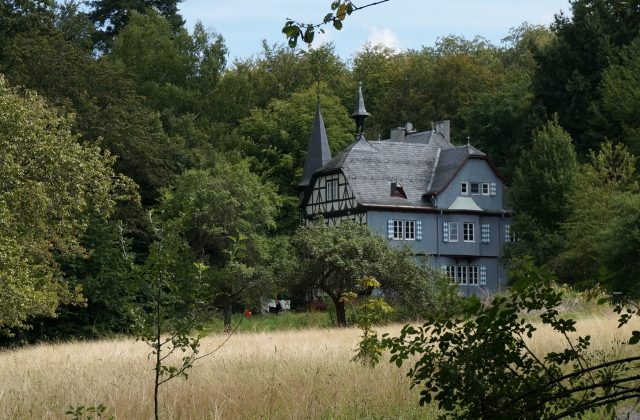
Luitpoldshöhe Castle was built in 1889 by Prince Regent Luitpold of Bavaria as a hunting lodge in the Spessart forest near Rohrbrunn. The castle is located in the district of Aschaffenburg in an area that belongs to the municipality of Weibersbrunn, but forms an exclave in the unincorporated area of the Rohrbrunner Forst. The Rohrbrunn motorway service station on the A 3 is in the immediate vicinity, and the castle can be seen from the motorway. Not far from the castle, in the forest, is the Dianalust hunting lodge.
The design of the castle came from the royal senior building officer Ritter von Siebert, who conceived it as a Franconian half-timbered house. The executing master builder was Karl Buchner from Würzburg, who exclusively employed Würzburg craftsmen and artists. This resulted in a building that on the one hand was based on the local Franconian style, but on the other hand was also recognizable as a representative building.
The Builder+
From 1886 until his death in 1912, Luitpold was initially for only a few days the ruler of the Kingdom of Bavaria as representative of his incapacitated nephew King Ludwig II, and thereafter as representative of Ludwig's mentally ill brother Otto I.
The people were initially very reserved towards the Prince Regent, as Ludwig II, who had been incapacitated under dubious circumstances and died shortly thereafter under equally dubious circumstances, had been very popular.
However, Luitpold managed to make himself popular throughout the country through his numerous appearances and hunting activities. Luitpoldshöhe Castle was his most important station in the Spessart, where large royal hunts, especially for wild boars, took place. During his hunts, the Prince Regent sought contact with the people and combined his appearances with charitable activities. He visited poor forest farmers and donated to children in the villages of the respective surrounding areas.
Architectural Description+
Due to the state finances heavily strained by Ludwig II, Luitpoldshöhe Castle was not very opulent. The castle has 19 rooms, almost all of which are paneled with wood. It is a larger half-timbered building, which was shingled on the weather side. As special features, the building received a bay window with a turret roof and a roof turret with a bell. The bell was originally rung upon the arrival and departure of the Prince Regent. The construction cost only 37,000 Marks and was considered a symbol of the Prince Regent's frugality in comparison to the extravagance of his predecessor, the "fairy tale king" Ludwig II.
After the end of the monarchy in 1918, the building, with 400 square meters of usable space, became the property of the Bavarian Forest Administration and served as the official residence of the respective forest office director of Rohrbrunn from 1920 to 1996. The property became vacant when the Rohrbrunn forest office was dissolved and its forest districts were incorporated into the districts of Altenbuch, Marktheidenfeld, and Rothenbuch. Thereafter, the building stood empty for several years, and the 26,600 square meter plot of land remained unused.
Long Vacancy+
After ten years of vacancy and decay, the Bavarian Administration of State Palaces, Gardens and Lakes announced in spring 2006 that it had no interest in the building, as its artistic and historical value was low. This led to numerous protests from citizens and local politicians in the area, as the memory of Prince Regent Luitpold is still very much alive in the Spessart, precisely because of his popular appearances combined with charitable actions.
In April 2006, several CSU state parliament members submitted a motion to the Bavarian state parliament to refrain from selling the castle and to develop a concept for its use. The building represents the region's relationship with Bavaria and, alongside the Pompejanum in Aschaffenburg, is the only significant Wittelsbach building in Lower Franconia.
In September 2007, it became publicly known that the Bavarian Palace Administration intended to sell the building together with the adjacent forest lodge, built between 1957 and 1961. In addition to the offered purchase price, the concept for use should also be decisive in the selection of a specific buyer.
In April 2008, the municipal council of Weibersbrunn dealt with two preliminary building inquiries for a possible new use of the forest lodge belonging to the castle. In this context, it also became known that purchase offers had already been received for the castle.
New Owner+
In August 2011, the real estate company of the Free State of Bavaria announced that a private individual had acquired the building for a price of 250,000.00 Euros. He intended to live there with his family and had already registered with the responsible residents' registration office.
Take Mobile History with you
You are reading this text for free. Premium adds what matters on the road: descriptions read aloud, sites found through your camera, whole regions taken offline.
- Every description, including the ~17,700 Premium sites
- Audio guide: have descriptions read to you on location
- AR finder: see sites through your camera, with distance and bearing
- Unlimited saved sites
14 days free, then from €2.99 a month. Cancel anytime.
Source: Wikipedia · Licence: CC BY-SA 4.0 · Image: Reinhold Schulz
This description draws on the facts documented in the linked Wikipedia article; Wikipedia content is licensed under CC BY-SA 4.0. Wording and editing: Mobile History.
Location: 49.8919, 9.3973