Museum
ResidenceDresden-Neustadt
Japanese Palais
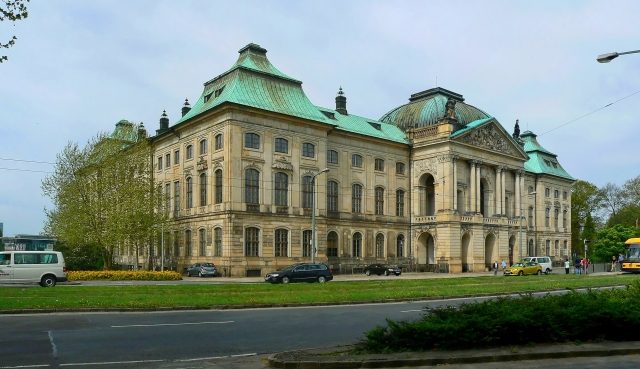
In Dresden-Neustadt, the Japanese Palace is a residence. Originally built as a country house, it evolved into a structure that now serves as a museum building, housing various collections.
History+
The origins of the Japanese Palace date back to 1715, when Rudolph Faesch built a country house for Jakob Heinrich Count von Flemming. Briefly known as the Dutch Palace, it passed into the possession of Augustus the Strong in 1717, who intended to house his porcelain and art collections there. After another change of ownership, the palace returned to Augustus the Strong in 1726, who commissioned extensive renovation plans. Between 1727 and 1733, architects Matthäus Daniel Pöppelmann, Zacharias Longuelune, and Jean de Bodt transformed the building into a late Baroque-classical four-wing complex. It received the name “Japanese Palace” in 1732, inspired by its Far Eastern-style roof and Asian elements in the facade design. During the Seven Years' War, the palace suffered significant damage.
Source: Wikipedia · Licence: CC BY-SA 4.0 · Image: Thomas Eichler
This description draws on the facts documented in the linked Wikipedia article; Wikipedia content is licensed under CC BY-SA 4.0. Wording and editing: Mobile History.
Location: 51.0597, 13.7379