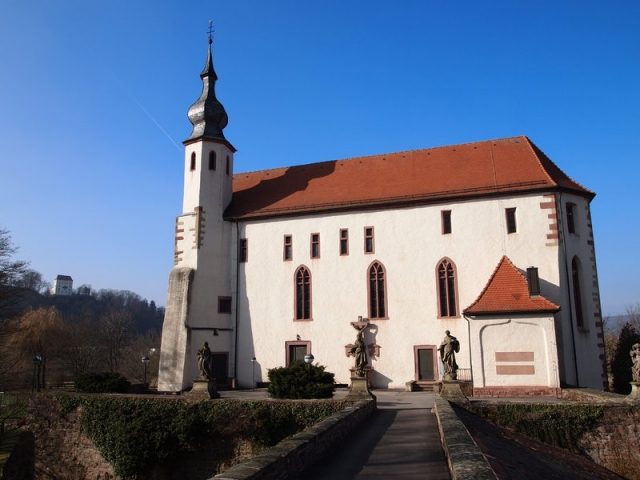
Church
Castle Neckarelz

The Tempelhaus near the Neckar river in Neckarelz, Baden-Württemberg, dates back to the medieval residential tower of a Knights Hospitaller castle, formerly known as Burg Elz. The building, called Tempelhaus since the late 16th century, is the second oldest building in Mosbach after Burg Lohrbach and the only Knights Hospitaller castle in Baden-Württemberg preserved in its authentic form. Among the art treasures of the building, which is used as a Catholic church, is the Conradusstein, a tombstone from around 1300.
The earliest mention of the presumably even older lowland castle appears in a document from June 11, 1300, stating that the Knights Hospitaller had their settlement in the already existing building. The origin of the complex can only be surmised. It is assumed that a residential tower was built around 1200, probably in connection with the nearby Staufer imperial palace of Wimpfen. The tower was surrounded to the north and west by the old course of the Elz river, and to the south and east by a slightly elevated moat.
The Order of St. John probably took over the castle towards the end of the 13th century and expanded it into a hospital with an associated chapel (the present choir), but after only about 50 years, on February 5, 1350, it was sold to Engelhart von Hirschhorn. In 1422, the complex was owned by the Count Palatine of Mosbach, and in 1500, it passed to the Electoral Palatinate. In 1581, the complex, which had long been used as a warehouse and winery, was first referred to as Tempelhaus by the Electoral Palatinate cellar master Hans Albrecht Eysenmenger. In 1606, the ground floor received an external access to be more easily accessible for storage purposes.
After a change of faith in the Electoral Palatinate in 1688, Catholic services were held again for the first time in the old castle chapel, while the rest of the building continued to be used as a barn and granary. In 1698, Elector Johann Wilhelm decreed the simultaneum for the nearby Martinskirche, so that Catholics also used it, before they were finally granted the eastern part of the Tempelhaus as a church during the Palatine Church Division in 1705, which they solemnly occupied in 1707. Initially, there was no direct access to the chapel; the only access led through winding paths through the storage rooms. Only from 1731-35 was the entire first floor converted into a church, and the church was consecrated in 1737 in honor of the Assumption of Mary. The church did not have a bell until 1875; instead, the Catholics made use of the right to ring the bells in the Protestant Martinskirche.
In 1803, the complex came into the possession of the Principality of Leiningen, and in 1872, the Catholic parish of Neckarelz acquired the complex and added a sacristy in 1879. Parts of the building continued to be used as a granary; as late as 1903, the ground floor was rented to a nursery. Between 1926 and 1929, the cellar was converted into a lower church, and a second gallery was added in the main church space after the removal of an 18th-century wooden ceiling.
After the Second World War, the Catholic community in Neckarelz grew significantly due to the influx of refugees, so that in 1955, the new Marienkirche was built in the town and became the parish church of the community. From 1963 to 1965, extensive renovations took place at the Tempelhaus, during which a wooden ceiling was again installed in the church space to allow the upper floor to be used again and the chapter room to be more easily accessible. In 2001, load-bearing walls were renovated, and the original 14th-century color scheme was restored in the interior.
Description+
The Tempelhaus is an elongated, multi-story stone building. Access to the church interior is via a stone bridge and a forecourt from the south, where some stone figures from 1752 are located. The polygonal choir with Gothic tracery windows and a ribbed vault is oriented to the east. The ribbed vault features ornate keystones, and the choir is decorated in a 14th-century color scheme. A historical fresco of Saint Christopher has been uncovered on the south wall of the choir. Historical noble coats of arms are preserved in the window walls of the nave, which makes up the rest of the floor area.
A historical tombstone, the so-called Conradusstein, is embedded in the north wall. Its inscription cannot be interpreted with certainty. According to recent research, it is the tombstone of a Konrad von Büchel, who died in 1302 and is said to have been the founder of the order castles in Neckarelz and Boxberg.
A stair tower is attached to the building in the southwest corner. This provides access to the upper floor, which again features a ribbed vault in the polygonal space above the choir. Various historical exhibits from the history of the Tempelhaus are displayed on the upper floor, including a historical altar.
Take Mobile History with you
You are reading this text for free. Premium adds what matters on the road: descriptions read aloud, sites found through your camera, whole regions taken offline.
- Every description, including the ~17,700 Premium sites
- Audio guide: have descriptions read to you on location
- AR finder: see sites through your camera, with distance and bearing
- Unlimited saved sites
14 days free, then from €2.99 a month. Cancel anytime.
Source: Wikipedia · Licence: CC BY-SA 4.0 · Image: http://www.wehrbauten.de/thread.php?threadid=1629
This description draws on the facts documented in the linked Wikipedia article; Wikipedia content is licensed under CC BY-SA 4.0. Wording and editing: Mobile History.
Location: 49.3417, 9.1030