CastleDüsseldorf-Kaiserswerth

Royal Palace Kaiserswerth
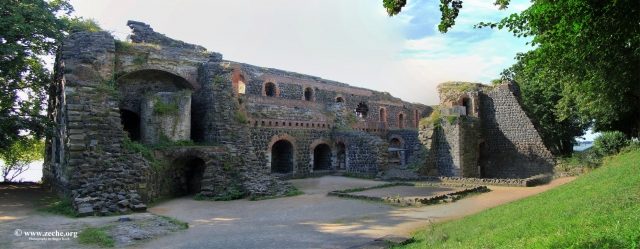
Royal Palace Kaiserswerth

The remains of the Castle can be visited


The ruin of the Imperial Palace of Kaiserswerth is located in the Kaiserswerth district of Düsseldorf. The palace dates back to a monastery foundation by the monk Suitbert(us) around 700. At that time, the Frankish Mayor of the Palace Pippin the Middle and his wife Plektrudis gifted the Anglo-Saxon monk an artificially created Rhine island, formed by encircling an old arm of the Rhine, where a Frankish royal estate – protected by an earth wall, moat, and palisades – already existed. This developed over time into a fortified customs fortress. On December 23, 1982, the complex was entered into the city's list of monuments in the category of castles, manor houses, fortifications, and palaces.

The name Kaiserswerth derives from the Middle High German word "werth" for island. It thus means "Emperor's Island" or "Island of the Emperor."

Development into a Royal Court

The location of the court and monastery was well chosen: on the one hand, the Rhine is easily surveyable there, and on the other hand, two important trade routes converged there: the Hellweg into the interior of Germania and the old Roman trade route between Xanten and Neuss.

In 1016, a castle located there was first mentioned in a document. In that year, Emperor Henry II reconciled with Count Palatine Ezzo and gifted him Kaiserswerth, including the castle. Ezzo's son Otto died in 1047 without heirs, and so the territories reverted to the Empire.

Henry III had the existing castle expanded into a palace shortly thereafter. By 1050, construction had progressed far enough that he and his retinue could stay there for some time. Until his death in 1056, Henry III demonstrably visited Kaiserswerth four more times. However, this first Salian complex has completely disappeared today.

The Royal Kidnapping of Kaiserswerth

After his death in 1056, Henry III left behind his six-year-old son Henry IV. His mother, Agnes of Poitou, continued the regency for her underage son, which met with disapproval from numerous imperial princes. At the head of a group of conspirators, Archbishop Anno II of Cologne therefore had Henry IV kidnapped during a visit to Kaiserswerth in 1062, during the coup of Kaiserswerth, to bring him under his influence. Consequently, Henry's relationship with the church was strained throughout his life. And he visited the palace only one more time in his life: for the assembly of princes in 1101. Subsequently, Kaiserswerth lost its significance for almost 100 years.

Frederick Barbarossa and Henry VI

In 1174, Emperor Frederick Barbarossa moved the Rhine customs from the Dutch city of Thiel to Kaiserswerth. For this purpose, he had Kaiserswerth expanded into a mighty fortress, the completion of which, contrary to common belief, did not occur in 1184, but probably only in 1193 under his son Henry VI. The visible remains of the Imperial Palace today date from that period.

However, the complex was not designed as a permanent residence, and so only a single stay by Barbarossa on April 22, 1158, is verifiable. Nevertheless, numerous documents issued in Kaiserswerth bear witness to stays by later emperors, such as Henry V, Conrad III, Henry VI, Otto IV, and Henry VII.

After its expansion by Emperor Barbarossa, the palace consisted of a three-story palas, in the center of which was a mighty keep. The main entrance was in the Klever Tower, located northeast of it. A semicircular curtain wall with a moat and two corner towers provided protection from the land side.

The End of the Island Location

After the death of Henry VI, the Imperial Palace came into Cologne-Welf hands. Otto IV held prominent prisoners here; for example, in 1213, Bishop Otto I of Oldenburg. His friend, Count Adolf III of Berg, tried unsuccessfully five times to free him through attacks "from the water." On his sixth attempt in 1215, he resorted to a trick: he had the artificial arm of the Rhine, which made Kaiserswerth an island, diverted south of the city. The riverbed was thus drained, and the palace could now be attacked from the land side, and the Bishop of Münster freed.

In 1247, Count William of Holland, elected anti-king to Frederick II, besieged the complex for a year. Its defenders ultimately had to surrender, probably because their food supplies had run out.

Pledges

After the decline of imperial power, Kaiserswerth, including its palace complex, was continuously pledged from 1273 onwards. Until 1424, the city and palace were in Dutch possession, then both belonged to Electoral Cologne, the Duchy of Cleves, or Jülich-Berg. These rather short periods of ownership were followed by a 350-year continuity of belonging to Electoral Cologne, which had acquired both for 100,000 guilders. The palace and city of Kaiserswerth were thus an important Electoral Cologne exclave in the Rhenish Duchy of Jülich-Berg. Under Salentin von Isenburg, the complex was expanded and rebuilt between 1567 and 1577, but in 1655, some buildings of the palace, including the palace chapel, were destroyed by a powder explosion.

The War of the Palatine Succession

During the War of the Palatine Succession, the then owner of the castle, the Elector of Cologne Joseph Clemens of Bavaria, sided with Louis XIV. As a result, an army of Brandenburg, Dutch, and Münster troops besieged Kaiserswerth from April 1689 and bombarded the Imperial Palace. On June 25, its French commander Marconier had to capitulate because a fire had destroyed the city's food supplies.

The palace had been severely damaged by the shelling and was subsequently repaired. However, it reverted to Electoral Cologne as early as 1692.

The War of the Spanish Succession

In 1702, the War of the Spanish Succession broke out. The Elector of Cologne, Joseph Clemens, again sided with France, thereby making an enemy of the Duke of Jülich-Berg, Johann Wilhelm II (also known as Jan Wellem), who was Elector Palatine and Arch-Steward of the Holy Roman Empire. In the spring, Kaiserswerth was besieged by troops from Brandenburg, the Netherlands, and England, who captured it on June 15, 1702.

12,000 cannon shots had left their clear marks: almost all houses in the city were destroyed, and the palace complex was again severely damaged. By order of Johann Wilhelm II, it was razed and blown up on August 9. This explosion also claimed the mighty keep, and the land side of the complex was completely destroyed thereafter. At low water, large masonry blocks are still visible today in the gravel bed on the riverbank. The mighty portal stone, which was located above the main entrance, was taken to Düsseldorf as spoils of war and displayed for 150 years in the courtyard of Benrath Castle there. It is now back on the grounds of the Imperial Palace. One of its two inscriptions reads: "In the year 1184 after the incarnation of our Lord Jesus Christ, Emperor Frederick increased the Empire with this adornment, willing to strengthen justice and that peace should reign everywhere."

However, through the Peace of Rastatt, Kaiserswerth reverted to the Electorate of Cologne in 1714. In 1838, the Imperial Palace was then taken over by the city of Kaiserswerth.

The 19th and 20th Centuries

For almost two centuries, the remaining ruins served as a quarry for the city houses, so that by the mid-19th century, the eastern side of the complex had been dismantled down to its foundations. In 1884, the construction of a flood dam, which ran across the palace grounds, destroyed further building fabric.

The then provincial conservator Prof. Paul Clemen began excavations and restoration work in 1899, which lasted until 1908. After that, the ruin fell into a Sleeping Beauty slumber again. During the Third Reich, the palace served as a national memorial, before further safeguarding work followed between 1967 and 1974.

During the National Socialist era, the palace ruin served as a regular meeting point for the Düsseldorf Hitler Youth (HJ), who held propaganda events and nocturnal torch illuminations there. The HJ "place of honor" was inaugurated as early as 1933 by Baldur von Schirach. There was a memorial plaque for 21 killed Hitler Youth members and an "eternal" Schlageter flame in memory of the Freikorps fighter and right-wing extremist saboteur Albert Leo Schlageter.

In 1958, the French painter Georges Mathieu used the backdrop of the Imperial Palace for an art action called "The Abduction of Henry IV by Archbishop Anno of Cologne from the Imperial Palace at Kaiserswerth": Assisted by Hans Peter Reuter, who carried a red cushion with paintbrushes, he solemnly walked through the ruin of the palace at dawn, dressed in a red coat. Afterwards, he threw the brushes from the highest point of the ruin into the Rhine. The action was documented by the photographer Charles Wilp.

The Palace Today+

In connection with Kaiserswerth's 1300th anniversary celebration, the palace ruin was restored once again from 1997 to 2001. The northern and southern parts are preserved, while no above-ground traces of the eastern half of the complex still exist.

The six-meter-thick western front of the palas, located on the Rhine side, still has a width of 50 meters and a height of 14 meters despite the destruction. In its heyday, the building had one more floor than its currently preserved wall shows. It was built from irregular basalt blocks from the Drachenfels and tuff stone. While large bricks were used for the construction of round arches and vaults, gray trachyte ashlar served as cornerstones and window frames. An ancient inscription in the castle proves its origin: "As trachyte, I rushed from the Drachenfels, opening the doors to both skilled boatmen and settlers."

Archaeologists assume that the ground floor of the palas housed the former utility rooms. However, this has not yet been conclusively proven. On the upper floor were reception and living rooms with brick vaulted ceilings, the beginnings of which are still recognizable. For example, the banqueting hall with a large balcony facing the Rhine was located there. The floors were connected by a monumental main staircase two meters wide, which is still preserved today.

An eight by eight meter area paved with bricks on the palace grounds marks the interior of the former approximately 55-meter-high keep with its approximately 4.5-meter-thick walls, which was completely blown up on August 9, 1702.

Compared to other Romanesque buildings, the palace in Kaiserswerth has a special feature: in the southern part of the complex are the remains of an approximately nine-meter-high cylindrical structure made of bricks and tuff, which formerly reached the second upper floor and represents the remains of a former cistern system, which was only built up on the 13-meter-deep well made of trachyte ashlar during electoral times. Collected rainwater was purified by a surrounding layer of sand and treated for use as drinking water.

So far, only one cellar room is known in the palace complex. This had the peculiarity that it could be flooded in times of need and, it is assumed, used as a fish pond.

A permanently installed wooden bridge now replaces the former drawbridge, over which one could reach the palas from the Klever Tower. Beneath the drawbridge was the Rhine-fed entrance to a small inland harbor. Only during the last restoration work did the Klever Tower regain its current form: its ruin was rebuilt to illustrate the former access situation to the core castle.

Buildings No Longer Extant+

The excavations carried out by Clemen unearthed the foundations and remains of some buildings no longer preserved today. Accordingly, the Kaiserswerth Palace formerly had a large outer bailey, which lay in a crescent shape around the core castle. It was enclosed by a curtain wall built of tuff ashlar with a double tower in the north and a round shell tower in the south. On the land side, a wide moat was located as an additional security measure.

The core castle had a sophisticated latrine system, whose cesspit emptied into the Rhine and was formerly misinterpreted as an inner courtyard.

Take Mobile History with you

You are reading this text for free. Premium adds what matters on the road: descriptions read aloud, sites found through your camera, whole regions taken offline.

  • Every description, including the ~17,700 Premium sites
  • Audio guide: have descriptions read to you on location
  • AR finder: see sites through your camera, with distance and bearing
  • Unlimited saved sites

14 days free, then from €2.99 a month. Cancel anytime.

Source: Wikipedia · Licence: CC BY-SA 4.0 · Image: http://www.zeche.org/

This description draws on the facts documented in the linked Wikipedia article; Wikipedia content is licensed under CC BY-SA 4.0. Wording and editing: Mobile History.

Location: 51.2995, 6.7319