To be privately owned
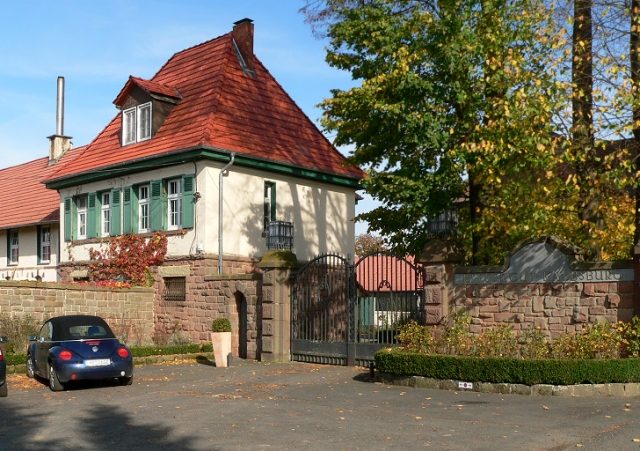
Kalbsburg Castle

The Kalbsburg is a former knight's estate in the district of Großenenglis, a part of the city of Borken in the Schwalm-Eder district in North Hesse. It is located on the northern edge of the Großenengliser Platte, the hill above the Eder plain, 4 km south of Fritzlar.
The first documented mention was in 1197, when Pope Celestine III confirmed income from Kalbsburg to Spieskappel Monastery. In 1320, the Fritzlar Collegiate Church granted the monastery further fiefs there. By 1386, these possessions at least partially belonged to Haina Monastery.
After the decisive victories of the Hessian Landgrave Ludwig I over Archbishop Konrad III of Mainz in the Mainz-Hessian War of 1427 in the battles near Großenenglis (July 23, 1427) and near Fulda (August 10, 1427), the Archbishopric of Mainz and its vassals in North Hesse lost large parts of their possessions to the Landgraviate of Hesse, including the Hohenenglis estate. As early as 1431, Landgrave Ludwig I had a watchtower built on the Hessian border with Mainz's Fritzlar, at the site of today's Kalbsburg, and secured it with a Landwehr; the tower was initially named after the settlement there, Bunebach (Bonebach). The name Kalbsburg only appeared from the mid-16th century.
His grandson Ludwig II gave this watchtower to Philipp von Borken in 1448 and, after his death in 1457, to Henne von Wehren. In 1497, Landgrave Wilhelm I transferred the Landwehr tower as a male fief to the Borken bailiff Philipp von Wildungen, and his successors expanded this fief with surrounding forests and fields. The von Wildungens developed the estate and held it until 1596, when Burkhard von Wildungen mortgaged it to his brother-in-law Melchior von Hanstein and then to his son Kaspar. Kaspar, heavily indebted, ceded the Kalbsburg as early as 1606 to Landgrave Moritz of Hesse-Kassel, who gave it in 1626 to his son from his second marriage, Friedrich (from the Rotenburg line).
In 1644, a Privy Councillor von Pohlheim and in 1657 his cousin Wilhelm Pohlheim were enfeoffed with the Kalbsburg. The latter sold it to Jost Philipp von Meysenbug. The further history is a series of sales and purchases to estate owners who farmed there until 1956. Only the family of the later government director of Kassel, Otto von Porbeck (1764-1841), who was elevated to the imperial nobility in 1779, held the estate for a longer period, from 1778 to 1885.
In 1956, the complex came into the possession of the Hessische Landgesellschaft, which then, over the years, sold the manor house, farm buildings, and the former servants' quarters to private owners.
Take Mobile History with you
You are reading this text for free. Premium adds what matters on the road: descriptions read aloud, sites found through your camera, whole regions taken offline.
- Every description, including the ~17,700 Premium sites
- Audio guide: have descriptions read to you on location
- AR finder: see sites through your camera, with distance and bearing
- Unlimited saved sites
14 days free, then from €2.99 a month. Cancel anytime.
Source: Wikipedia · Licence: CC BY-SA 4.0 · Image: http://de.wikipedia.org/wiki/Kalbsburg#mediaviewer/Datei:Kalbsburg_Eingang.jpg
This description draws on the facts documented in the linked Wikipedia article; Wikipedia content is licensed under CC BY-SA 4.0. Wording and editing: Mobile History.
Location: 51.0945, 9.2702