Monastery
MonasteryAltötting
Capuchin Abbey
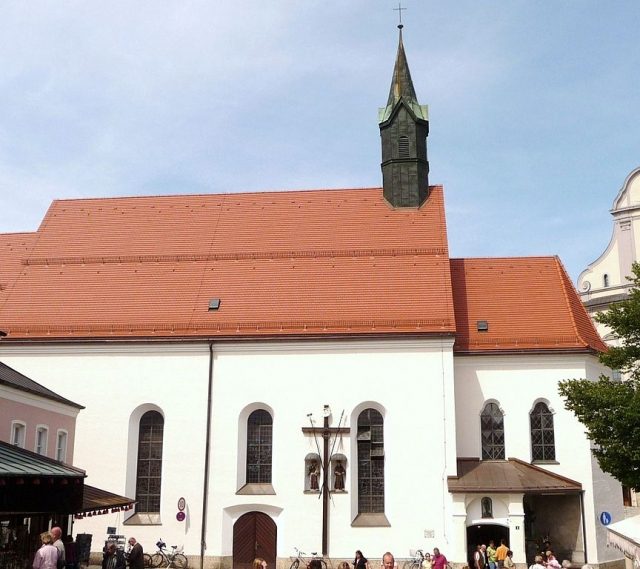
The Capuchin Monastery Altötting is a former monastery of the Franciscan Reformists, now of the Capuchins in the pilgrimage town of Altötting in Bavaria in the Diocese of Passau.
History+
The monastery, named after Saint Konrad von Parzham, was founded in 1654 by Franz Wilhelm von Wartenberg, Prince-Bishop of Regensburg and Provost of the Collegiate Church of Altötting. The church was named after Saint Anna out of gratitude to the widowed Electress Maria Anna. In the course of secularization, the Franciscans were expelled to Ingolstadt and Tölz in May 1802 and the monastery was assigned to the Capuchin Order as a dying-out monastery. Around 150 Capuchins from other dissolved Bavarian Capuchin monasteries were housed here. Under the rule of King Ludwig I, the Bavarian Capuchin province of Altötting was re-established. Since then, the Capuchins have been in charge of the pilgrimage to the Holy Chapel with the miraculous image of Our Lady in Altötting. On March 23, 1953, the Sacred Congregation of Rites permitted the re-titling of the former St. Anna Church to the name of St. Brother Konrad von Parzham. In 1956/57, the church was redesigned accordingly by the Regensburg architect Beckers. In 1961, the former St. Anna Monastery was also renamed Brother Konrad Monastery.
Design+
Nothing has been changed at the monastery gate since the time of Brother Konrad, not even during the renovation of the monastery in 1959/60. From the gate corridor, a door on the left leads into the Alexius cell, where Brother Konrad liked to pray in between, because from there he had a clear view of the altar. In the Alexius cell, letters of petition and thanks to the Saint are also handed in. Before the renovation and redesign in 2017/18, the reliquary shrine of the Saint was located in the church under the altar crowned by a baldachin.
Source: Wikipedia · Licence: CC BY-SA 4.0 · Image: https://commons.wikimedia.org/wiki/File:St._Konrad,_Alt%C3%B6tting.JPG
This description is a machine translation of an excerpt from the linked Wikipedia article. The source text was written by its authors, the translation is by Mobile History; like the original it is licensed under CC BY-SA 4.0.
Location: 48.2271, 12.6743