Hotel
MonasteryBaden-Baden
Capuchin Monastery
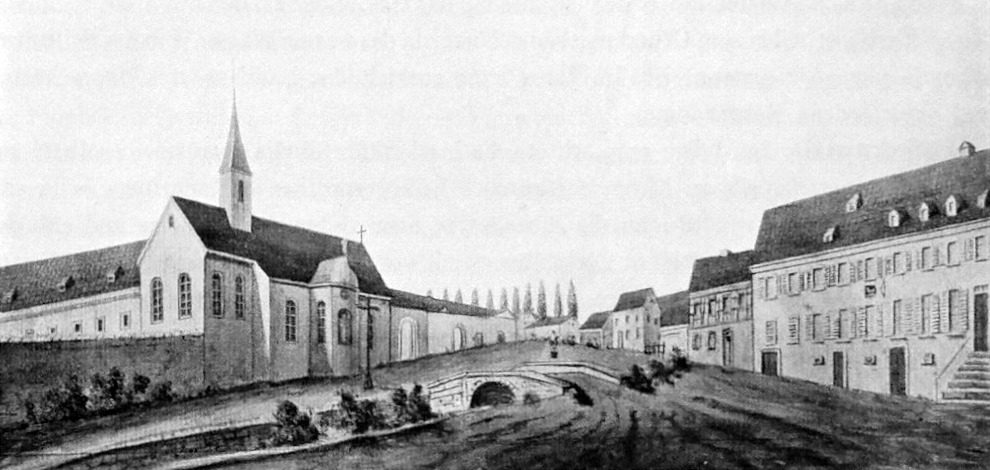
The Capuchin Monastery Baden-Baden is a defunct monastery of the Capuchin order in the city of Baden-Baden. The foundation stone was laid in 1631. The monastery, incinerated in 1689 and rebuilt from 1694 to 1698, was dissolved in 1807 and converted into a guesthouse and bathhouse, the predecessor of the Hotel Badischer Hof.
History+
Founding+
After Tilly's victory at Wimpfen on May 6, 1622, Margrave Wilhelm was able to take up his inheritance. One of his main goals was the re-Catholicization of his dominion. In this spirit, he promoted the Capuchin order. In 1624, the episcopal ordinariate of Speyer transferred the pulpit of the collegiate church to the Capuchins. On May 16, 1625, the General Chapter of the Capuchins in Rome approved the construction of a Capuchin monastery in Baden-Baden. The choice of the building site for the monastery on the northern border of the Swiss Capuchin province was complicated. The building site was outside the city walls on the south bank of the Oos and thus in the territory and jurisdiction of the Diocese of Strasbourg. De facto, the monastery was connected to the Diocese of Speyer, whose southern border was the Oos. On May 28, 1631, the stone cross of the Capuchins was erected on the building site and the foundation stone was laid by Margrave Wilhelm. The commenced construction work was interrupted by the Swedish occupation of Baden-Baden from January 1632 to September 1634.
First Monastery+
On August 2, 1641, the first monastery building was consecrated by the Speyer auxiliary bishop Gangolf Stailinger in honor of Saint Birgitta of Sweden, an ancestress of the Margrave. A local peculiarity of the monastery was the use of thermal water in two bathing tubs. During occupations of the city by Bernhard von Weimar in 1643 and by Swedish and French troops in 1645, the monastery remained undisturbed. In 1668, the Austrian Capuchin province split off from the Swiss Capuchin province. During the French conquest of Baden-Baden in 1689, the Capuchin monastery was burned down on November 9, contrary to an instruction from Marshal Duc de Duras.
Second Monastery+
By edict of Margrave Ludwig Wilhelm, the monastery was rebuilt at the expense of the Margrave from 1694 to 1698. In addition to the Lichtenthal Monastery, the Capuchin church served as the heart burial site for the Margraves of Baden-Baden. In 1712, Margravine Franziska Sibylla Augusta of Saxe-Lauenburg donated a chapel next to the monastery. As late as 1746, a chapel was added in honor of Fidelis of Sigmaringen, a member of the order canonized on June 29, 1746. In the inheritance treaty of January 28, 1765, between the houses of Baden-Baden and Baden-Durlach, the monastery was guaranteed and the occupation was set at 14 fathers and four lay brothers. In 1803, the monastery was placed on the extinction budget. In 1805, Margrave Karl Friedrich united the monasteries of Baden-Baden, Bruchsal, Waghäusel, Michaelsberg, Offenburg, Oberkirch, Wertheim and Mannheim into the Baden Custody.
Secularization+
In 1807, the monastery was dissolved. Seven remaining fathers and three lay brothers left the monastery, taking with them a supposed Dürer painting. The inventory was distributed to neighboring parish churches or auctioned off. The high altar and the pulpit of the lay church were placed in the parish church of Ebersteinburg. The side altars went to Daxlanden and the statues of Saints Joseph and Fidelis were placed in the forecourt of the church in Steinbach. A Roman tombstone depicting a wagon, which was inserted into the wall of the monastery garden and was the subject of a legend, went to the city's antiquity hall. A cedar in the courtyard was illegally felled by the Capuchins and the wood sold to a carpenter. The monastery building was sold to Johann Friedrich Cotta and, on his behalf, converted into the Hotel Badischer Hof by Friedrich Weinbrenner from 1807. Today, the adjacent Kapuzinerstraße commemorates the defunct monastery.
Dissolution of the Library+
The library of the Capuchin monastery was confiscated by the Baden State after the dissolution of the monastery in 1807 and initially went to the library of the Lyceum Baden-Baden. A part of the book collection, which also includes 16 incunabula and some post-incunabula, has been preserved in the library of the city of Rastatt in the Ludwig-Wilhelm-Gymnasium after being moved there in 1808.
Take Mobile History with you
You are reading this text for free. Premium adds what matters on the road: descriptions read aloud, sites found through your camera, whole regions taken offline.
- Every description, including the ~17,700 Premium sites
- Audio guide: have descriptions read to you on location
- AR finder: see sites through your camera, with distance and bearing
- Unlimited saved sites
14 days free, then from €2.99 a month. Cancel anytime.
Source: Wikipedia · Licence: CC BY-SA 4.0 · Image: von Schaffroth · Wikimedia Commons · Public domain
This description is a machine translation of an excerpt from the linked Wikipedia article. The source text was written by its authors, the translation is by Mobile History; like the original it is licensed under CC BY-SA 4.0.
Location: 48.7652, 8.2364