The Capuchin Monastery in Ostengasse was founded in 1613 at the instigation of Emperor Matthias as part of the Counter-Reformation. The Emperor intended to alleviate denominational tensions in Regensburg by settling the Capuchins there. Despite the resistance of the Protestant city council, he succeeded in persuading the abbess of Niedermünster Abbey to provide a vineyard for the construction of the monastery. Emperor Matthias personally laid the foundation stone on October 10, 1613, and made a substantial contribution to the construction of the church and the donation of its main altar. The construction of the monastery, surrounded by a ring wall, was completed as early as 1614. The monastery was used by the Capuchins until 1810, when it was dissolved during secularization. The buildings were then handed over to the Poor Clares from St. Maria Magdalena, whose own monastery had been destroyed in 1809 during the siege of Regensburg. The Poor Clares expanded the complex in the 19th century and inhabited it until 1974. After the Poor Clares left, the city of Regensburg acquired the site, initially planning demolition for road construction projects. These plans were averted in the 1970s. Parts of the buildings were used by the Eastern Church Institute Regensburg and later by the city administration and youth welfare services. Following a sale in 2010 and extensive renovations in 2013/14, the complex is now used by the Catholic Youth Welfare of the Diocese of Regensburg e. V. for assisted living, mother-and-child apartments, and an educational counseling center. The monastery church of St. Matthias, consecrated in 1615, was expanded in 1811 and is now used by the Romanian Orthodox Parish of the Holy Trinity, while a chapel in the choir is used by the Serbian Orthodox community. The church underwent general renovation in 2022/2023.
Klosterkirche St. Matthias in Regensburg
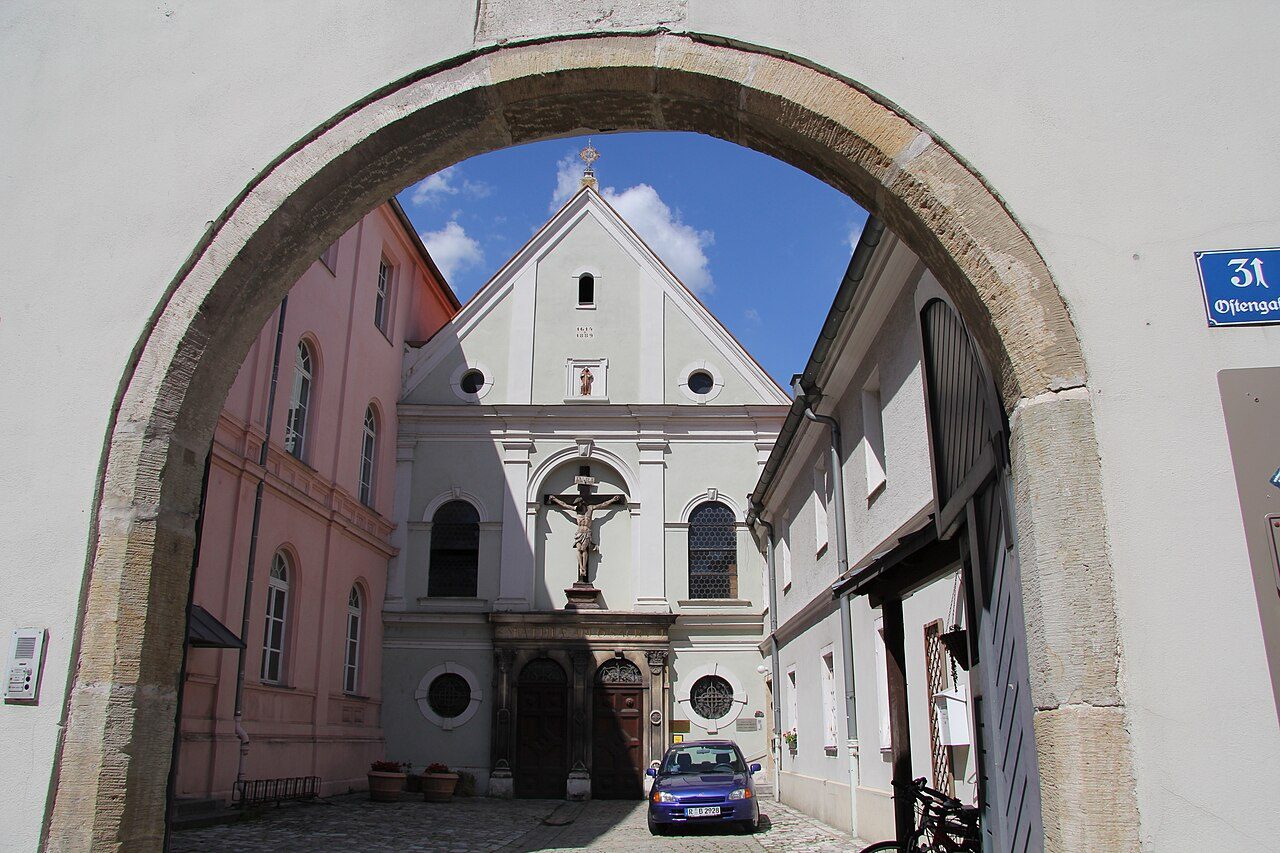
The former Capuchin Monastery in Regensburg, a significant architectural monument in Bavaria, is a historic sacred building that has undergone a varied history from its foundation in the 17th century to its current use by various communities and social institutions. It is centrally located in the city of Regensburg and stands as a testament to the region's religious and urban development.
History+
Location+
The former Capuchin Monastery is situated in the city of Regensburg in Bavaria, Germany. It lies at an elevation of approximately 339 meters above sea level.
On site+
The former monastery complex now houses an inclusive concept by the Catholic Youth Welfare of the Diocese of Regensburg e. V., offering outpatient assisted living, mother-and-child apartments, affordable housing, and an educational counseling center. The monastery church of St. Matthias is used by the Romanian Orthodox Parish of the Holy Trinity, and a chapel serves the Serbian Orthodox community. As part of the designated area monument 'Old Town of Regensburg with Stadtamhof', the monastery church has been a UNESCO World Heritage site since 2006.
Nearby+
- Royal Villa (Palace, approx. 168 m away)
- Franciscan Monastery (Sacred building, approx. 314 m away)
- Niedermünster Abbey (Sacred building, approx. 417 m away)
- Collegiate Church of Our Lady (Sacred building, approx. 452 m away)
Take Mobile History with you
You are reading this text for free. Premium adds what matters on the road: descriptions read aloud, sites found through your camera, whole regions taken offline.
- Every description, including the ~17,700 Premium sites
- Audio guide: have descriptions read to you on location
- AR finder: see sites through your camera, with distance and bearing
- Unlimited saved sites
14 days free, then from €2.99 a month. Cancel anytime.
Location: 49.0185, 12.1062