Music school
Youth hostel
MonasteryBurghausen
St. Anna Capuchin Abbey
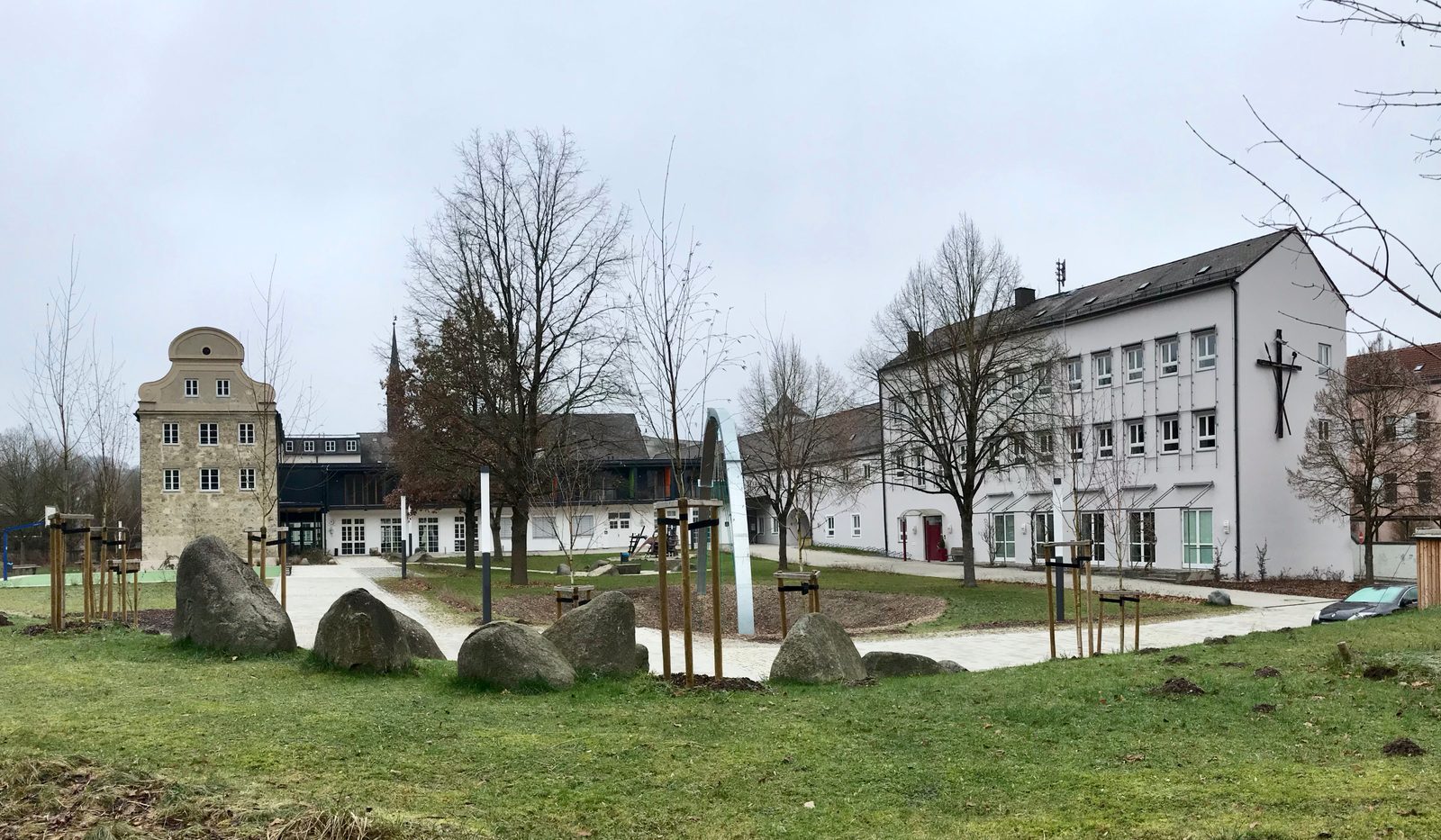
The former Capuchin monastery of St. Anna was a monastery of the Capuchins in Burghausen. It also housed the former St. Konrad study seminary. It is now used as a municipal music school and youth hostel.
History+
In 1618, at the suggestion of Elector Maximilian, the mendicant order of the Capuchins came to the city of Burghausen. In 1649, after the end of the Thirty Years' War, the order cared for plague victims in the city. However, the convent was not established until 1654. In 1754, the Capuchin monastery solemnly celebrated its hundredth anniversary. The Capuchin monastery was secularized at the beginning of 1802, i.e., declared state property. However, it continued to exist as a central monastery of the Capuchin order and thus survived the secularization in Bavaria. Saint Brother Konrad worked here as a novice in 1851. On July 13, 1877, Bishop Wilhelm Emmanuel von Ketteler died in the monastery. From 1892, the monastery also served as a seminary for young priests of the order. The students attended the Kurfürst-Maximilian-Gymnasium in the old town. The dissolution of the monastery and seminary occurred in 1994 due to a lack of new recruits. In 2010, allegations of abuse against a former seminary director were publicly discussed. The assaults are said to have occurred in the school year 1984/85.
Convent and Seminary Building+
The former convent building (now the music school) is a one-and-a-half-story wing building along Kapuzinergasse, probably 17th century, with later alterations. Above the entrance is an epitaph for Bishop Freiherr von Ketteler, erected in 1927. The former seminary building (southwest wing), now a youth hostel, is an unplastered tuff ashlar building with a neo-baroque ornamental gable, dating from 1923/24. To the west, there is a three-story building with a mansard roof and a small chapel on the southeast edge of the seminary garden. This chapel has larch shingle cladding, renovated in the 19th century, restored in 1977. The former monastery wall serves as the southern and western boundary of the monastery garden.
Church St. Anna+
The Capuchin Church of St. Anna, built in 1656 by the Munich Capuchin Nikolaus, is a barrel-vaulted hall building of great simplicity. The church was redesigned in Neo-Romanesque style around 1865 and purified and redesigned in 1965–1967 according to the plans of Karl-Heinz Limpert (Burghausen) and Toni Rückel (Munich). The large crucifix in the choir was created by Johann Georg Lindt. The tabernacle, made of gilded bronze, shows symbolic figures on the front and the stigmatization of St. Francis on the back. On the ambo by Toni Rückel, Saints Fidelis, Francis, and Brother Konrad are depicted. For the altar, the 300-year-old red marble slab of the former Baroque altar was used. On the walls are two former side altar paintings by Johann Nepomuk della Croce from 1781, depicting St. Anthony with a donkey and St. Felix of Cantalice. Above them are the order saints Lawrence of Brindisi and Seraphin of Montegranaro. A marble plaque on the wall commemorates a Father Pacificus from Munich, who came here from the Braunau monastery in 1648 and lost his life as a pastor and caregiver for plague victims. South of it is the seminary chapel and the cemetery with a red marble memorial plaque for the deceased Capuchin fathers of the first half of the 19th century. The side chapel, accessible through a small door, is dedicated to St. Brother Konrad. The Sorrowful Mother of God under the gallery from the first half of the 18th century is probably by Johann Jakob Schnabel.
Take Mobile History with you
You are reading this text for free. Premium adds what matters on the road: descriptions read aloud, sites found through your camera, whole regions taken offline.
- Every description, including the ~17,700 Premium sites
- Audio guide: have descriptions read to you on location
- AR finder: see sites through your camera, with distance and bearing
- Unlimited saved sites
14 days free, then from €2.99 a month. Cancel anytime.
Source: Wikipedia · Licence: CC BY-SA 4.0 · Image: XoMEoX · Wikimedia Commons · CC BY 4.0
This description is a machine translation of an excerpt from the linked Wikipedia article. The source text was written by its authors, the translation is by Mobile History; like the original it is licensed under CC BY-SA 4.0.
Location: 48.1540, 12.8267