Residential building
MonasteryHeidelberg
Karmeliterkloster Heidelberg
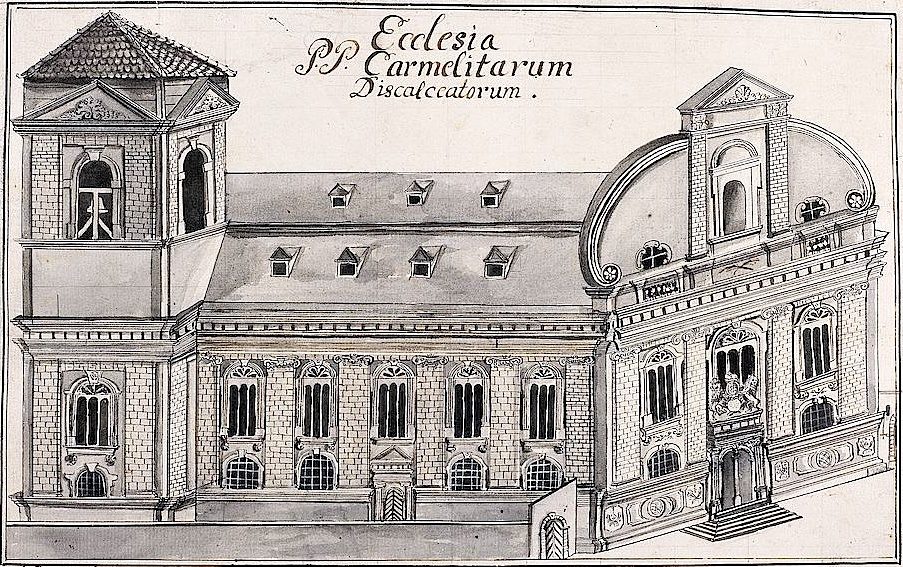
The former Carmelite Monastery in Heidelberg was a significant convent, comprising a church and associated monastic buildings. It notably served as a burial site for members of the Wittelsbach ruling house. Today, only a few remnants of the original structures, now built over, remain.
History+
The monastery's origins trace back to the early 18th century when Elector Johann Wilhelm of the Palatinate intended to establish the Calced Carmelites in Heidelberg. However, at the request of his sister Eleonore Magdalene of Pfalz-Neuburg, who favored the Discalced Carmelites from Vienna, the order was granted the ruins of St. James's Church on Friesenberg in 1701. This church, a medieval foundation by Elector Ruprecht I, had been rebuilt in 1688 but subsequently destroyed by French forces in 1693. In March 1702, the first Discalced Carmelites arrived from Augsburg and began rebuilding the church, a project completed by 1713. Its consecration took place in 1724, performed by Auxiliary Bishop Johann Baptist Gegg of Worms. The foundation stone for the monastery buildings was laid in November 1718. Brother Dominicus a S. Euphrosina, known for his work on the Carmelite convent in Munich, oversaw the construction. The convent buildings were expanded around 1730 and again around 1760. The church was endowed with a high altar dedicated to Saint Joseph and, in 1753, a Marian altar. From 1721, a Confraternity of Saint Joseph existed at the monastery, counting Electors Karl Philipp and Karl Theodor, numerous court personalities, and prominent Heidelberg citizens among its members. This confraternity played a crucial role in Saint Joseph's designation as the patron saint of the Electoral Palatinate in 1753. Between 1755 and 1787, the Heidelberg branch served as the study convent for the Cologne Carmelite province, where new recruits were educated in theology, philosophy, and languages. The Carmelites also held chairs at Heidelberg University. The monastery's decline began around 1780, influenced by Enlightenment ideas, which led to recruitment difficulties and internal conflicts. During the Coalition Wars, the monastery was used as a provisions depot and, around 1800, as barracks for recruits. On March 31, 1803, Elector Max IV Joseph dissolved the convent. The church, monastery, and garden were auctioned off; the church was demolished in 1806/07, along with parts of the convent buildings. A remaining corner building still exists today in a modified form.
Location+
The Carmelite Monastery was situated in the city of Heidelberg, in the federal state of Baden-Württemberg, within the area of today's Friesenberg street on the eastern edge of the city.
On site+
Today, only a few built-over remnants of the former monastery complex remain at Friesenberg 1a, including the former refectory, which have been integrated into the current buildings in a modified form.
Nearby+
- Palais Buhl (residence, approx. 71 m away)
- Palais Weimar (residence, approx. 96 m away)
- Grand Ducal Palace (residence, approx. 236 m away)
- Palais Boisserée (residence, approx. 266 m away)
Take Mobile History with you
You are reading this text for free. Premium adds what matters on the road: descriptions read aloud, sites found through your camera, whole regions taken offline.
- Every description, including the ~17,700 Premium sites
- Audio guide: have descriptions read to you on location
- AR finder: see sites through your camera, with distance and bearing
- Unlimited saved sites
14 days free, then from €2.99 a month. Cancel anytime.
Location: 49.4127, 8.7160