Offices
MonasteryJena
Carmelite monastery
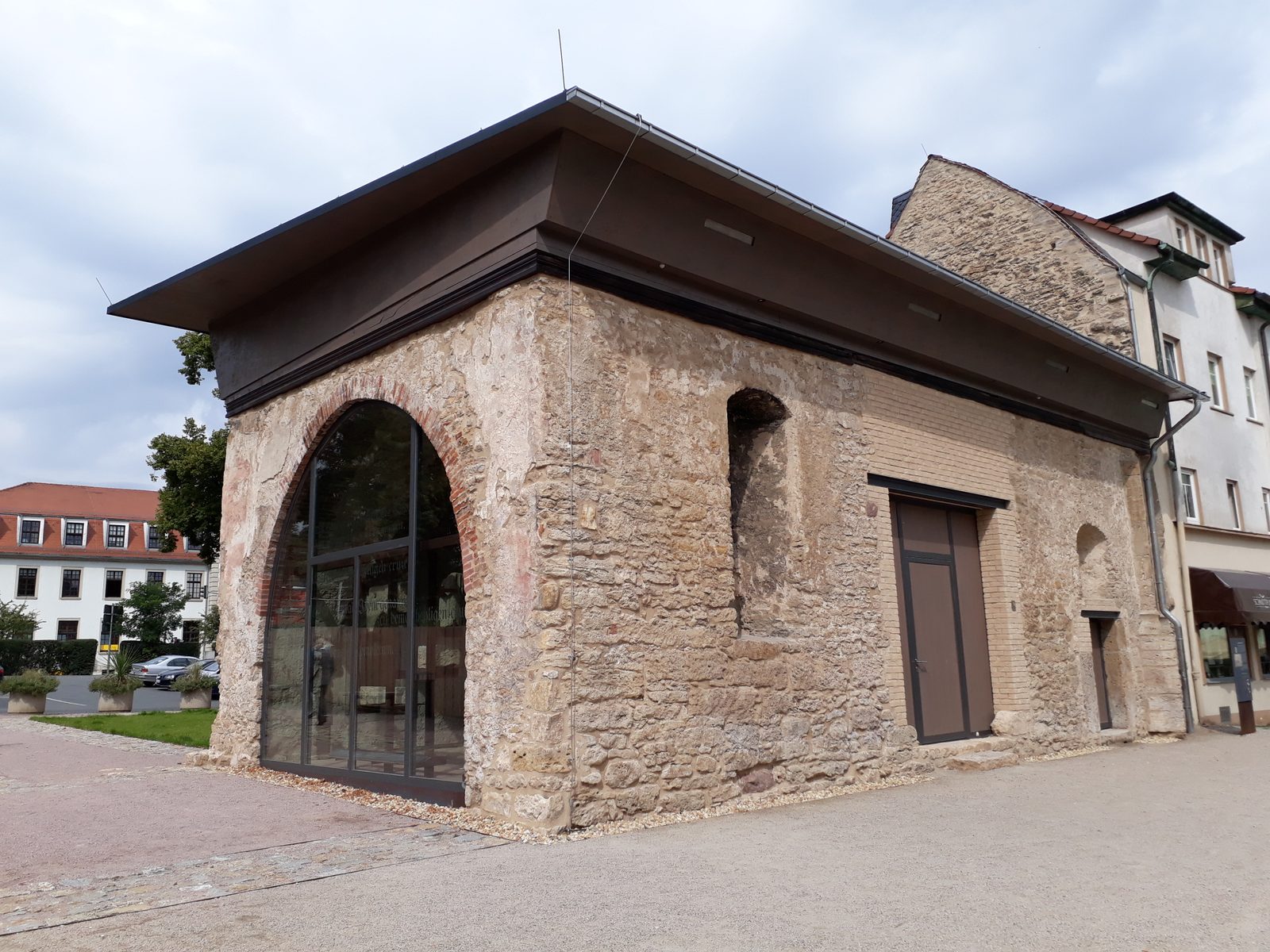
The Monastery of the Holy Cross was a Carmelite monastery in Jena, Thuringia, from the 15th to the 16th century.
The monastery was located at the Church of the Holy Cross in the settlement of Zweifelbach, south of the medieval city of Jena. Small parts of the complex are preserved.
History+
As early as 1382, a Carmelite terminarium from Pößneck existed in Jena. In 1414, the provincial of the order reported that he had received a plot of land in Jena for the founding of a monastery. A document from 1418 shows that the city council of Jena granted the Carmelites a plot of land in Zweifelbach, as well as the use of the Holy Cross Church. Margraves Friedrich and Wilhelm of Meissen supported the monastery's founding, for which they were admitted to a brotherhood of the order that year. The monastery was the third in the city, alongside those of the Dominicans and Cistercian nuns. In the early years, construction work seems to have progressed slowly; in later times, the monastery was able to exist well from donations and possessions. In 1524, the city council brought most of the possessions, including about 80 vestments, almost all of the cash, and household items such as tables and bedding, to the town hall and sold them. The proceeds were given to the poor population of the city. In 1525, the monastery was plundered and damaged during the Peasants' War. Afterwards, nine monks still lived there; by 1529, the monastery was probably dissolved. Thereafter, the complex fell into disrepair and was partly used as building material.
Structures+
The convent was headed by a prior, who in the 15th century was also a lector. In accordance with the ideals of the order, the monastery was particularly oriented towards education, as evidenced by school and student masters and a library, parts of which were preserved after its dissolution. In addition, a chaplain, a preacher, and a sacristan were mentioned as functional titles.
Economy+
The monastery received numerous endowments and donations, especially for soul masses. It also owned small landholdings, including some vineyards. Beer was also brewed, in smaller quantities, mainly for its own consumption. The possessions inventoried and stolen in 1524 indicate a certain prosperity.
Take Mobile History with you
You are reading this text for free. Premium adds what matters on the road: descriptions read aloud, sites found through your camera, whole regions taken offline.
- Every description, including the ~17,700 Premium sites
- Audio guide: have descriptions read to you on location
- AR finder: see sites through your camera, with distance and bearing
- Unlimited saved sites
14 days free, then from €2.99 a month. Cancel anytime.
Source: Wikipedia · Licence: CC BY-SA 4.0 · Image: Aschroet · Wikimedia Commons · CC0
This description is a machine translation of an excerpt from the linked Wikipedia article. The source text was written by its authors, the translation is by Mobile History; like the original it is licensed under CC BY-SA 4.0.
Location: 50.9261, 11.5844