MonasteryBad Urach-Güterstein

Güterstein Abbey
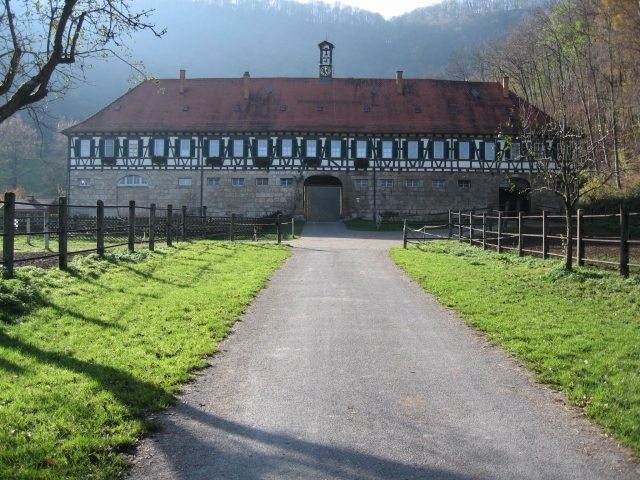
Güterstein Abbey

To be privately owned

The Charterhouse of Güterstein was a Carthusian monastery near Bad Urach. However, the name Güterstein only appears in sources towards the end of the 14th century.

Cistercian Period

Konrad von Urach, Cardinal and General Abbot of the Cistercians, is said to have founded a monastery "ad lapidem" in the early 13th century, which his brother Rudolf von Urach later also looked after. The source material for this early period is sparse. With the end of the Staufer period, when the Counts of Urach withdrew from the Ermstal valley, the first phase of the monastery probably also ended.

Benedictine Period

Apparently, the monastery was taken over by the Benedictines of Zwiefalten Abbey and experienced a flourishing period under them.

For the period around 1380, the existence of the Chapel of St. Mary in Güterstein is documented, which was cared for by a Benedictine provostry and apparently became a much-visited pilgrimage site; furthermore, the monastery was promoted by its patrons, the Counts of Württemberg, as well as the lower nobility.

Carthusian Period

In 1439, the Benedictine period in Güterstein ended for political reasons. Counts Ludwig I and Ulrich V of Württemberg patronized the Carthusians, to whom they had entrusted the monastery in Güterstein and from whom they hoped for reforms in the monasteries of their dominion, so that the Güterstein lordship could soon be expanded to include outposts in Ehningen im Gäu and Entringen near Tübingen. The order also had influence over the appointment of parish priests in the surrounding area through its numerous patronage rights. The monastery was financially secure and was significantly expanded until the end of the 15th century.

From 1441/1442, Güterstein was the burial place of the Counts of Württemberg, who, after the division of the country according to the Treaty of Nürtingen, ruled the southern part of the territory and resided in Urach. As numerous members of the ruling family died in quick succession, the monastery benefited from numerous endowments for memorial services.

But it was not only the church policy of the territorial lords that made the Charterhouse famous.

Twenty years after the Carthusians settled in Güterstein, the Prior of Güterstein was commissioned by Pope Pius II in his reform bull to conduct a monastic visitation.

In the Charterhouse of Güterstein, spiritual literature, also aimed at laypeople, was written. From the year 1447 dates the

Spiritual Conversation between a Princess and a Peddler, a folk medicine book that exploited readers' interest in medical topics to also convey spiritual content. The conversation quickly spread through copies and soon appeared in Augsburg and Kirchheim im Ries.

Vernacular lives of saints and a printed rosary prayer also originated in Güterstein. The Alphabetum divini amoris, printed in Memmingen in 1493, was translated there. The translation into German was done by Johannes Mickel, who died in Güterstein in 1508. Another outstanding personality among the monks was the physician Dr. Thomas Finck, who is probably identical with the translator Thomas de Heilprun. He died towards the end of the first quarter of the 16th century.

The Güterstein monks Benedikt Eichel and Thilmann Mosenus belonged to the college of diffinitors of the General Chapter; the latter also played a not insignificant role in the Carthusians' dispute with the emerging Reformation. The Charterhouse of Güterstein was influential within its order already because of its size - in addition to 20 cells for religious, it also had ten more cells for lay brothers.

However, the close ties to the Counts of Württemberg, which had secured it even more power, gradually dissolved again. Count Eberhard V founded the University of Tübingen in 1477 and, in the same year, called the Brothers of the Common Life to Urach, who, in contrast to the hermitic Carthusians, were actively involved in pastoral care.

Both measures again limited the importance of the Güterstein Charterhouse.

In 1535, the Reformation put an end to monastic life in Güterstein. A large part of the monks moved to the Charterhouse of Buxheim, so that an attempt to revive the Charterhouse of Güterstein in 1550/1551 was doomed to failure. The former procurator of the Charterhouse, Johannes Frey, converted and became the first Protestant clergyman in Metzingen.

Buildings+

A monastic farm of the Charterhouse can still be seen in Urach today, but almost nothing remains of the monastery complex itself on

site. It consisted of a Church of St. Mary, a burial chapel, a pilgrim chapel, and the residential and economic facilities of the convent. In the course of the Reformation, most of the buildings were demolished; only the princely burial place initially remained. Its remnants, still recognizable in 1554, were transferred to the Stiftskirche in Tübingen. Among the preserved tombs is, for example, that of Archduchess Mechthild, which was possibly created around 1450 by Hans Multscher. The origin of the Passion Altar from 1512 in the parish church in Oberstenfeld from the Charterhouse of Güterstein is not certainly documented.

However, the proximity of the Güterstein waterfalls made the former site of the Charterhouse attractive for later users, partly because of the tufa stone that was quarried there, and partly because of the spring water.

In 1715, Theodosius Ernst established a water pumping station there, which supplied the ducal stud farm. Another stud farm was probably built on the site of the former economic court of the monastery.

Take Mobile History with you

You are reading this text for free. Premium adds what matters on the road: descriptions read aloud, sites found through your camera, whole regions taken offline.

  • Every description, including the ~17,700 Premium sites
  • Audio guide: have descriptions read to you on location
  • AR finder: see sites through your camera, with distance and bearing
  • Unlimited saved sites

14 days free, then from €2.99 a month. Cancel anytime.

Source: Wikipedia · Licence: CC BY-SA 4.0

This description draws on the facts documented in the linked Wikipedia article; Wikipedia content is licensed under CC BY-SA 4.0. Wording and editing: Mobile History.

Location: 48.4911, 9.3572