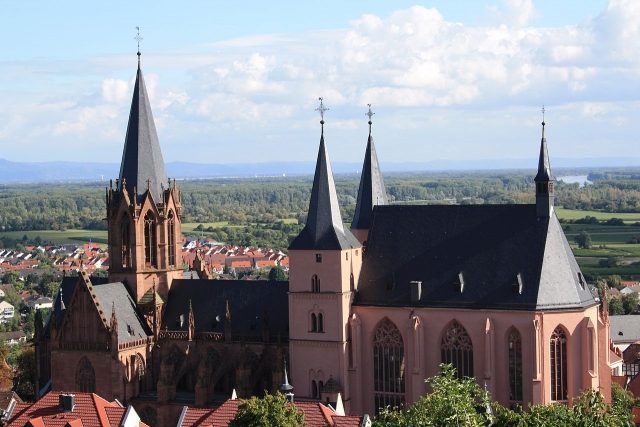
ChurchOppenheim

Katharinen Church

Katharinen Church

The church can be visited

St. Catherine's Church in Oppenheim is considered one of the most important Gothic churches on the Rhine between Strasbourg and Cologne.

Construction of the city's landmark probably began after the city was granted its charter in 1225. It combines stylistic elements of the late Romanesque and Gothic architectural eras and is considered the most important Gothic church building on the Rhine between Strasbourg and Cologne.

In 1258, the construction work of the first Romanesque phase was probably completed. The erection of the east tower began in 1262, and work on the nave started in 1317. The beginning of the nave's construction (1317) is recorded in a building inscription in the shape of a round loaf of bread to the right of the small entrance door to the church. The stone is also called "Hungerbrotstein" (hunger bread stone) because it documents the high price of bread at that time.

The Mainz Parish Church (1258)

In the course of the efforts of the Archbishop of Mainz to gain a foothold in Oppenheim, he claimed, along with the new town, which already belonged to Mainz, the patronage rights over the newly completed St. Catherine's Church, which had previously been served by the pastor of St. Sebastian. King Richard of Cornwall separated the two churches in 1258 and drew the diocesan boundaries of Mainz and Worms right through the city. St. Catherine's Church became part of Mainz and the parish church of the Mainz new town. St. Sebastian's Church fell to the Diocese of Worms and remained the parish church of the Worms old town.

Further History

In 1317, the Archbishop of Mainz established a collegiate church at St. Catherine's, meaning the institution was assigned to a community of clergy who were to hold regular services (collegiate foundation). Around 1360, the crossing tower and the gable of the transept were completed. From 1415-1439, the canons added their own choir in the west (consecrated in 1439). St. Catherine's Church had been a Lutheran parish church in Oppenheim since 1556, and a Reformed parish church since 1565. After the Peace of Westphalia in 1648, the church was finally handed over to the Reformed, until it served as a common house of worship for the united Lutherans and Reformed from 1822. In 1689, the building fell victim to destruction by the French. The roofs were destroyed and almost all windows, and subsequently almost all vaults collapsed.

Reconstruction

The city's population was unable to rebuild the church. Attempts were made to repair and preserve the remaining building fabric. Among other things, the main tower was fitted with a baroque dome at that time. From 1834 to 1845, a first comprehensive renovation took place under district architect Ignaz Opfermann.

In 1873, notary Lippold suggested the formation of a building association to prepare for a restoration. The population raised the necessary funds, and in 1889 the church was completed. This second renovation, which began in 1879, was carried out by the Viennese cathedral master builder Friedrich and his son Heinrich von Schmidt. The re-vaulting of the west choir could only be completed in 1937 under Paul Meissner. In 1959, extensive renovation work was carried out again. In 1965, work was done on the north front of the church and on the gallery of the crossing tower.

The Oppenheim Rose+

St. Catherine's Church is particularly famous for its windows. The most significant are the two windows in the south facade, the Lily Window, which was re-glazed in 1937, and the so-called Oppenheim Rose, whose glass panes from the 14th century (1332/1333) are largely preserved in their original state. The ground plan of the Oppenheim Rose was based on a wild rose, a symbol of God's love for humanity. The center of the window is adorned with the imperial eagle, the Oppenheim city coat of arms. Arranged in a circle around the city coat of arms are the coats of arms of the Oppenheim councilors from 1332/33.

The Legend of the Oppenheim Rose

The citizens of Oppenheim had engaged a renowned master sculptor from Mainz for their church. Among many other things, he meticulously designed the tracery of a rose window. However, he entrusted the execution of the rose to an apprentice. The apprentice worked with great zeal. While building, he unknowingly altered his master's design, thus creating his own work of art. When the master saw the changes, he scolded him: "Your boy's hand has ruined the entire artwork." A punch struck the apprentice, who fell so unfortunately from the scaffolding that he succumbed to his injuries. The Oppenheimers considered the fall an accident. When they saw the apprentice's outstanding work, they said: "The apprentice has surpassed his master." The master was sentenced to death and executed. Many years later, it turned out that the master was not the murderer, but a jealous journeyman, who, however, could not be punished during his lifetime.

Furnishings+

Baptismal Font

The design for the baptismal font comes from the architect Paul Wallot, the builder of the Reichstag building in Berlin. In the form of the baptismal font, one can recognize echoes of the dome construction of that building at the time. The baptismal font was donated in 1888 by Johann Wilhelm Wallot, Paul Wallot's father.

Tombs

Members of the noble families residing in Oppenheim sought to be buried in St. Catherine's Church. Originally, there were over 100 tombs in the church. Many of them were destroyed during the destruction of the city in 1689. Among the preserved tombs, those of the married couple Johann von Dalberg and Anna von Bickenbach († 1415) and Anna von Dalberg († 1420) are particularly noteworthy. The Dalbergs, like many other noble families, had come to Oppenheim as vassals of the Elector Palatine.

Organs+

The large organ of St. Catherine's Church was built from 2004-2006 by Gerald Woehl (Marburg). The instrument partly consists of historical pipe material from the organ by Eberhard Friedrich Walcker from 1871. So far, 17 stops of the Walcker organ could be reused in the new instrument. The installation of two further stops is planned for a later date. The instrument has mechanical key actions and mechanical couplers. The stop action is electric.

Take Mobile History with you

You are reading this text for free. Premium adds what matters on the road: descriptions read aloud, sites found through your camera, whole regions taken offline.

  • Every description, including the ~17,700 Premium sites
  • Audio guide: have descriptions read to you on location
  • AR finder: see sites through your camera, with distance and bearing
  • Unlimited saved sites

14 days free, then from €2.99 a month. Cancel anytime.

Source: Wikipedia · Licence: CC BY-SA 4.0 · Image: https://commons.wikimedia.org/wiki/File:0ppenheim_Katharinenkirche_2009-09-06_20.jpg

This description draws on the facts documented in the linked Wikipedia article; Wikipedia content is licensed under CC BY-SA 4.0. Wording and editing: Mobile History.

Location: 49.8540, 8.3546