Church
ChurchCanterbury
Canterbury Cathedral
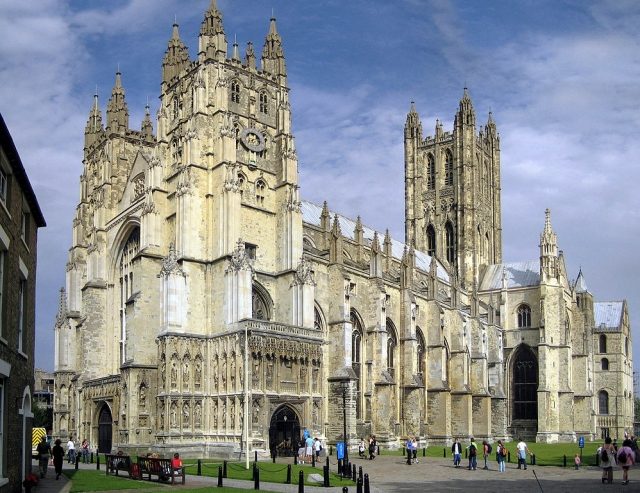
In Canterbury, England, Canterbury Cathedral, officially known as The Cathedral of Christ Church, is an example of Gothic architecture. Its 75-meter-high central tower, known as Bell Harry, shapes the city's skyline.
History+
The cathedral's history begins in 597 with the arrival of the Benedictine monk Augustine from Rome, who was consecrated as the first archbishop. An initial cathedral was built, whose Roman and early structural remains were discovered in 1993 during renovations. After a fire in 1067, shortly after the Norman Conquest, a reconstruction began that lasted for centuries, combining Romanesque, Early Gothic, and Late Gothic elements. Under Lanfranc, reconstruction began in 1067. An expansion of the eastern part occurred after 1096 under Anselm of Canterbury, with the choir being replaced by a long choir with an ambulatory and radial chapels above a crypt. The consecration of this building took place in 1130. A pivotal event was the assassination of Archbishop Thomas Becket in 1170, which made Canterbury one of Europe's most important pilgrimage sites. After another fire in the choir in 1174, reconstruction began under the French master builder William of Sens, who introduced Early Gothic to England. After an accident involving William, William the Englishman continued the work.
Source: Wikipedia · Licence: CC BY-SA 4.0
This description draws on the facts documented in the linked Wikipedia article; Wikipedia content is licensed under CC BY-SA 4.0. Wording and editing: Mobile History.
Location: 51.2797, 1.0832