School
Hotel
Katlenburg Castle

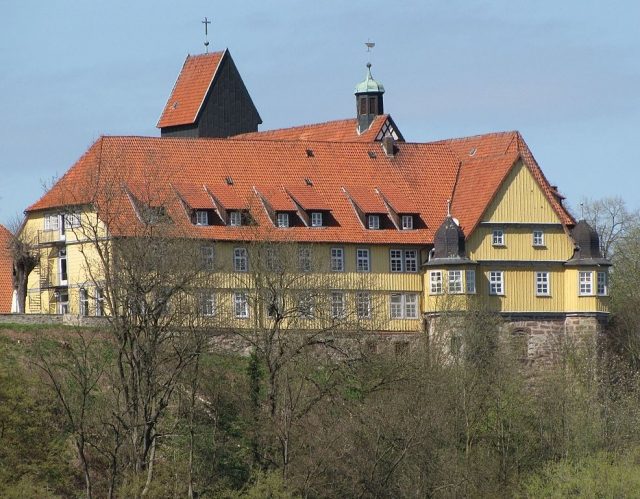
The Katlenburg is a former castle and monastery complex in the Katlenburg district of the municipality of Katlenburg-Lindau in Lower Saxony. The complex, which originated in the 11th century as a spur castle, was a monastery and the seat of an agricultural domain for the longest time in its eventful history, later becoming an educational institution. Since 1990, the complex has become known as the "Book Castle" (Bücherburg).
The Katlenburg is located near the Katlenburg district in the western Harz foothills. It is situated in a strategically favorable position at the end of a mountain spur on the Katelberg, which gave the castle its name. On two sides, it is protected by 50 m high steep slopes. The Rhume and Katlenbach rivers flow on two sides of the castle hill. In total, there are four river and stream courses in the lowlands, which, with their once swampy river plain, made it difficult for enemies to approach. These are the Rhume with two river arms, the Söse, and the Katlenbach. Without major obstacles, an approach to the castle is only possible over the mountain plateau from the south. Below the castle in the plain, the Nordhäuser Heerstraße to Leipzig ran in the Middle Ages, over which traffic from the Rhineland to Thuringia passed. The road crossed the Rhume directly below the castle.
Architectural Description+
The Katlenburg originally consisted of a triangular main castle at the steeply sloping end of a mountain spur. Merian's engraving from 1654 shows this castle area with ruined buildings and wall remains. Presumably, the buildings that still exist today were erected on these foundations in later centuries. The unprotected south side towards the mountain plateau was secured by a now filled-in section ditch. In this area, the keep was probably located, which can be interpreted from the remains of a 10 × 10 m foundation wall platform. In addition, there was an outer bailey in the later established domain area.
Due to its varied history with multiple destructions by fire and war, the buildings on the castle hill today do not form a uniform group from a single style period. They are loosely distributed over the terrain and originate from different eras. The center of the complex is the church, as the former castle church with a crypt. Both are the oldest parts of the building and are attributed to the castle with an origin in the 13th century.
The medieval gatehouse southeast of the church has Gothic stylistic elements. In addition to the passage in the eastern half-timbered wall above a door beam, Gothic curtain arches are present.
North of the church is the magazine building. In its basement, in addition to barrel vaults, there are also ribless cross vaults.
The basement of the eastern curtain wall of the lower castle is preserved. Originally, a solid building with half-timbered upper floors stood here, similar to the Welfenschloss in Herzberg am Harz. Parts of the plaster-covered cellar vaults are filled with rubble. The lower part of the wall is so deep in the slope debris that even the loopholes are covered with refuse. On a Merian engraving, these light openings can be seen at least 5 to 6 meters above the ground. The north, west, and south areas of the former curtain wall are only partially preserved.
Directly north of the northwest gate is the former district prison, which is used as a residence.
The building now called "Magazin" (magazine) consists on the ground floor of a chapel formerly located in the western part, with extensions of a representative solid building. The cramped chapel has Gothic vaults, as does the attached larger eastern part. Apparently, the building originally had one or more upper floors. In the building on the south side, there is a solid semicircle as the remnant of a former round tower or stair tower. The outer wall is built straight, as if the tower remnant had been cut off. A door leads from the outside into the semicircle. The south wall of the "Magazin building" shows, east of a bend in the wall line, high early Gothic windows and accesses set at different heights. On the "Philippschlösschen" located directly opposite to the south, still walled-up Gothic wall openings indicate that older subdivision of the floors and the beginning of the eastern residential wing that formerly connected the two buildings.
The younger buildings located north of the "Magazin" date from the 18th century.
The solid and half-timbered buildings of the Amtshof (bailiff's court) south of the church were only built after the Thirty Years' War. The "Reitstall" (riding stable), built in the middle of the farmyard in the 17th century, has an astonishing self-supporting ceiling construction for its time.
Next to the current southern access road, on the left are the remains of the "Ochsenstall" (ox stable). It became a ruin due to a severe storm in the 1980s due to neglected building repairs.
Middle Ages
The castle was built in the 11th century by the Counts of Katlenburg, who at that time had supra-regional importance in imperial politics. The comital family has been documented since 1002 by the brothers Heinrich and Udo von Katlenburg. Their descendants were Dietrich I, Dietrich II, and Dietrich III. The pious Count Dietrich III, who remained without offspring, and his wife Adela von Beichlingen converted the castle into a monastery in 1105, where they had the curtain wall demolished. The monastery was founded in honor of the Evangelist John and was called the Johanneskloster (John's Monastery). It is not entirely clear whether piety or childlessness was the motive for the monastery's founding. Another reason is suspected to be that the center of power was moved to Stauffenburg near Gittelde, where Count Dietrich also had his own coins minted. The comital couple had the monastery church of Katlenburg built. With Dietrich's death in 1106 during the siege of Cologne, his lineage died out. He was buried in the crypt of the church he had built. In the castle complex converted into a monastery in the 12th century, Augustinian monks initially lived, and later also Augustinian nuns.
In the 14th century, the monastery suffered several misfortunes. In 1346, the monastery complex burned down, presumably as a result of arson. This fire was reflected in the "Catlenburger Lied" of 1346, which is considered the oldest Low German song in Lower Saxony. In 1348, the plague raged in the area, which worsened the monastery's economic situation. In 1392, there was an attack from Thuringia.
Modern Era
Between 1525 and 1534, the monastery created a ledger in which all possessions, rights, and income were recorded. The reason was concern about the loss of property due to the Peasants' Wars developing in 1525. The book lists monastic possessions belonging to 270 people in 70 places. Around 45 villages in the surrounding area belonged to the monastery, but also places near Braunschweig. In addition, the monastic possessions included fishing rights on the Rhume, Oder, Söse, Bever, as well as hunting and mill rights. Patronage rights also existed for churches in the area.
During the Reformation, the monastery was secularized in 1534. In 1560, Philipp II of Grubenhagen and his wife Clara von Wolfenbüttel moved into the buildings. They converted part of the former monastery buildings into a Renaissance castle. They inhabited the complex until 1595, which thus became a secondary residence of Grubenhagen. After the princely couple moved out, a bailiff inhabited the castle. He was the administrator, judicial lord, and manager of the Amtshof at Katlenburg.
During the Thirty Years' War, a prolonged siege of Katlenburg, which was under Protestant sovereignty, took place in 1625. The besieger was the imperial general Tilly. After the garrison surrendered and he had taken over the castle, General Christian von Wolfenbüttel recaptured it in April 1626. In doing so, he had the castle and church plundered and set on fire.
In the Seven Years' War, French and Saxon troops occupied the complex in 1761. In doing so, they desecrated the castle church.
In 1819, the Amtshof was separated from the administrative seat at Katlenburg as an agricultural enterprise. A royal domain was established, which was initially leased and existed as a state domain until 1950. The first domain tenant had a riding stable with a riding hall built as early as around 1820. In 1859, the administrative seat was moved to Lindau.
20th Century
In 1964, the Schreberjugend Niedersachsen established a leisure and educational center at the castle, which was closed in 2007 due to insolvency. The premises of Katlenburg are to continue to serve as an educational institution. Today, other facilities on the castle and castle hill include a church section since 1955, the Burgbergschule since 1974, a sports hall since 1975, and a hotel since 2008.
Since the early 1990s, Katlenburg has become known nationwide as the "Book Castle" (Bücherburg). Around half a million old books, mainly from remaining GDR stocks, are stored in its premises. They are given away for a donation in favor of "Brot für die Welt" (Bread for the World). The initiator of the campaign is Martin Weskott, pastor of the St. John's Parish in Katlenburg. In the castle area, there is a restaurant with a hotel and seminar house.
Take Mobile History with you
You are reading this text for free. Premium adds what matters on the road: descriptions read aloud, sites found through your camera, whole regions taken offline.
- Every description, including the ~17,700 Premium sites
- Audio guide: have descriptions read to you on location
- AR finder: see sites through your camera, with distance and bearing
- Unlimited saved sites
14 days free, then from €2.99 a month. Cancel anytime.
Source: Wikipedia · Licence: CC BY-SA 4.0 · Image: https://commons.wikimedia.org/wiki/File:KatlenburgBurgOst.jpg
This description draws on the facts documented in the linked Wikipedia article; Wikipedia content is licensed under CC BY-SA 4.0. Wording and editing: Mobile History.
Location: 51.6776, 10.1002