To be privately owned
Bruck Castle

The name "Keltschenschloss" (Keltsch Castle) goes back to the story of the Bruck carter Cunz Keltsch, who, with the support of the margraves, engaged in a feud with the imperial city of Nuremberg from 1501 to at least 1505. The seat of the legendary carter on the property, presumably attributed by popular lore only since the 19th century, could, however, be refuted by Rudolf Memmert, who researched the history of the Bruck properties. He records Cuntz Hewplinn as the first verifiable owner (around 1400), followed by the Humser family from 1481 to after 1513. The property, which was subject to ground rent to the Nuremberg noble family Geuder and burned down around 1633 during the Thirty Years' War, only briefly held the status of a manor house around 1800.
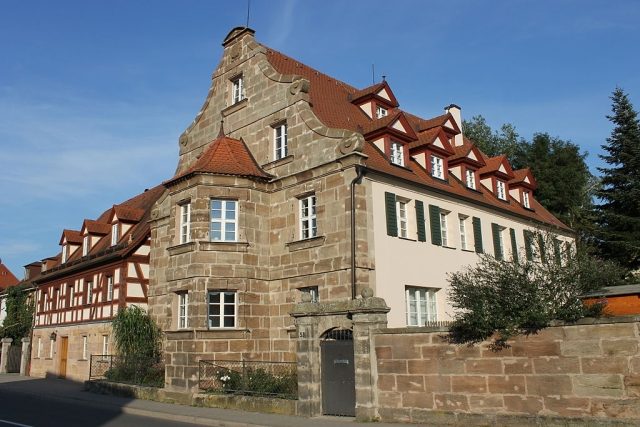
The house, rebuilt as an inn before 1649, only acquired its representative appearance after it was purchased by the physician Georg Pfann in 1716. The son of a naturopath often disparaged as a "quack" by the medical profession was apparently so wealthy that he was able to have the property significantly rebuilt around 1724/26. On this occasion, in 1724, as an inscription indicates, the massive gable facade with the curved ashlar gable adorned with volutes and the two-story tower bay window were created.
Even under Georg Pfann and his successor, the surgeon Johann Michael Meyer, the house was leased to an innkeeper. In the second half of the 18th century, the inn "Zum goldenen Bären" (To the Golden Bear), known by this name since 1702, was operated here. The transformation into a manor house seems to have occurred in the late 18th century, when the feudal lords, the Geuder zu Heroldsberg, took possession of the property under circumstances not yet clarified. Already in 1801, the Geuder family sold the property, now referred to as a manor house, with its stables, courtyard house, and a belvedere in the garden, to the Prussian Justice Councilor Hoeflich from Erlangen. The manor house was also described as a half-timbered building with a "stone gable".
Around 1806, perhaps in connection with the annexation of the Principality of Bayreuth by France, the Prussian official sold the manor to Privy Councilor Friedrich August von Ausin. Around 1820, the brewer and innkeeper Bernhard Gechter and his wife Elisabeth from Baiersdorf followed. With the Gechters, the interlude as a manor house ended: the family applied for economic rights and once again opened an inn "Zum goldenen Bären" here. In 1828, the Gechter couple sold the property to the tobacco manufacturer Johann Ernst Neder, who soon began setting up a tobacco factory. In 1856, however, Neder had to declare bankruptcy, and the property fell to the wholesale widow Johanna Regina Elch from Kaufbeuren, who was related to him. The widow, however, allowed Neder to continue living and producing on the property. After the death of the widow Elch, an inheritance community followed, which finally agreed in 1870 to transfer the property to August Neder. The new owner had a new horse stable built in 1876 as an extension to the former manor house.
In 1890, a few years after August Neder's death, the property was owned by Neder & Cie., Cigarren & Tabakfabrik, which had major alterations carried out on the ground floor in 1888 to meet the needs of the tobacco factory. Around 1900, production apparently ceased, and the property was first sold to the Leikam family, then in 1904 to Lucie Pöhlmann. Her heir was still the owner in the second half of the 20th century.
Take Mobile History with you
You are reading this text for free. Premium adds what matters on the road: descriptions read aloud, sites found through your camera, whole regions taken offline.
- Every description, including the ~17,700 Premium sites
- Audio guide: have descriptions read to you on location
- AR finder: see sites through your camera, with distance and bearing
- Unlimited saved sites
14 days free, then from €2.99 a month. Cancel anytime.
Source: Wikipedia · Licence: CC BY-SA 4.0 · Image: http://commons.wikimedia.org/wiki/File:F%C3%BCrther_Stra%C3%9Fe_53,_Erlangen-Bruck.jpg?uselang=de
This description draws on the facts documented in the linked Wikipedia article; Wikipedia content is licensed under CC BY-SA 4.0. Wording and editing: Mobile History.
Location: 49.5711, 10.9853