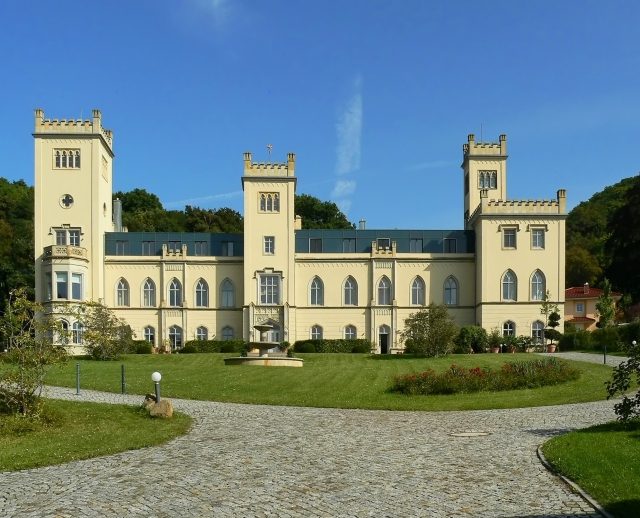
CastleDresden-Hosterwitz

Kepp Castle

Kepp Castle

To be privately owned

The Keppschloss at Dresdner Straße 97 in Dresden-Hosterwitz is a listed former country estate at the exit of the Keppgrund.

Marcolini's Summer Residence+

Around 1775, the Electoral Court of Saxony resided in Pillnitz Castle during the summer months. At this time, the Saxon Master of the Horse and Privy Councillor Camillo Marcolini was looking for a summer residence in the immediate vicinity to always be close to his liege lord Frederick Augustus III. He found an estate in the neighboring village of Hosterwitz that met his expectations. The first mention of a plantation estate on this ground dates back to 1661. From 1749 to 1763, the estate belonged to the property of the Saxon Prime Minister Heinrich von Brühl. The property included, among other things, a tobacco factory and a silkworm farm.

In 1774, Marcolini had the large vineyard area, built with a country house and a wine house with a press, among other things, bought in Hosterwitz with his own funds. As a Catholic, Marcolini was prohibited from acquiring land, so the Electoral Saxon Chief Supervisor Clemens Gustav Petzold made the purchases. In 1785, Marcolini expanded the property to include the neighboring Hosterwitz Mill, in 1792 the adjacent plantation estate, and finally acquired the so-called "Zuckerhut" (sugarloaf), a hill on the Hosterwitz Elbe slope, through Petzold around 1800. Only in 1807 did Marcolini officially become the owner of his property, as Catholics and Protestants were legally equalized.

Marcolini had the summer residence renovated and expanded to his taste; for example, a room in the left side wing of the country house received its own bowling alley. In 1801, Marcolini had a pleasure house built on the grounds. In 1808, the later Pope Leo XII stayed here, giving the house the name "Papstschlösschen" (Pope's Little Castle). After Marcolini's death in 1814, the mill, the plantation estate, and the vineyards were sold by his heirs. The heir Peter Marcolini bought numerous parts of the estate from other heirs and sold them as early as 1834 to the Privy Legation Councillor Friedrich Wilhelm von Trautvetter: the latter had renovations carried out by the architect Woldemar Hermann in the same year. Trautvetter lived on the estate with his family from the summer of 1837. From 1840, the estate was initially called "Köpp-" and later "Keppschloss". In 1850, Trautvetter had the main building extended and a stair tower added. In 1861, the banker Robert Thode acquired the castle. He had already bought the plantation in front of it in 1859.

Renovation under Robert Thode+

From 1861 to 1863, Thode had the manor house on the right and the adjoining country house with a side wing on the left connected and transformed into a uniform exterior appearance in the Neo-Gothic Tudor style. Both buildings were connected by an inserted tower with a battlement. This contained, among other things, the staircase and represented the new main entrance of the building.

As early as 1865, Thode sold the Keppschloss, which in 1872 passed to Grand Duchess Augusta Caroline Elisabeth of Mecklenburg-Strelitz, Countess of Stargard. She used it as a summer residence from 1886 until her death on December 5, 1916. The Keppschloss became a popular photographic subject in the second half of the 19th century, with photographs existing by August Kotzsch and Hermann Krone, among others.

The Keppschloss in the 20th and 21st Century+

The Grand Duchess's heirs sold the castle and the neighboring Zuckerhut in 1920 to the Romanian Consul General Tudor Dumitrescu, before it served as a children's convalescent home from 1925 to 1931. Until the end of the Second World War, the use of the building constantly changed; it was used, among other things, as an old people's home and an air raid shelter school. After the end of the war, it was initially inhabited by refugees, before the property was expropriated in 1947 and served as a training facility for civil defense from 1951 to 1989, from 1978 under the name "District School for Civil Defense Dr. Kurt Fischer". During this time, several alterations were made, such as the partial removal of the three towers and the replacement of the battlement with flat hip and gable roofs. In addition, the building was raised by half an upper floor to create quarters for the trainees. Numerous additional buildings for teaching were erected in the surrounding park. Until 1989, the building was used as a holiday camp during the summer holidays, with the students accommodated on the upper floor.

From 1990 to 1996, the building was used by the Saxon Administrative and Economic Academy and then stood empty. In 2004, the now dilapidated Keppschloss and the large property were bought by a real estate company. Subsequently, nine single-family house plots were created on the property. The building was reconstructed and renovated, and its interior was converted to create seven condominiums.

Take Mobile History with you

You are reading this text for free. Premium adds what matters on the road: descriptions read aloud, sites found through your camera, whole regions taken offline.

  • Every description, including the ~17,700 Premium sites
  • Audio guide: have descriptions read to you on location
  • AR finder: see sites through your camera, with distance and bearing
  • Unlimited saved sites

14 days free, then from €2.99 a month. Cancel anytime.

Source: Wikipedia · Licence: CC BY-SA 4.0 · Image: Thomas Eichler

This description draws on the facts documented in the linked Wikipedia article; Wikipedia content is licensed under CC BY-SA 4.0. Wording and editing: Mobile History.

Location: 51.0195, 13.8623