The church can be visited
ChurchOrvault
Saint-Léger d'Orvault Church
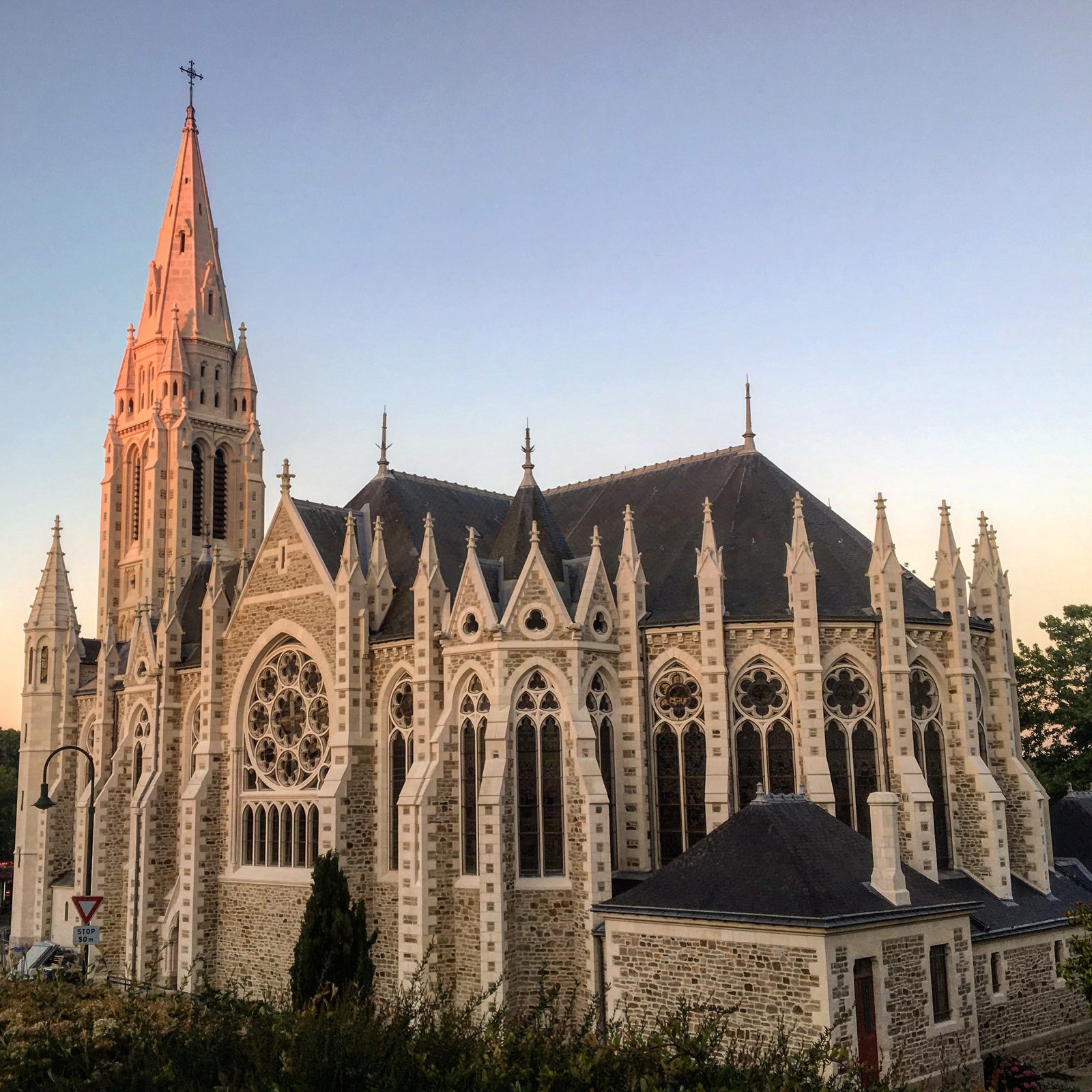
The Church of Saint-Léger is a Catholic church in Orvault, in the French department of Loire-Atlantique, in France. The current church in the town of Orvault is the fourth to be built there.
Location+
The church is located in the town of Orvault, on the church square. It is one of three churches of the parish of Bienheureux-Célestin-et-Michel-en-Val-de-Cens, which was founded on September 24, 2022. It belongs to the Nantes-Nord pastoral zone of the Diocese of Nantes (Ecclesiastical Province of Rennes). This new parish unites the former parishes of Sainte-Bernadette and Saint-Léger d'Orvault, founded in 2003, and that of Sautron.
History+
The Church of Saint-Léger d'Orvault is an ancient foundation. In fact, the current church, the fourth, first replaces the original church, which was founded as early as the 8th century by the disciples of Saint Hermeland and placed under the protection of Saint Léger (616-678), former Bishop of Autun. Afterwards, there was a new church in the 12th century, which was heavily restored in the 15th century. However, from 1830, the church, too small and in poor condition, showed its limitations. It became necessary to build a new church. The third church is the work of Rector Julien Lemarié, parish priest of Orvault from 1802 to 1840. The demolition of the old church began in 1835. The architect Joseph-Fleury Chenantais was commissioned to build the new one. The building was modest with its small porch and bell tower. But quickly, this new building proved too small and its general condition deteriorated increasingly. Already in the 1890s, the construction of a new church was again discussed. This time, however, a new location was chosen. Canon Jean Richeux (1870 to 1902) decided to build the church on the very large vegetable garden of the presbytery, which stretched between the Route de la Carrière and the Route du Pont-aux-Prêtre to the Parc de la Grée. On April 2, 1898, permission to begin construction was granted, according to the plans of architect François Bougoüin. Joseph Vallet executed the sculptures. The foundation stone was blessed on December 26, 1898. The church, in neo-Gothic style, was blessed on May 28, 1901. However, it was still without a bell tower and stained glass windows. Already in 1903, the choir was equipped with a white marble altar dedicated to the Sacred Heart of Jesus. The pulpit was acquired in 1909 and a small pipe organ adorned the church in 1912. It was not until 1935 that the bell tower was built. In 2017, the stained glass windows of the nave and transepts were completed, thus completing the church. In 2018, the complete renovation of the bell tower and the installation of a new organ took place.
Description+
Exterior+
In neo-Gothic style, the church is oriented northeast-southwest. Called a hall church, its central nave consists of five bays. All roofs are covered with slate. The richly decorated polygonal apse is characteristic of churches built by architect François Bougoüin. This arrangement can be found in the department in Aigrefeuille-sur-Maine, Nort-sur-Erdre or in Saint-Hilaire-de-Chaléons.
The bell tower, whose concrete spire was only added in 1935. It houses four bells, cast in 1935 by the Paccard foundry in Annecy. They were consecrated on April 2, 1935.
Bell 1: D flat 3 - Notre-Dame-des-Anges - 1,800 kg Bell 2: E flat 3 - Léger - 1,200 kg Bell 3: F 3 - Jeanne-d'Arc - 900 kg Bell 4: A flat 4 - Thérèse de l'Enfant-Jésus - 530 kg.
Interior+
The interior bears witness to an architectural research characteristic of the neo-Gothic style, which was very fashionable in the Diocese of Nantes at the end of the 19th century. The church has three naves separated by slender columns, thus forming a single space. All bays, including the side aisles, are covered with ribbed vaults. The keystones are decorated in various ways. The most remarkable are those of the transept, which show Christ in the center presenting the book of the Word of God, and at the four corners the Tetramorph, formed by the four winged symbolic figures. Other keystones represent the coats of arms of Leo XII and Mgr Rouard, then Bishop of Nantes. All the stained glass windows of the choir tell the life of Saint Léger, Bishop of Autun, patron saint of the parish. From left to right: Léger's childhood – His education at the court of Chlothar II in Soissons – His ordination as deacon by his uncle Dido, Bishop of Poitiers – He gives alms – He is appointed abbot of Saint-Maixent – Queen Bathilde, Queen of Neustria, sends for him to make him her advisor – Glorification of Saint Léger – Léger, Bishop of Autun around 663 – Léger angers King Childeric II – The king comes to murder him – He orders him to be torn from the abbey of Luxeuil, where he was in exile – Léger wants to prevent the looting of Autun by Erbroïn, the mayor of the palace – The martyrdom of Léger – In exile in the monastery of Fécamp – he is beheaded.
In October 2016, a restoration campaign for the choir windows of the church was carried out by the city of Orvault, owner of the building. In addition, a project to replace the nave and transept windows with the two large white glass rosettes was undertaken, and in 2017, the new, contemporary and abstractly inspired stained glass windows were manufactured and installed. This large-scale art project was realized by the company Vitrail-France from Le Mans in collaboration with the heritage architect from Nantes, Pierluigi Pericolo, who designed the project. Emmanuel Putanier, master glassmaker and owner of the company Vitrail-France, which manufactured the stained glass windows, affirmed at the beginning of the work: "It is a monumental construction site, quite rare nowadays, as three quarters of the church are affected. Indeed, projects of contemporary stained glass art are unfortunately too rare nowadays" (Eglise en Loire-Atlantique No. 74 – September 2017).
The theme of the project consists of a color gradient of yellow, ocher, green and blue, representing the city of Orvault from a bird's eye view, with the main windows traversed by a large and fine white cross.
Furniture+
The high altar, built in 1903, is made of white marble, decorated with mosaics and bas-reliefs of Carrara marble. The sculptures of the high altar depict in the center the meal of Jesus with the disciples of Emmaus. To the left stands Saint Joseph, holding the lily, symbol of purity and righteousness. To the right, Saint John the Baptist, dressed in his camel skin. The tabernacle is surrounded by two statues, depicting Saint Peter on the left and Saint John on the right.
In the church, in the left side chapel, there is also a statue of Our Lady of the Fields, depicting the Infant Jesus holding ears of corn and fruits in his hands. The right side chapel is dedicated to the Sacred Heart of Jesus. The two confessionals were made in 1911 by the Orvault carpenter Louis Aillerie. The pulpit, originally from the chapel of the Sacré-Cœur nuns in Nantes, was bought from them in 1909. Noteworthy is the decoration of the sounding board with its garland-shaped pendants, its pinnacles and its angels. Since July 13, 2013, the choir of the church has been equipped with a contemporary cross made of solid oak, which takes up the trefoil motifs of the stained glass windows of the side chapels. A cast iron Christ (from the 19th century) was attached to this cross. This work is the work of the Nantes carpenter Thomas Fouillet.
In 2018, the parish, with the support of the city of Orvault, acquired the old organ of the chapel of the La Persagotière Institute in Nantes. The small organ that had adorned the church since 1912 and came from the church of Saint-Père-en-Retz, was thus replaced by this new instrument. Built at the end of the 19th century by Auguste Tolbecque, this study organ with its "romantic" sound benefited from a comprehensive restoration by the organ builder Nicolas Toussaint during its transfer. A change to the sound system will take place in 2026 to avoid the known feedback of the old system.
Take Mobile History with you
You are reading this text for free. Premium adds what matters on the road: descriptions read aloud, sites found through your camera, whole regions taken offline.
- Every description, including the ~17,700 Premium sites
- Audio guide: have descriptions read to you on location
- AR finder: see sites through your camera, with distance and bearing
- Unlimited saved sites
14 days free, then from €2.99 a month. Cancel anytime.
Source: Wikipedia · Licence: CC BY-SA 4.0 · Image: Loïc LLH · Wikimedia Commons · CC BY-SA 4.0
This description is a machine translation of an excerpt from the linked Wikipedia article. The source text was written by its authors, the translation is by Mobile History; like the original it is licensed under CC BY-SA 4.0.
Location: 47.2707, -1.6236