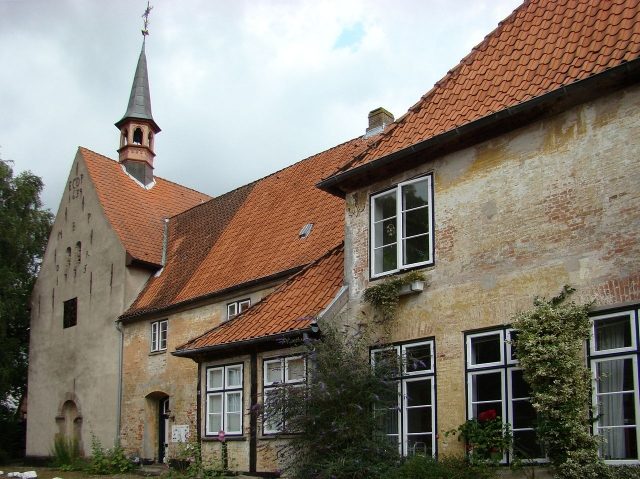
MonasterySchleswig

St.-Johannis Church

St.-Johannis Church

The Abbey can be visited

The St. Johannis Monastery in front of Schleswig was founded in 1194 as a Benedictine nunnery.

After the Reformation, it was converted into a convent for noblewomen, but the name St. Johannis Monastery was retained. The complex, located directly on the northern bank of the Schlei, has survived to this day and is considered the best-preserved medieval monastery complex in Schleswig-Holstein.

The first settlement of the Benedictine order in Schleswig, which became the episcopal see of the Diocese of Schleswig founded under the influence of Otto I in 948, was the St. Michaelis Monastery. It was first mentioned in a document in 1192, at the time of its dissolution by Bishop Waldemar of Schleswig, and described as a double monastery, but this is not historically confirmed. It is considered certain that, in addition to monks, nuns also lived in the area of the monastery, triggering a religiously and politically motivated crisis. The moral decay of its inhabitants is often cited as the reason for the dissolution of the monastery. It is certain that the monks were sent to Guldholm on Langsee near the present-day municipality of Böklund, where Waldemar intended to found his own house monastery, which was to be run according to the rules of the Cistercian order.

From 1194, the St. Johannis Monastery was built on the Holm, an island (Danish: Holm) in the Schlei in front of the city of Schleswig, near a fishing settlement. The Benedictine nunnery dedicated to John the Baptist on the Holm was first mentioned in writing in a document issued by the Danish King Abel on March 7, 1251 (not 1250, as erroneously stated). In it, Abel, as King of Denmark and Duke of Jutland (Schleswig), confirmed extensive freedoms for the St. Johannis Monastery in front of Schleswig, including exemption from military burdens, tax demands, and compulsory services. The provisor was granted jurisdiction. Only at the end of the 14th century was St. Johannis explicitly referred to as a Benedictine nunnery. The widespread story that the St. Johannis Monastery directly emerged from the St. Michaelis Monastery is therefore also not historically verifiable.

At the time of the monastery's founding, Schleswig still held the position of Haithabu, which was abandoned in 1066 after a fire, as a supra-regional trading center in the North, but it was to lose this position to Lübeck and the emerging Hanseatic League in the following years. As an episcopal see and seat of the Dukes of Schleswig, it initially remained a religious and political center. Approximately at the same time as the St. Johannis Monastery, the Franciscan Monastery of St. Paul (1234) and the Dominican Monastery of St. Maria Magdalena (1235) were also built in Schleswig. The St. Petri Cathedral in Schleswig was at that time still a Romanesque basilica, built before 1134 and partially collapsed in 1275; around the time of the founding of St. Johannis, the still existing Petri Portal (around 1180) and the Canon's Sacristy (1230) were built.

For the year 1402, six nuns were attested in addition to the prioress, and for the year 1464, nine. This corresponds to the preserved early Gothic ten-seat nun's choir stalls from around 1240. Fires in 1299 and 1487 led to massive destruction and subsequent reconstruction. In 1536/1542, the monastery came into the possession of the Schleswig-Holstein knighthood and was converted into a convent for the unmarried daughters of the Schleswig-Holstein nobility. In the 17th and 18th centuries, the monastery complex was supplemented by further buildings. In the 1840s, the then cantor of the monastery church, Carl Gottlieb Bellmann, composed the melody of the Schleswig-Holstein song "Schleswig-Holstein meerumschlungen."

The complex, which is a protected cultural monument, is today considered the best-preserved medieval monastery complex in Schleswig-Holstein despite the two fires. The outdoor areas are freely accessible, while the interior of the monastery can only be visited as part of a guided tour. Parts of the convent are now used for cultural events and weddings. The convent is primarily financed by rentals today, and a dedicated support association, in addition to public authorities, is responsible for the restoration of the complex.

Monastery Complex and Inventory+

Throughout history, there have been repeated structural and design changes, with the conversion of the Benedictine nunnery into a convent for noblewomen representing a profound turning point. The changes primarily relate to the design of the complex, while the basic structure, determined by the location of the refectory and church, has been preserved. It essentially follows the St. Gall Monastery Plan from the 9th century. The following section describes the current state, which represents a mixture of elements from the period before and after the Reformation.

Monastery Church

In the north of the monastery complex, located directly on the Schlei, is the single-nave Romanesque monastery church from the period between 1200 and 1230. A parish church built of tuff, which originated before 1170, already stood on this site before the monastery was founded. The church's floor plan is divided into the tower, the nave, and the choir, which are located under a common gable roof. Instead of a visible tower, the church only has a simple roof turret. The choir apse here is not semicircular, as is common in Romanesque architecture, but flat.

Above the nave with the stalls for the common people is the nuns' gallery, which now serves as the organ gallery, dating from around 1240 with its painted balustrade. On the west wall of the nave below the nuns' gallery, remnants of Gothic frescoes from the 15th century were uncovered in 1936. They had been painted over in later centuries and partly covered by the inserted ribbed vault below the gallery.

A choir portal from the period between 1505 and 1525 separates the nave from the choir. Above it rises the crucifix group (the body of Christ and the cross inscription INRI are attached to the front and back of the cross). To the left and right are the statues of Mary and John. The altar area is dominated by Baroque elements: the high altar with a painting of the Crucified by D. Oberdorff dated 1712, the pulpit, and the ten prayer cubicles of the conventuals from the period between 1711 and 1717. Next to the high altar on the east wall, the late Gothic sacrament house, created around 1450, rises 4.5 meters high. On the walls around the altar hang the funeral escutcheons of the deceased conventuals. Various sculptures and paintings, donated by the convent ladies, adorn the church walls, including a late Gothic Mary in a halo and a Bartholomew from the same period.

Monastery around the Cloister

On a vaulted cellar from the 13th century in the southern part of the complex stands the refectory, built after the fire of 1487; it is the only part of the monastery with a cellar. The richly carved ten-seat nun's choir stalls from 1240, located there, originally stood on the nuns' gallery of the church. On the walls hang the counterparts of the funeral escutcheons from the altar area of the church. Bellmann is said to have composed the Schleswig-Holstein song on the small cabinet organ from the second half of the 18th century.

In the chapter house directly next to the monastery church, the monastery treasures are kept, including the oak head of John the Baptist carved around 1400 in a bowl, a so-called John's bowl. This head is present at all important events in the monastery. The silverware is said to come from the house of the poet Johann Wolfgang von Goethe.

The buildings of the complex are connected by the four-winged cloister, the so-called Schwahl, with its ribbed vault from the 14th century, which surrounds the monastery courtyard. The living areas are arranged around the cloister. The nuns' gallery and the choir are also accessible from the Schwahl, so the nuns could reach their choir stalls or the conventuals their prayer cubicles without having to enter the generally accessible nave. The east wing was largely rebuilt in 1899/1900.

In the cemetery next to the monastery church lie the graves of the prioresses of St. Johannis. Bellmann and his wife were also buried in the cemetery next to the monastery church; a tombstone and a memorial plaque on the monastery wall commemorate him.

Parsonage and House of the Monastery Provost

Opposite the church is the residence of the provosts of the convent, built around 1754, which today houses the St. Johanniskloster Bible Center, focusing on the history of the Bible. Next to the so-called Provost's House are a Bible garden and a sculpture park, designed by renowned artists on "Prophets" and "Animals of the Bible," a garden with stone sculptures made of Anröchte dolomite. The 18th-century houses Am-St.-Johannis-Kloster 2-6 (Parsonage), 4 (Provost's House) are listed buildings. House No. 10 probably dates back to the 17th century.

Convent for Noblewomen+

The close ties to the Schleswig-Holstein nobility prevented the dissolution of the monastery after the Reformation, but allowed its conversion into an evangelical noblewomen's convent. As the nobility was by then largely Lutheran, the church order of March 9, 1542, transformed the monastery on the Holm into an evangelical convent. The rule of the reformer Johannes Bugenhagen, which was under the heading: "Eyne Godtfürchtige vnde Recht Christike ock der Olden Kercken gelickmetige Ordeninge der Ceremonien vor Domheren vne Clöster" (A God-fearing and truly Christian and also ancient church-like order of ceremonies for canons and monasteries), replaced the Benedictine rule. In the confirmation of the privileges of the St. Johannis Monastery by King Frederick II of Denmark on September 11, 1566, it was emphatically pointed out that the church order of 1542 must remain inviolate. It can therefore be assumed that individual conventuals, more or less openly, remained loyal to the old rule. As a foundation for the appropriate provision of unmarried daughters of the Schleswig-Holstein nobility, the St. Johannis Monastery has survived to the present day.

Similar fates befell the nunneries of Preetz, Uetersen, and the monastery in Itzehoe, which also came into the possession of the Schleswig-Holstein knighthood.

Part of the admission ritual for the St. Johannis Convent for noble maidens is that the applicant kisses the wooden head of Saint John. In the poem "Das Haupt des heiligen Johannes in der Schüssel" (The Head of Saint John in the Bowl) from the book "Adjutantenritte und andere Gedichte" (Leipzig, 1883) by Detlev von Liliencron, it says:

"But he [Isern Hinnerk] made the condition,
Every maiden who wanted to become a nun,
Had to become one,
Should kiss this head."

Even today, the daughters of members of the knighthood can be admitted to the convent. Usually, the daughter is enrolled immediately after birth, the expectancy is confirmed with a convent letter, and the daughter becomes a so-called "expected maiden." If the expectant remains unmarried, she can be admitted to the convent as a conventual when a position becomes vacant. Upon admission, she receives a lifelong right of residence in the convent and – depending on its financial situation – a right to an appanage. However, the ladies do not have to live in the convent. In 2001, there were six conventuals, two of whom lived in the convent.

The convent is led by the Prioress and a Provost. The Prioress is elected from among the conventuals; until her death at the age of 93 in October 2012, Henny von Schiller was the Prioress and sole resident of the convent. Her successor as Prioress is Baroness Gesa von Maydell. The Provost (to be distinguished from "Propst" as a cleric) is nominated by the Schleswig-Holstein knighthood and elected by the conventuals; the incumbent Provost is Friedrich von Ahlefeldt-Dehn (as of July 2008).

Prioresses

  • 1382,1383 Lutghard (Luidgaard) von der Wisch
  • 1402 Grete Schinkel
  • 1439 Cecilia Esbern
  • 1464 Syle Esbern
  • 1487 Wybe Meynerstorp (Wiebe Meinstof)
  • 1498 Margarete Smalsteden (Smalstedt)
  • 1515 Elisabeth von Aleuelde (von Ahlefeld)
  • 1546 Margharete Strangens
  • 1864–1875 Ulrike von Pogwisch
  • 1984–1992 Gerda Baroness von Löwenstern a. d. Hs. Rösthof
  • 2012 † Henny von Schiller

Provosts

  • Johann Krummendiek 1388
  • Johann Adolph Kielmann von Kielmannsegg
  • Wulff von Ahlefeldt
  • Detlev von Reventlow 1714
  • Cai von Rantzau 1770
  • Jürgen von Ahlefeldt 1771–1777
  • Wulf Christopher von Ahlefeldt
  • Theodor von Reventlow 1840–1847
  • Rochus von Liliencron 1876–1908
  • Friedrich von Ahlefeldt-Dehn since 2008
Economic Conditions+

In the first two centuries of its existence, the monastery struggled with severe economic difficulties, partly because the convent consisted of at most ten nuns. In the second half of the 14th century, the economic situation improved, especially with the acquisition of the patronage and the church of Sankt Marien in Kahleby (today a district of Schaalby) in 1385. Finally, religiously motivated donations from the nobility and bourgeoisie provided the monastery with extensive landholdings.

The administration of the monastery was in the hands of the monastery provost. Before the Reformation, the monastery provosts were clerics. Nevertheless, the prioresses seem to have had more authority than the provost. After the destruction of the monastery by fire in 1487, Prioress Wybe Meynerstorp alone issued a fire letter for alms. In contracts from 1383, 1402, 1439, 1446, and 1464, the prioress was always named, not the provost.

In the 15th century, further lands in Angeln and the area east of the Haddebyer Noor were added and grouped as the Schlei district. Until the 19th century, the monastery's possessions included extensive lands up to 6500 hectares in the vicinity of Schleswig, including four farms, 140 smaller landholdings, four mills, and three churches. The total area was more than 6500 ha and included villages such as Jagel.

In the 19th century, according to monastery provost Henning von Rumohr, the property and lands were sold for reasons that are difficult to understand.

Take Mobile History with you

You are reading this text for free. Premium adds what matters on the road: descriptions read aloud, sites found through your camera, whole regions taken offline.

  • Every description, including the ~17,700 Premium sites
  • Audio guide: have descriptions read to you on location
  • AR finder: see sites through your camera, with distance and bearing
  • Unlimited saved sites

14 days free, then from €2.99 a month. Cancel anytime.

Source: Wikipedia · Licence: CC BY-SA 4.0 · Image: http://de.wikipedia.org/wiki/Datei:Kloster_St.Johannis_Schleswig.JPG

This description draws on the facts documented in the linked Wikipedia article; Wikipedia content is licensed under CC BY-SA 4.0. Wording and editing: Mobile History.

Location: 54.5116, 9.5789