Museum
ChurchMönchsondheim
Kirchenburg Mönchsondheim (Church Castle)
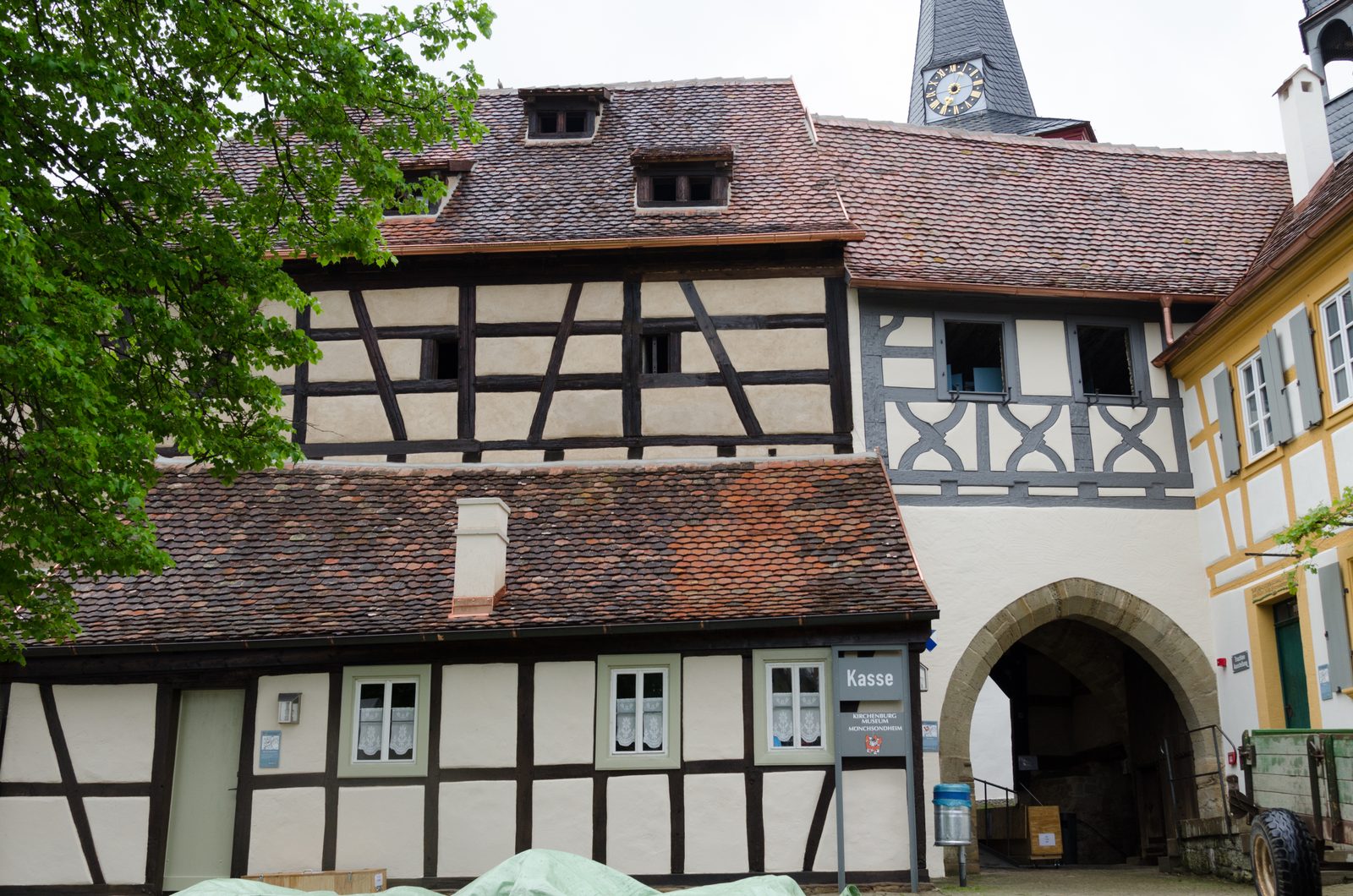
The fortified church of Mönchsondheim encompasses the fortified areas of the churchyard around the Evangelical-Lutheran Church of St. Boniface in the village of Mönchsondheim in the district of Kitzingen in Lower Franconia. The complex is considered one of the best-preserved of its kind in Franconia and is now the center of the Mönchsondheim Fortified Church Museum.
The fortified church forms the center of the village of Mönchsondheim. It is located at some distance from the district road KT 1, which runs through the village as the main road, to the west on a slope. The two streets "An der Kirchenburg" and "Bergstraße" form a ring around the complex. Unlike many neighboring fortified churches, Mönchsondheim did not develop an almost rectangular complex. Instead, the castle today forms an irregular polygon. The Boniface Church forms the center.
History+
In general, fortified churches date back to the threats of the Middle Ages. While cities and richer villages surrounded themselves with a ring wall, poorer communities only fortified the churchyard, which also served as a cemetery in earlier times. By 1400 at the latest, the Mönchsondheim churchyard was fortified. Particularly noteworthy is the fact that the fortified church was surrounded by a moat, at least in the gate area, which was filled with water like a real castle moat. The church in the center of the complex, with its tower, simultaneously offered a vantage point. It was therefore particularly annoying for the Mönchsondheim fortified church when the tower of the Boniface Church and with it part of the church was destroyed in 1638. However, by this time the complex had largely lost its military significance because the walls could not withstand the latest artillery. Nevertheless, the community continued to maintain the fortified church and even had a new gatehouse built in 1698. This is due to the fact that the supplies of the Mönchsondheim residents could be stored in the church houses, which were built closely around the church inside against the ring walls. Therefore, in the 18th century, the church houses and storage rooms began to be renovated. In 1975, the houses, which were still used by private individuals, began to be converted into an open-air museum. The fortified church is listed as a historical monument.
Description+
Boniface Church+
The Evangelical-Lutheran parish church inside the fortified church today presents itself as a simple hall building with a choir tower from the late 17th century. The church had to be rebuilt between 1688 and 1690 because the old church had been damaged in the Thirty Years' War. For this purpose, the new building was integrated into the existing fortified church. This explains the partly narrow passages between the church and the surrounding church houses.
Source: Wikipedia · Licence: CC BY-SA 4.0 · Image: Tilman2007 · Wikimedia Commons · CC BY-SA 3.0
This description is a machine translation of an excerpt from the linked Wikipedia article. The source text was written by its authors, the translation is by Mobile History; like the original it is licensed under CC BY-SA 4.0.
Location: 49.6672, 10.2777