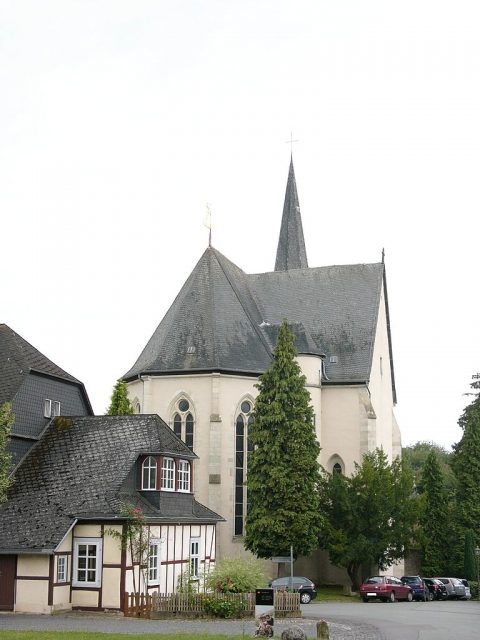
MonasteryAltenberg

Altenberg Abbey

Altenberg Abbey

Offices

Altenberg Abbey is a former Premonstratensian convent. It is located between Wetzlar and Solms-Oberbiel on the Michelsberg above the Lahn river.

In 1167, the priest Gottfried von Beselich founded a chapel dedicated to Saint Michael on the "old mountain". He was also the founder of Walsdorf Abbey near Idstein and Beselich Abbey near Obertiefenbach. He is also credited with building the Lahn bridges near Limburg and Wetzlar.

Around this chapel, the Premonstratensian convent was established around 1170. Abbot Engelbert von Rommersdorf sent 12 Wülfersberg virgins who transformed the Nikolauskapelle of Altenberg into a monastery. The mother abbey was thus Rommersdorf Abbey. Many members of noble families from the surrounding area, such as the House of Nassau and the House of Solms, entered the convent. The second mistress of the convent was Christina von Biel, who laid the foundation for the later wealth of the convent with her fortune.

In 1248, Gertrud, the daughter of Saint Elisabeth of Thuringia, became the third mistress of the order's convent; she held this office for 49 years. Under Gertrud, the convent experienced a boom. The convent church was built between 1260 and 1270. The convent acquired extensive possessions on the Lahn, in the Wetterau and in the hinterland (including the Hülshof, today a district of Bad Endbach). Emperor Barbarossa granted the convent imperial immediacy before 1192. After her death in 1297, Gertrud was venerated as a blessed. Gertrud's successor was Katharina von Nassau (1297-1324), an aunt of King Adolf von Nassau and sister of Otto.

Altenberg Abbey, unlike the nobles of the surrounding area, did not join the Reformation and formed a Catholic enclave remaining with Kurtrier. During the Thirty Years' War, the convent was burned to ashes by Swedish soldiers in 1636, but was able to recover under Mistress Katharina von Derschen (1644-1655).

Altenberg Abbey was at times the burial place of the House of Solms. The House of Solms tried to gain the imperial Vogtship over the convent. However, the convent was able to maintain its imperial immediacy until 1802. After 1802, as a result of the Reichsdeputationshauptschluss, the convent complex came into the possession of the Princes of Solms-Braunfels, who dissolved the convent and converted it into a domain, using the complex as a summer residence. They moved numerous art objects from the convent to other castles for protection. The winged altar from around 1330, for example, is now partly in Braunfels Castle, and the wings designed by an unknown master can be viewed in the Städel in Frankfurt. The convent church was converted into an evangelical parish church.

Since the end of the First World War, the convent has served various purposes; among other things, a children's home was housed there after 1947. In 1952, the complex was severely damaged by a fire. After renovation in 1955, the Königsberger Diakonie der Barmherzigkeit, a community close to the Evangelical Alliance, leased the buildings until 2054 as a mother house. They operated a nursing facility here until 2010. From 2009 to 2011, the Gießen-Friedberg University of Applied Sciences had offices in the former convent and tried to establish a part-time training program. Due to the economic difficulties of the Königsberger Diakonie, Kloster Altenberg gemeinnützige GmbH took over the rights and obligations of the lease agreement for three years from August 2010.

Complex+

The 13th-century church and the convent buildings are still preserved. Numerous 17th-century farm buildings are also present. The outer wall of the convent almost completely encloses the complex.

Both the former convent church and various exhibits in the sacred rooms of Braunfels Castle in Braunfels (Lahn-Dill-Kreis) can be visited.

Organ

In 1757, Johann Wilhelm Schöler built the third organ of the convent. Predecessor instruments date from 1452 and 1653. Schöler's instrument has 23 stops, 2 manuals, and pedal. With its limited keyboards and gentle but very colorful sounds, it is entirely designed for its liturgical function. Apart from maintenance and minor repairs, the original work has been preserved almost unchanged.

Take Mobile History with you

You are reading this text for free. Premium adds what matters on the road: descriptions read aloud, sites found through your camera, whole regions taken offline.

  • Every description, including the ~17,700 Premium sites
  • Audio guide: have descriptions read to you on location
  • AR finder: see sites through your camera, with distance and bearing
  • Unlimited saved sites

14 days free, then from €2.99 a month. Cancel anytime.

Source: Wikipedia · Licence: CC BY-SA 4.0

This description draws on the facts documented in the linked Wikipedia article; Wikipedia content is licensed under CC BY-SA 4.0. Wording and editing: Mobile History.

Location: 50.5585, 8.4452