Abbey
Brewery
MonasteryErling
Andechs Abbey
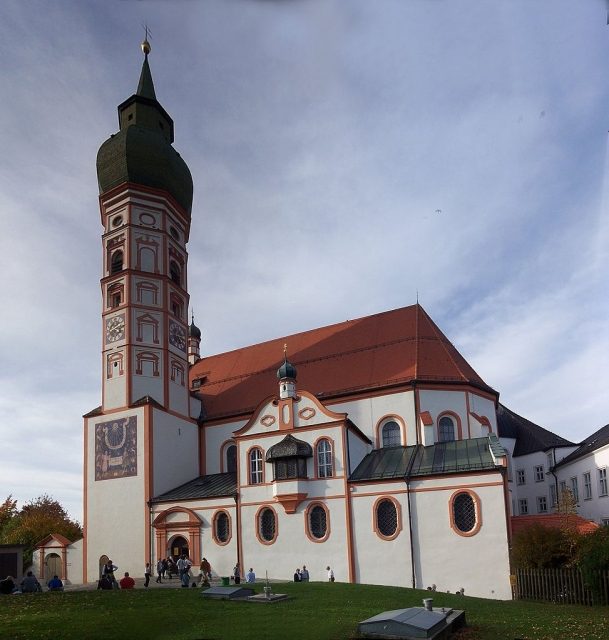
The Benedictine abbey of Andechs is a place of pilgrimage on a hill east of the Ammersee in the Landkreis of Starnberg (Upper Bavaria) in Germany, in the municipality Andechs. Andechs Abbey is famed for its flamboyant Baroque church (1712) and its brewery. Composer Carl Orff is buried in the church.
Counts and dukes of Andechs+
The site of Andechs was originally occupied by a castle belonging to the counts of Dießen on the Ammersee, probably built on a Roman castrum, and remained the seat of the powerful counts of Dießen-Andechs (1135 to 1180) and dukes of Andechs-Merania (1180 to 1248). In 1132 the count donated his ancestral seat at Dießen to the Holy See and moved to Andechs.
Otto II of Andechs was bishop of Bamberg, 1177 – 1196. In 1208, when Philip of Swabia, King of the Germans, was assassinated at Bamberg by Otto of Wittelsbach, members of the house of Andechs were implicated, and the castle at Andechs was razed before the family was rehabilitated.
Saint Hedwig of Andechs (ca 1174 – October 1243) born at Andechs, was one of eight children born to Berthold IV, Count of Dießen-Andechs and Duke of Istria. Of her four brothers, two became bishops, Ekbert of Bamberg (1203 – 1231), and Berthold, Patriarch of Aquileia; Otto succeeded his father as Duke of Dalmatia, and Heinrich became Margrave of Istria. Of her three sisters, Gertrude of Andechs-Merania (1185–September 24, 1213) was the first wife of Andrew II of Hungary and the mother of St Elisabeth of Hungary; Mechtilde became Abbess of Kitzingen; while Agnes, a famous beauty, was made the unlawful wife of Philip Augustus of France in 1196, on the repudiation of his lawful wife, Ingeborg, but was dismissed in 1200, after Pope Innocent III laid France under an interdict.
When the dukes of Andechs-Merania were extinguished in the direct male line in 1248, the entire region was annexed by the bishop of Bamberg. A history of the house of Andechs was written by Joseph Hormayr, Baron zu Hortenburg, the historian-statesman, and published in 1796.
The heilige Berg+
In 955, relics which Rasso, count of Diessen, had brought from Rome and the Holy Land to his monastery at Wörth (later called Grafrath) had been transferred to thi …
Source: Wikipedia · Licence: CC BY-SA 4.0
This description draws on the facts documented in the linked Wikipedia article; Wikipedia content is licensed under CC BY-SA 4.0. Wording and editing: Mobile History.
Location: 47.9744, 11.1831