Hotel
Baumburg Abbey

Baumburg Abbey is a former Augustinian canons' monastery in the northern district of Traunstein, which was dissolved in 1803 during the secularization. Today, Baumburg is also a Catholic deanery, encompassing the parishes of the northern Chiemgau region.
The founding of the collegiate monastery of St. Margareth in Baumburg by Count Berengar I of Sulzbach around 1107/09 was preceded by his vow in 1105 upon the death of his wife, Countess Adelheid of Megling-Frontenhausen. Under pressure from his numerous obligations, Count Berengar I appointed Eberwin as provost of the monastery and assigned him the Augustinian canons whom he had previously called from Rottenbuch Abbey, along with Eberwin, to establish the collegiate monastery of Berchtesgaden. He also transferred Berchtesgaden's estates to the new monastery. However, at Berengar's request, Eberwin returned to Berchtesgaden around 1116 (according to Helm between 1106 and 1112, according to Feulner probably around 1116, according to Albrecht and Weinfurter between 1116 and mid-1119) to lead it again as an independent monastery.
The regained "former freedom" of Berchtesgaden did not please the new and "first" provost of Baumburg, Gottschalk (approx. 1120–1163), at all. He regarded Eberwin as an "apostate" and removed him from the list of provosts. Furthermore, he was unwilling to accept the loss of Berchtesgaden's endowment properties. After Berengar's death (December 3, 1125), he challenged the legitimacy of the separation of the two collegiate churches and appealed to the responsible bishop, Archbishop Konrad I of Salzburg (1106-1147), for a decree to reunite them. Only after an arbitration ruling by Konrad in 1136 was the coexistence of both collegiate churches confirmed in Berengar's sense, and again confirmed by Pope Innocent II in 1142. Baumburg's demands, however, were dismissed as "the opinion of certain simple-minded brothers."
During Gottschalk's tenure as provost of Baumburg Abbey (until 1163), a St. Nicholas church was consecrated in 1129, and the Romanesque Basilica of St. Margareth was built by 1156. The foundress Adelheid has been buried there ever since. Around this time, the Archbishop of Salzburg transferred an archdeaconry to the provostship of Baumburg. Thus, the provost acted as the archbishop's representative for ecclesiastical jurisdiction, church supervision, and asset management. In 1185, this function was confirmed by the Pope.
The Augustinian canons primarily served as pastoral caregivers. The collegiate church included the parishes in Baumburg-Altenmarkt, St. Georgen, Truchtlaching, Traunwalchen, Neuenchieming, Kienberg, Poing (today Truchtlaching), and Haberskirchen, as well as possessions in Lower Austria. The collegiate school also gained importance, predominantly attended by sons of the regional nobility. From 1367, the provosts also received the right to carry an abbot's staff.
Like other collegiate churches, Baumburg also experienced religious and economic decline in the 15th century, and especially during the Reformation. Baumburg was repeatedly placed under administration, including between 1536 and 1538 under that of the Berchtesgaden collegiate provost and later prince-provost Wolfgang II Griesstätter zu Haslach. In addition, fires devastated the collegiate church three times between 1523 and 1539, so that by 1579 only three canons resided in the collegiate church.
By the end of the 16th century, Baumburg experienced a new lease of life. The collegiate school, as in the Middle Ages, once again enjoyed a good reputation among the nobility. The number of canons also increased again.
The Baroque redesign of the formerly Gothic buildings of the collegiate church began around 1600 with a renovation of the medieval church. During this time, the tower tops received their characteristic onion domes. Provosts Michael Doegger (reg. 1688-1706) and Patricius Stöttner (reg. 1707-37) initiated alterations and new constructions of the collegiate buildings. On the occasion of the 600th anniversary of its consecration, master builder Franz Alois Mayr from Trostberg erected the current church of St. Margareta from 1755 onwards in the Rococo style with delicate stucco work and frescoes.
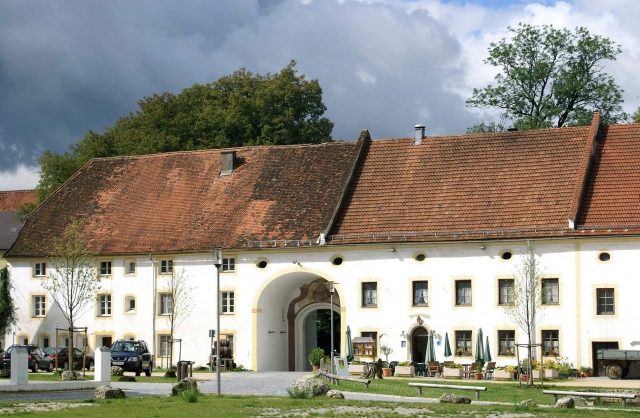
In 1803, the collegiate church was dissolved by the Bavarian state as part of the secularization. By 1812, the collegiate and economic buildings, as well as the collegiate's own properties, were auctioned off. The collegiate church henceforth served as the parish church of Altenmarkt an der Alz. Many of the monastery's buildings were demolished. Since 1910, a wing of the complex has served as the rectory. Another wing served for a long time as a recreation home for the English Ladies. Today, a private seminar hotel is housed there, which is popular with choirs and orchestras. The Baumburg monastery brewery, founded in 1612, is also privately owned today.
Take Mobile History with you
You are reading this text for free. Premium adds what matters on the road: descriptions read aloud, sites found through your camera, whole regions taken offline.
- Every description, including the ~17,700 Premium sites
- Audio guide: have descriptions read to you on location
- AR finder: see sites through your camera, with distance and bearing
- Unlimited saved sites
14 days free, then from €2.99 a month. Cancel anytime.
Source: Wikipedia · Licence: CC BY-SA 4.0
This description draws on the facts documented in the linked Wikipedia article; Wikipedia content is licensed under CC BY-SA 4.0. Wording and editing: Mobile History.
Location: 47.9985, 12.5317