Home for people with handicap
Restaurant
Bildhausen Abbey

The Bildhausen Monastery (also Maria Bildhausen Monastery) is a former Cistercian abbey near Münnerstadt in Bavaria in the Diocese of Würzburg. It is located in a partially wooded hilly landscape on the eastern edge of the Rhön.
The Cistercian monastery, dedicated to Saint Bilhildis, was founded in 1156 by Hermann von Stahleck, Count Palatine of the Rhine, and settled on February 12, 1158, by monks from Ebrach Monastery in the Steigerwald.
Until 1525, the monastery experienced a first period of prosperity, characterized by rich acquisitions and donations. During the German Peasants' War, the so-called Bildhausen Horde, the regional association of rebellious peasants and citizens, brought devastation and looting to the abbey between Easter and Pentecost 1525. Between 1552 and 1555, in the so-called Second Margrave War, the monastery suffered further severe damage to its assets and buildings. The third setback was the Thirty Years' War, which nullified restorations by Abbot Michael Christ (1582).
In the 17th and 18th centuries, reconstruction work took place, which essentially gave the monastery complex, as it still presents itself in its preserved parts, its current appearance.
The monastery was dissolved in 1803 during the secularization. In 1826, the church, as well as the cloister, the gate chapel, and the guest house, were demolished. In 1897, Dominikus Ringeisen acquired the monastery complex. Sisters of the St. Josefskongregation from Ursberg moved into the preserved buildings and established a facility for people with disabilities in 1929. In 1954, at the request of the municipality of Kleinwenkheim, the district of Bildhausen was renamed Maria Bildhausen by resolution of the Bavarian State Government. Since 1996, the facility for people with disabilities has been continued by the ecclesiastical Dominikus-Ringeisen-Werk foundation.
Dominikus-Ringeisen-Werk Maria Bildhausen+
The Dominikus-Ringeisen-Werk operates as a facility for disability assistance:
- Central residential services in Maria Bildhausen,
- Decentralized residential services in Bad Königshofen and Münnerstadt,
- a workshop for people with disabilities in Maria Bildhausen and Münnerstadt,
- a support center in Maria Bildhausen,
- Outpatient and open assistance in the districts of Bad Kissingen and Rhön-Grabfeld, and
- a day support center for people with autism in Aschaffenburg.
The central residential services at the Maria Bildhausen location provide care for adults with intellectual disabilities as a residential home, residential care home, and specialized care facility. 182 places are available in 14 residential groups.
The decentralized residential services include a residential home with 14 places and assisted living in Bad Königshofen, since 2008 a supervised residential group with 9 places, and since 2009 a residential home with 14 places and assisted living in Münnerstadt.
In the workshop for people with disabilities (WfbM) with 180 places, people with disabilities are employed in the areas of industrial and manual production, in-house production, and services. There is a vocational training area to introduce them to working life within a period of up to two years, as well as internship and training opportunities in household management, butchery, central kitchen, gardening, and the monastery shop. With appropriate aptitude, workshop employees can receive work in these areas or in outsourced workplaces after the training phase.
Sights+
The following buildings of the former monastery complex are preserved today:
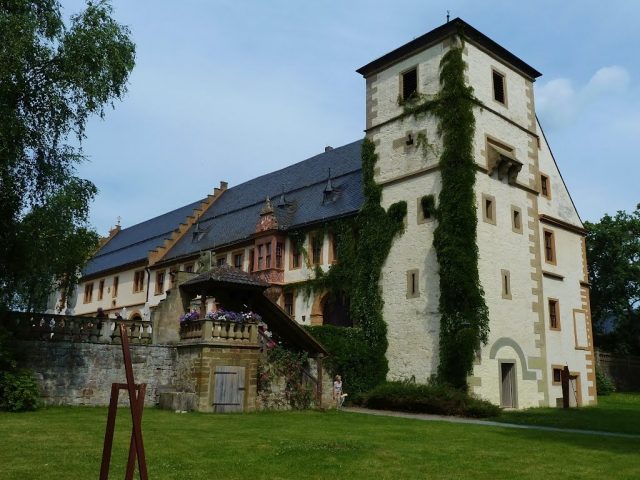
- The former abbey and syndicate building was built in 1625 under Abbot Georg Kihn as a replacement for the war-destroyed previous buildings in the Renaissance style. The building consists of the chancellery with a Renaissance gable and bay window on the south side, connected to the older square archive tower on the east side (built at the end of the 16th century) and the chancellery adjoining to the north. The interior (staircase with rich stucco work and abbot's apartment on the upper floor with Rococo decor) dates back to Abbot Bonifaz Geßner (second half of the 18th century).
- For the new convent buildings of St. Maria (17th and 18th centuries), parts of the building fabric of the original 12th-century construction were used.
- The plinth floor of the octagonal, five-story stair tower from the early 17th century in the Renaissance style still originates from the medieval building. It stands alone today but was formerly connected to the no longer existing refectory.
- The garden pavilion, built in 1766, also belongs to the era of Bonifaz Geßner.
- The gatehouse (entrance gate) was built in 1788 by the last abbot of the monastery, Nivardus Schlimbach.
- Also from the last abbot are the summer residence and farm buildings at the current golf course.
Nothing remains of the monastery church, which was demolished in 1826 and dated back to Abbot Georg Kihn (17th century). The 17 Baroque altars that the church once possessed are distributed among various churches in the region; 4 are missing. A permanent exhibition with photographs and accompanying material in the preserved basement of the former guest house (Kaisersaal) documents the research of the former estate manager Alfons Maria Wirsing (deceased 1986) on these altars, after the files kept in the Würzburg State Archives were burned during the bombing in 1945.
Gastronomy+
There is a monastery inn, which is temporarily closed, as well as a restaurant at the golf course.
St. Josefskongregation+
The convent currently has five sisters (as of May 2013).
The agricultural areas, insofar as they are still used as such today, were leased in summer 2009 and are being converted to organic farming. Local products include apple juice, liqueurs, and schnapps.
A golf course was built on another 138 hectares of previously agriculturally used areas in 1992–1993; the summer residence and farm buildings of Abbot Schlimbach were partially renovated or renewed. The operator is the Golfclub Maria Bildhausen e. V. On the 18-hole course, parts of the natural field and meadow landscape were preserved, and additional ponds and plantings were created. With an area of twelve kilometers, the golf course is twice as spacious as an average-sized facility; the length of the fairways is not affected by this.
Take Mobile History with you
You are reading this text for free. Premium adds what matters on the road: descriptions read aloud, sites found through your camera, whole regions taken offline.
- Every description, including the ~17,700 Premium sites
- Audio guide: have descriptions read to you on location
- AR finder: see sites through your camera, with distance and bearing
- Unlimited saved sites
14 days free, then from €2.99 a month. Cancel anytime.
Source: Wikipedia · Licence: CC BY-SA 4.0 · Image: Reinhold Schulz
This description draws on the facts documented in the linked Wikipedia article; Wikipedia content is licensed under CC BY-SA 4.0. Wording and editing: Mobile History.
Location: 50.2769, 10.2875