College
Private school
MonasteryBüren
Böddeken Abbey (Büren)
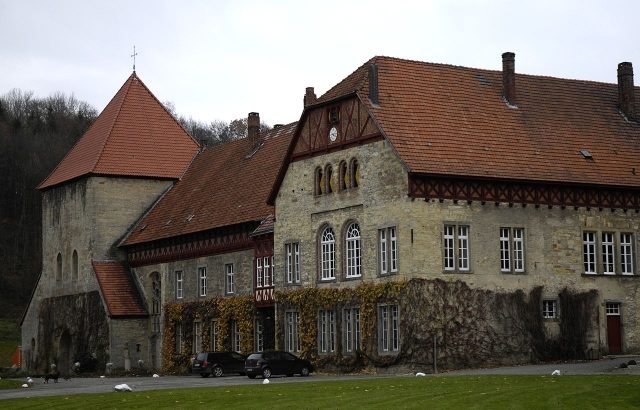
Böddeken is a historic settlement in the northeast of the city of Büren in the district of Paderborn. The former monastery and current estate of Böddeken is located in a karst valley of the Paderborn plateau at the intersection of state roads L751 and L 818, about 2 km southeast of Wewelsburg Castle. The valley areas of the estate are traversed by a tributary of the Dahlgosse, a temporary watercourse that flows into the Alme a few kilometers north near Niederntudorf.
In the history of the Prince-Bishopric of Paderborn, Böddeken Monastery, dissolved by Prussia in 1802, was one of the most important monastic houses in Westphalia. In the 15th century, it was even one of the most influential monasteries in Germany with a European reach.
The oldest monastery of the Prince-Bishopric of Paderborn was founded in 836 by the Paderborn Archdeacon Meinolf as a women's collegiate foundation. Only Corvey Abbey, founded in 815, was older, but it soon gained its independence from the Bishop of Paderborn. Little is known about the early history of the house. The foundation is directly related to the translation of the relics of St. Liborius from Le Mans to Paderborn. Meinolf vowed to build the women's monastery in Bodicon. Legend has it that a stag with a cross in its antlers appeared to Meinolf at this spot. Over the years, the canonesses' collegiate foundation became an influential and wealthy monastery. More and more, only women of noble background were admitted. Since the 11th century, it came to be known as a canonesses' collegiate foundation.
It seems to have been economic difficulties that led to the decline of the monastery in the 14th century. Also, originally religious tasks receded into the background due to the house's function of providing for noble women.
The internal refoundation followed at the beginning of the 15th century through the reform movement of the Windesheim Congregation. Initially, in 1408/09, the Paderborn Prince-Bishop Wilhelm (1382-1428) transferred the rights to Dutch Augustinian canons from the monastery of Windesheim near Zwolle. These joined the reform movements and made the monastery one of the largest German monasteries, with more than 40 canons and over 170 lay brothers. The canons followed a very modest and laborious code, which not only led the monastery itself to flourish but also enriched many other monasteries in Europe. Canons from Böddeken also migrated to Switzerland and France. The reform monastery itself was a magnet for many visitors. Closely associated with this reconstruction and fame is the church reformer and historian Gobelin Person, trained in papal Italy, who died in Böddeken in 1421.
Source: Wikipedia · Licence: CC BY-SA 4.0
This description draws on the facts documented in the linked Wikipedia article; Wikipedia content is licensed under CC BY-SA 4.0. Wording and editing: Mobile History.
Location: 51.5962, 8.6791