MonasteryGuxhagen-Breitenau

Breitenau Abbey
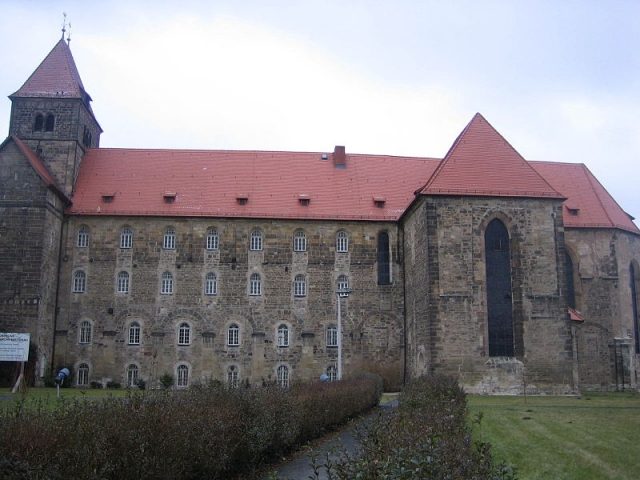
Breitenau Abbey

Hospital

Breitenau Monastery was a Benedictine monastery located in Breitenau, Guxhagen municipality near Kassel, in the former "Breite Aue" (Broad Meadow) at the confluence of the Eder and Fulda rivers. From the 19th century, the complex was used as a "correctional facility," and from 1974, as a psychiatric hospital. During the National Socialist era, the Breitenau concentration camp was housed in the monastery.

Architecturally, the Romanesque complex is an important example of the Hirsau School of Architecture in Hesse.

Benedictine Monastery

The foundation in 1113 goes back to the Hessian count Werner IV of Maden and his wife Gisela. Werner's family came from Markgröningen in Württemberg and was related to Abbot Bruno of Beutelsbach from Hirsau Monastery in the Black Forest. Werner turned to him regarding the monastery's foundation, and on November 17, 1119, Drutwin and twelve other Benedictine monks from Hirsau Monastery moved into the first monastery buildings in the "Breite Aue." The Archbishop of Mainz, Adalbert I, appointed Drutwin as the first abbot of the monastery. Probably in the spring of 1120, the monks began construction of a large monastery church.

Werner IV, who died on February 22, 1121, without a male heir, bequeathed his entire private fortune to the monastery, with the exception of his wife's dower, who died around 1155. Werner was buried in the choir of the church, which was still under construction. The monastery was placed under the protection of the Archbishop of Mainz on July 7, 1123. Adalbert freed it from all archdiaconal powers and granted it a number of privileges, such as the right to pastoral care, the right to baptism and burial, the free election of an abbot, and customs exemption within the Mainz lands. He also added further lands to the already rich possessions of the monastery. The Vogtship over the young monastery remained with the count until the Hessengau was inherited by the Landgrave of Thuringia in 1137. After the extinction of the male line of the Thuringian Landgrave family in 1247, their Hessian possessions became independent again as the Landgraviate of Hesse, and the Landgrave became the patron of Breitenau Monastery.

After Drutwin's death, the highly learned Hirsau monk Heinrich became the new abbot in 1132. He had a reputation for being particularly holy and capable of performing miracles. According to legend, in 1144, Pope and martyr Felix is said to have appeared to him in a dream and shown him his head, hidden beneath the church, which became a relic of the monastery. Likewise, Abbot Heinrich is said to have received four bodies of the 11,000 virgins for the church from the Archbishop of Cologne, Arnold II (1151–1156). Abbot Heinrich had reformed an extreme Limburg canon for Arnold when the latter was still provost of St. Georgstift in Limburg an der Lahn (1122–1152).

The monastery church was a 54-meter long and 18-meter wide cruciform, three-aisled, flat-roofed Romanesque pillar basilica in the style of the "Hirsau School of Architecture" with five apses for the main altar and side altars. The choir and transept of the large church were probably completed between 1142 and 1145 and dedicated to the Mother of Jesus. The nave and side aisles are said to have been built between 1160 and 1180, and the westwork without its superstructure from the end of the 12th century to the middle of the 13th century. The central nave, in particular, was adorned with elaborate ornaments, many of which are still visible today.

The entire monastery complex was almost circularly enclosed by a wall, still existing today, in which there were two gate towers: the still preserved "Grifter Gate" and the former "Fulda Gate." The actual monastery buildings connected to the north side of the church with the cloister; only remnants of the former cloister building remain today. The stone tithe barn was built in the 15th century. To the south of the area was the monastery cemetery with the St. Nicholas Church, first mentioned in 1321, which served as a parish church. At the western end of the grounds were barns and stables, and on the banks of the Fulda was the monastery mill. Fruit, vegetables, and wine were cultivated on the monastery grounds, and fishing was carried out in and on the Fulda.

The monastery's heyday was probably between the mid-12th century and the early 14th century. It owned the villages of Guxhagen, Ellenberg, and Büchenwerra, where it also exercised lower jurisdiction, as well as fields, meadows, forests, vineyards, and waters in almost 100 other locations, and later still in 70 locations in the nearer and wider surroundings. In 1239, the abbot received the right, granted only by the Pope, to wear an infula. However, with increasing wealth, morals also declined. As a result, there were fewer and fewer donations to the monastery, and due to disorderly housekeeping and "greed of neighbors," the monastery lost possessions again. The lands were eventually so fragmented that in 1324, Pope John XXII appointed a commissioner to address the grievances. In the 15th century, however, the general decline of the Benedictine order followed, both economically and morally and spiritually. Breitenau's affiliation with the Bursfelde Congregation in 1497, a reform movement originating from Bursfelde Monastery on the Weser, brought a brief resurgence for the monastery, which then ended with the introduction of the Reformation in the Landgraviate of Hesse. An external sign of the will for reform was the reconstruction of the choir and transept in Gothic style between 1502 and 1509, and the subsequent painting of the choir in 1508.

Abbots of the Monastery

The abbots of the monastery and their terms of office are not completely documented. The list therefore shows the abbots known by name and the years of their documentary mention.

  • Drutwin 1123 (1119–1132)
  • Heinrich I. (1132), 1144, 1155
  • Cuno 1162
  • Heinrich II. 1170, 1171
  • Eilbert 1196
  • Giso 1215, 1236
  • Widekind 1239, 1246
  • Isfridus 1255, 1264
  • Hermann von Wolfershausen (Anti-Abbot) 1260
  • Heinrich III. 1261, 1282
  • Bodo 1289, 1294
  • Johannes 1295, 1305
  • Sifrid 1307, 1309
  • Werner von Elben 1314, 1339
  • Albert (Anti-Abbot) 1342
  • Heinrich IV. von Wallenstein 1346, 1348
  • Reinhard 1354, 1368
  • Johann von Wolfershausen 1377, 1380
  • Hermann von Gilsa 1383, 1407
  • Heinrich V. von Wolfershausen 1407, 1414
  • Hermann von Schlutwindsdorf 1415, 1436, 1440, 1443
  • Werner (Anti-Abbot) 1419
  • Konrad von Herzenrode (1434), 1436, 1438
  • Kurt Platzfuß (Head of the Convent, Anti-Abbot) 1439
  • Johannes Gossel 1444, 1463
  • Nikolaus Merlen (Anti-Abbot) 1458
  • Nikolaus Ratzenberge 1464, 1469, (1499?)
  • Dithmar von Uttershausen 1471, 1477
  • Johannes Storen 1485, 1497
  • Konrad (Anti-Abbot) 1494
  • Johannes Meyer († 1529) 1497–1527
  • Nikolaus (Ratzenberge?) (Anti-Abbot) 1499

Secularization

In October 1527, monastic operations were ceased by Landgrave Philipp as part of the introduction of the Reformation in the Landgraviate of Hesse. Abbot Johann Meyer (Maier), Prior Theobald Zabel (Cabel), and the 16 remaining monks converted to Protestantism. They were compensated with a grain annuity, and almost all left the convent. Zabel, a Dutchman from the island of Texel, then became the first Protestant pastor of Guxhagen. He had rendered great services to viticulture, harvesting 6½ Fuder (about 6240 liters) of red and white wine in 1527. The vineyard in Breitenau stretched from the monastery to the Fulda, but around 1650 it became unprofitable, and fruit trees were planted instead of vines.

The entire monastery complex was converted into a landgrave's demesne, and most of the scattered lands that once belonged to the monastery were leased out. The estate's income went to the princely treasury and partly served ecclesiastical purposes, such as the salaries of the pastors in Breitenau, Wollrode, and six other surrounding villages, as well as the sacristan in Guxhagen. In addition, the Philipps University of Marburg, founded in 1527, received scholarship funds for poorer students. The church building was converted into a grain store and a horse stable in 1579: the windows and arcades were bricked up, new hatches were broken, and several intermediate floors were installed throughout the nave, dividing the building into five stories. The side aisles were probably demolished at the same time. For worship in Breitenau, only the St. Nicholas Church, the parish church of the communities of Guxhagen, Ellenberg, and Wollrode, remained.

Landgrave Moritz of Hesse-Kassel planned to found a city in 1606, but the attempt to persuade Cologne merchants to settle in Breitenau failed, as did the settlement of 630 citizens from various Hessian towns. From 1607/1608, he had the estate converted into a "pleasure residence" according to his own plans. The old priory, the old Vogt's house, and the dilapidated cloister were demolished. Master builder Wiedekindt completed the construction of a stable in 1622, followed by a manor house, a hunting lodge, several farm buildings, pleasure gardens, fish ponds, and a fountain.

War Destruction

During the Thirty Years' War, the complex was repeatedly ravaged by troops of the Catholic League. In 1626, it was plundered and burned by soldiers of the Bavarian commander Tilly. All buildings that Landgrave Moritz had erected were destroyed, three large bells and the extensive library were stolen. In 1637, Croats under the imperial general Isolani invaded. Finally, in 1640, troops of Octavio Piccolomini burned down the entire complex except for the two church buildings, the stone tithe barn, and the monastery wall with its two gates. After that, the rest of the former monastery was left to decay; only the monastery church was still used as a granary and the St. Nicholas Church as a parish church, which received its first organ in 1660. In 1713, the rectory on the banks of the Fulda was rebuilt and enlarged.

During the Seven Years' War (1756-1763), the complex was plundered once again; this was literarily processed by Heinrich Ruppel in the story "The Michaelis Bride of Guxhagen." In 1785, the community of Guxhagen submitted a petition to the Landgrave to divide the land of the Breitenau domain into hereditary leases among the completely impoverished inhabitants of Guxhagen, who had suffered almost the entire seven years under the war. Around 900 acres were then distributed among the 40 inhabitants who had applied. On September 1, 1786, public church penance was abolished. In 1791, the dilapidated St. Nicholas Church had to be demolished; from then on, the old tithe barn served as the parish church.

Institution and Home

In 1850, the hereditary leases were redeemed, and the former monastery property became state property of the Electorate of Hesse, thus the monastery church ceased to be used as a grain store and had been empty ever since. During the Franco-Prussian War, from January 18 to April 6, 1871, about 750 French prisoners of war were interned in the monastery church and presumably also in the tithe barn, guarded by 80 men of a Thuringian infantry regiment. After the war, the Prussian administrative district of Kassel – the Electorate of Hesse had been occupied and annexed by Prussia in 1866 – took over the neglected complex and rebuilt it from 1872 to 1874. The choir, transept, and about one-eighth of the nave were separated from the rest of the monastery church by a wall, furnished as a house of worship for the community, and used as a church again since August 23, 1874. The tithe barn was converted into official residences. The other part of the monastery church received a large staircase, new windows were partly broken into the walls, and dormitories were set up on the four intermediate floors in the nave. This housed a "Correctional and Rural Poorhouse" for beggars, vagrants, prostitutes, and "neglected" youths, later called "State Labor Institution and State Welfare Home Breitenau." In 1911, a cell block was added, which was primarily used for prisoners from the Royal Prussian Penitentiary Cassel-Wehlheiden.

In 1897, the old "stone bell" from Fulda Cathedral, dating from 1401, which was then receiving a new set of bells, could be acquired for the monastery church in Breitenau, and a second, slightly smaller bell was also cast. According to the plan of state building inspector Alfred Röse from Kassel, a Neo-Romanesque bell tower, adapted to the westwork, was built on the monastery church in 1900. Thus, the Guxhagen-Breitenau parish once again had a set of bells for the first time since 1626, which was consecrated on September 30, 1900. In early November 1927, however, a vault section collapsed into the interior of the church and destroyed the organ. The entire building complex had to be secured; it was then restored until 1929 under the direction of district conservator Friedrich Bleibaum, the Gothic ceiling paintings from the early 16th century were uncovered, and a new, large organ was installed. The church was festively reconsecrated on March 23, 1930.

Concentration Camp

From June 1933 to March 1934, a concentration camp (abbreviation: KL or KZ) for political prisoners was established on the site. A total of 470 opponents of National Socialism were imprisoned in Breitenau concentration camp. One of the political prisoners from 1933 to 1945 was the SPD politician and later SED functionary Fritz Wagner. In 1940, the former monastery became a so-called "labor education camp" for German and foreign forced laborers who had to work in the armaments industry and agriculture. It also simultaneously served as a concentration collection camp for deportation to other concentration camps. The Jewish doctor Lilli Jahn, mother of the later Federal Minister of Justice Gerhard Jahn, was brought to Breitenau on August 30, 1943, and deported to Auschwitz in March 1944, where she was murdered. (In 2002, journalist Martin Doerry published "My Wounded Heart: The Life of Lilli Jahn 1900–1944." Doerry literarily processed Lilli Jahn's correspondence with her children in Immenhausen.) In 1944, the monastery was an alternate location for the Gestapo Kassel, which murdered 28 prisoners on the Fulda not far from the monastery in 1945. Wilhelm Hugues created a memorial stone in 1950 for the victims of National Socialism from Breitenau concentration camp. In 1984, a memorial for the concentration camp established by the National Socialists in the former monastery from 1933 to 1945 was opened in the former tithe barn.

Post-War Period

The American military government dissolved the state labor institution in 1949, but the state welfare home continued to exist. From 1952 to 1973, Breitenau Monastery housed a girls' reformatory, the Fuldatal Youth Home. From 1974, Breitenau Monastery became an outpatient branch of the psychiatric hospitals Haina and Merxhausen.

In 2012, the memorial in the former monastery became one of the exhibition venues for the dOCUMENTA (13) art exhibition.

Personalities+
  • Heinrich (I.), scholar and second abbot of Breitenau Monastery (1132–1155).
  • Carl Glinzer, landscape painter, born 1802 in the Breitenau Mill as the son of the mill owner.
  • Christoph Weber, librarian, born October 27, 1883, as the son of the gardener of the correctional facility in Breitenau.
  • Friedrich Bleibaum, art historian.
  • Heinrich Ruppel, teacher and writer.
  • Friedrich Paulus, Field Marshal, Commander-in-Chief of the 6th Army during the Battle of Stalingrad, born September 23, 1890, in Breitenau.

Take Mobile History with you

You are reading this text for free. Premium adds what matters on the road: descriptions read aloud, sites found through your camera, whole regions taken offline.

  • Every description, including the ~17,700 Premium sites
  • Audio guide: have descriptions read to you on location
  • AR finder: see sites through your camera, with distance and bearing
  • Unlimited saved sites

14 days free, then from €2.99 a month. Cancel anytime.

Source: Wikipedia · Licence: CC BY-SA 4.0 · Image: http://de.wikipedia.org/wiki/Kloster_Breitenau#mediaviewer/Datei:Klosterkirche_Breitenau.jpg

This description draws on the facts documented in the linked Wikipedia article; Wikipedia content is licensed under CC BY-SA 4.0. Wording and editing: Mobile History.

Location: 51.2024, 9.4765