Monastery operation
Dinklage Castle (Abbey)
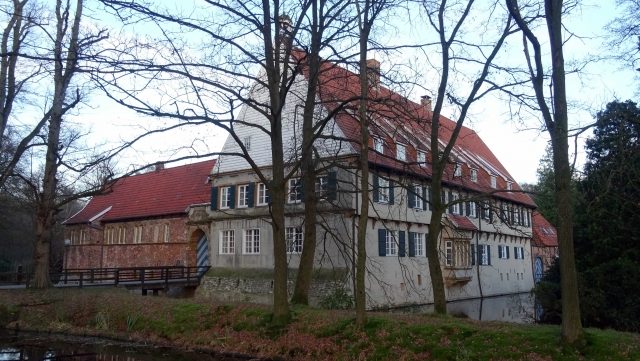
Dinklage Abbey (Abtei St. Scholastika) is the name of a Benedictine abbey. It is housed in the rooms of Dinklage Castle in Dinklage, Vechta district, in the Oldenburg Münsterland (Lower Saxony).
The abbey is named after Saint Scholastica, the sister of Saint Benedict of Nursia. The monastery is located in Dinklage Castle, a moated castle owned by the Westphalian noble family von Galen. The later Bishop and Cardinal of Münster, Clemens August Graf von Galen (1878–1946), who was beatified by Pope Benedict XVI on October 9, 2005, was born in the castle.
In December 2009, the Cardinal von Galen Foundation Dinklage Castle was established. The foundation, initially endowed with a capital of 50,000 Euros, is primarily intended to create and operate a place of remembrance, commemoration, and inspiration at Dinklage Castle with the buildings of the castle chapel, the old water mill (the forester's house), and the so-called bakehouse – the "Cardinal's Triangle".
The Castle
The first castle complex in Dinklage was the Ferdinandsburg, first mentioned in a document in 980, seat of the Counts of Dersagau. It was built approximately 500 meters east of the complex still existing today. In 1231, the Ferdinandsburg came into the possession of the family of Johann von Dinklage, a former administrator in the service of the Gaugrafen. The Ferdinandsburg was razed by the Prince-Bishop of Münster in 1374.
In 1394, the Prince-Bishop enfeoffed the four surviving sons of Friedrich von Dinklage with all possessions of Dinklage and Vechta. They were forbidden to rebuild the Ferdinandsburg, but they built four new castles in its vicinity, three of which are documented by name: the Herbordsburg (where the Alte Rentei, built in 1677, now stands), the Hugoburg (which was demolished in 1840; the count's castle chapel now stands in its place) and the Dietrichsburg, today's moated castle Dinklage.
In 1588, the Dietrichsburg passed by inheritance into the possession of the von Ledebur family; the Hugoburg and the Herbordsburg remained in the possession of the von Dinklage family. Hugo Arnold von Dinklage, the last of his name in Dinklage, sold both castles to Baron von Galen in 1667. In 1775, the Ledebur family also acquired ownership of the Dietrichsburg, which also sold the property to the von Galen family in 1801. Already in 1641, Heinrich von Galen, Drost of the office in Vechta, had leased the Dietrichsburg and taken up residence there. Thus, the Dietrichsburg became the ancestral seat of the von Galen family in the Oldenburg Münsterland, who were elevated to the rank of count in 1803.
In 1677, the Prince-Bishop, as sovereign, established the imperial immediacy of Dinklage (abolished in 1827) from the feudal estates and the parish of Dinklage and transferred it to the von Galen family.
Count Ferdinand von Galen (1803 to 1881), known as a member of the Reichstag, and his son Friedrich Mathias (1865 to 1918) were the last owners to inhabit Dinklage Castle. Until 1928, Franz von Galen (1879 to 1961), a brother of Friedrich Mathias and the later Cardinal Clemens-August von Galen, managed the Dinklage possessions for the heir Christoph Bernhard Graf von Galen (1907-2002). In 1949, Count Christoph Bernhard transferred ownership of the castle to the Benedictine nuns mentioned below.
The Monastery
1941 to 1945
From 1941 to 1945, Benedictine nuns from Vinnenberg Monastery in Warendorf (North Rhine-Westphalia), who had been expelled from their monastery by the National Socialists, were housed in Dinklage Castle. They returned to Warendorf in 1945 after the end of the Second World War.
Since 1949
When Benedictine nuns from St. Gertrud Abbey in Alexanderdorf (then Zossen district), occupied by the Soviets after the Second World War, came to Westphalia in 1946, Christoph Bernhard Graf von Galen took them in at Haus Assen for two years. On June 8, 1949, monastic life began in Dinklage Castle, where the community of nuns initially housed in Assen had moved. The first prioress in Dinklage was Radegund Kemper. In 1961, the priory received a church. The architect Max Clemens von Hausen converted a barn in the castle courtyard into a church. The organ comes from the workshop of Rudolf von Beckerath from Hamburg. Heinrich Tenhumberg, auxiliary bishop in the Diocese of Münster, consecrated the church on September 3, 1961. In 1972, Agatha Rohtert succeeded Radegund Kemper as prioress.
Abbey since 1977
In 1977, the monastery was elevated to an abbey; Sr. Agatha Rohtert was elected abbess. She was succeeded in 1983 by Sr. Máire Hickey. She was re-elected in 1995. Her term of office saw the purchase of the economy (1983) and the new rent office of Dinklage Castle (1985) by the Diocese of Münster. These became part of the "Catholic Church Fund St. Scholastika" foundation, of which the abbess became the church provisor. The buildings of the economy and the new rent office were converted into an educational and retreat house from 1985 to 1999. In 1997, the conversion of a barn belonging to the economy was completed. The Martinsscheune serves as a shelter for homeless and other people in need. The "Martinsscheune, Herberge für Menschen in Not e.V." association took over the sponsorship. The educational and retreat house has been the monastery's guesthouse since 1999. In 2000, a monastery shop was opened. Since 2001, the monastery has operated a monastery café, which was extensively renovated in the winter of 2014.
On November 21, 2007, the 23 sisters elected their former prioress Sister Franziska Lukas as the new abbess for the next twelve years.
The monastery maintains relations with its mother monastery St. Gertrud in Alexanderdorf (municipality of Am Mellensee, Teltow-Fläming district) and with the Benedictine Abbey of St. Matthias in Trier.
Monastery Facilities+
In addition to the Martinshaus (since 1997) and the guesthouse (1999), since 2000 the monastery has had a monastery shop where the Benedictine nuns sell candles and icons from their own workshop, as well as fudge, a caramel confection. They also make liturgical vestments in the paraments workshop. In 2001, a monastery café was opened. The nuns operate a weaving mill and a host bakery. Among the newer operations of the monastery is the candle workshop, where candles are made for various ecclesiastical and private occasions.
Cardinal von Galen Foundation+
Due to the beatification of Cardinal von Galen in 2005 by Pope Benedict XVI, interest in him, his person, his family, and his life's work grew. In response, in 2010, the sisters, in cooperation with regional entrepreneurs, founded the Cardinal von Galen Foundation. One of the most important goals of the foundation is to honor the memory of von Galen as an important "son" of the Oldenburg Münsterland. The foundation is financed by voluntary donations. In 2013, the foundation opened the permanent exhibition "Clemens August von Galen: Courage from where? Courage for what?" in the castle mill at von Galen's birthplace. For this purpose, the castle mill, which was used as a forester's house, was completely renovated by the foundation. The financing was provided by donations. The exhibition is open from Wednesday to Sunday. Admission is free. In addition, the foundation also maintains a small exhibition in the bakehouse, which was created on the occasion of von Galen's beatification. Further projects are in planning.
Take Mobile History with you
You are reading this text for free. Premium adds what matters on the road: descriptions read aloud, sites found through your camera, whole regions taken offline.
- Every description, including the ~17,700 Premium sites
- Audio guide: have descriptions read to you on location
- AR finder: see sites through your camera, with distance and bearing
- Unlimited saved sites
14 days free, then from €2.99 a month. Cancel anytime.
Source: Wikipedia · Licence: CC BY-SA 4.0 · Image: Jörg Heldt
This description draws on the facts documented in the linked Wikipedia article; Wikipedia content is licensed under CC BY-SA 4.0. Wording and editing: Mobile History.
Location: 52.6542, 8.1367