Cultural Events
Museum
Edelstetten Abbey

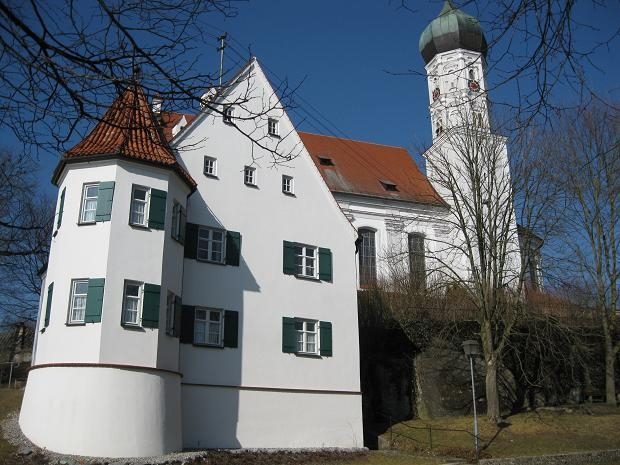
Edelstetten Abbey is a former canonesses' collegiate church in Edelstetten (municipality of Neuburg an der Kammel) in Bavaria in the Diocese of Augsburg. The former monastery is one of the outstanding Baroque buildings in the district of Günzburg, due to which the area of the district is also called the Swabian Baroque Corner.
The monastery, consecrated to SS. John the Baptist and Evangelist as well as St. Paul, was founded in 1126. According to tradition, the founder and first abbess of the monastery, founded as an Augustinian canonesses' collegiate church, was Gisela von Schwabegg-Balzhausen, whose coat of arms the monastery also adopted. The Ursberg monastery, only a few kilometers away, was also founded by this noble family. The patronage lay with the Margraviate of Burgau until 1460, when the monastery bought it as a pledge. In 1153, the blessed Mechthild von Dießen, who came from the Augustinian canonesses' collegiate church of Dießen, was called to Edelstetten as abbess to reform the collegiate church. After six years, however, she returned there unsuccessfully. In 1283, the number of noble canonesses was limited to thirteen by the Bishop of Augsburg.
By around 1500 at the latest, Edelstetten was recognized as a secular canonesses' collegiate church, which the women's collegiate church had apparently been striving for since its foundation. The collegiate church usually housed seven canonesses who lived without vows according to statutes. Except for the abbesses, who were elected for life, the canonesses could leave and marry at any time, consequently it was more of a welfare institution for daughters of the lower Swabian nobility than a monastery. As a result of its recognition as a secular canonesses' collegiate church, the place, which until then was called Oetlinstetten, was renamed Edelstetten.
The monastery was destroyed three times. The first time in the 14th century, the second time in 1525 during the Peasants' War, and the third time in the Thirty Years' War, in 1632 by the Swedes.
The present Baroque monastery complex was built during the monastery's greatest heyday, which lasted approximately from 1680 to 1725. From 1682 to 1705, the monastery buildings were rebuilt according to plans by the Vorarlberg master builder Michael Thumb, who a few years earlier had designed the collegiate buildings and the collegiate church in Wettenhausen Abbey, located only a few kilometers to the north. Between 1709 and 1712, the present church was built as the south wing of the monastery complex according to plans by Father Christoph Vogt from the Benedictine monastery of Ottobeuren, which, like the previous building, was both the collegiate church and the parish church of the village. The construction was carried out by Simpert Kraemer, for whom this building was the first major commission. The completion of the interior decoration dragged on until the second half of the 18th century. In 1783, 20 years before secularization, the monastery was elevated to an Imperial Abbey.
In 1803, Prince Ligne received the lordship of Edelstetten as compensation for the County of Fagnolle in Hainaut. In 1804/1805, Prince Nikolaus II Esterházy de Galantha acquired the complex, which still belongs to the Princes Esterházy today. Shortly thereafter, the lordship of Edelstetten was elevated to a princely imperial county. A year later, Edelstetten, like the entire area between the Iller and Lech, became part of Bavaria as a result of the Peace of Pressburg.
All buildings were preserved. The interior decoration of the representative rooms from the 18th century with their significant stucco work, for example the Chinese Hall, also remained intact. However, the interior of the castle is largely only accessible in exceptional cases. The church is still the parish church of Edelstetten today.
The very valuable Baroque nativity scene, in which the Christmas story is depicted in seven scenes, also remained preserved and is presented museally every year during the Christmas season in rooms of the castle, including the former chapter house. The seven scenes are: Adoration of the Shepherds, Adoration of the Kings, Presentation in the Temple, Massacre of the Innocents in Bethlehem, House in Nazareth, the twelve-year-old Jesus in the Temple, and Wedding at Cana; The district of Günzburg is also referred to as the Swabian Nativity Paradise because of this nativity scene.
Since March 2009, there has been the "Schwäbisches Literaturschloss Edelstetten" (Swabian Literature Castle Edelstetten) association. Initially, the association will organize readings or award ceremonies in the castle. In the long term, if the corresponding financial means should also be available, the establishment of a museum for Swabian literature and language is aimed for.
Take Mobile History with you
You are reading this text for free. Premium adds what matters on the road: descriptions read aloud, sites found through your camera, whole regions taken offline.
- Every description, including the ~17,700 Premium sites
- Audio guide: have descriptions read to you on location
- AR finder: see sites through your camera, with distance and bearing
- Unlimited saved sites
14 days free, then from €2.99 a month. Cancel anytime.
Source: Wikipedia · Licence: CC BY-SA 4.0
This description draws on the facts documented in the linked Wikipedia article; Wikipedia content is licensed under CC BY-SA 4.0. Wording and editing: Mobile History.
Location: 48.2986, 10.3948