Church
MonasteryBetheln - Haus Escherde
Escherde Abbey
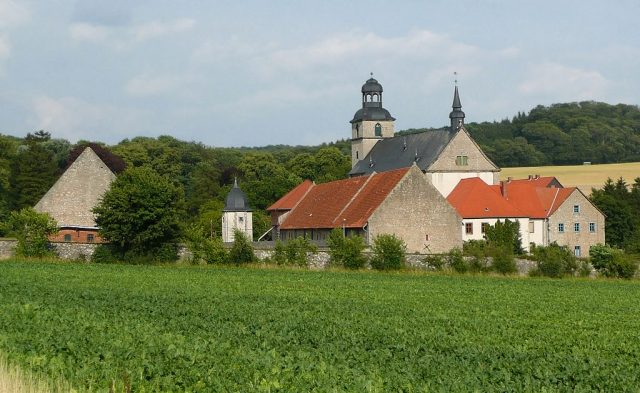
Kloster Escherde, a former Benedictine nunnery, is situated near Hildesheim in Lower Saxony. The complex is notable for its long history and the largely preserved historical architecture, offering insights into past eras.
History+
The foundation of Kloster Escherde dates back to around 1200. In 1203, Lippold von Escherde endowed the church and four farmsteads to establish a Benedictine nunnery. Initially located in Groß Escherde, the convent was relocated in 1236 to its current site on the Hildesheim Forest. In 1296, the monastery was separated from the parish of Betheln. A reform of the monastery was carried out in 1441 by Johannes Busch. Following the Quedlinburg Recess of 1523, the monastery became part of the Principality of Calenberg and was converted into an evangelical women's collegiate foundation. During the Thirty Years' War, the last canonesses left the monastery, and its buildings were destroyed by fire in 1641. With the restoration of the Great Diocese of Hildesheim in 1643, Escherde once again came under princely episcopal rule. Under Auxiliary Bishop Adam Adami, the economic and convent buildings were rebuilt. The baroque monastery church of St. Marien, dedicated to the patron saints Mary, John the Baptist, and John the Evangelist, was completed in 1685. From 1709, the complex was surrounded by a stone wall and received a gatehouse. In the course of secularization, the monastery was dissolved in 1810, and its property was sold. The church was deconsecrated and subsequently used as an agricultural storage facility.
Source: Wikipedia · Licence: CC BY-SA 4.0 · Image: https://de.wikipedia.org/wiki/Datei:Kloster_Escherde_Mauer.jpg
This description draws on the facts documented in the linked Wikipedia article; Wikipedia content is licensed under CC BY-SA 4.0. Wording and editing: Mobile History.
Location: 52.1160, 9.8201